

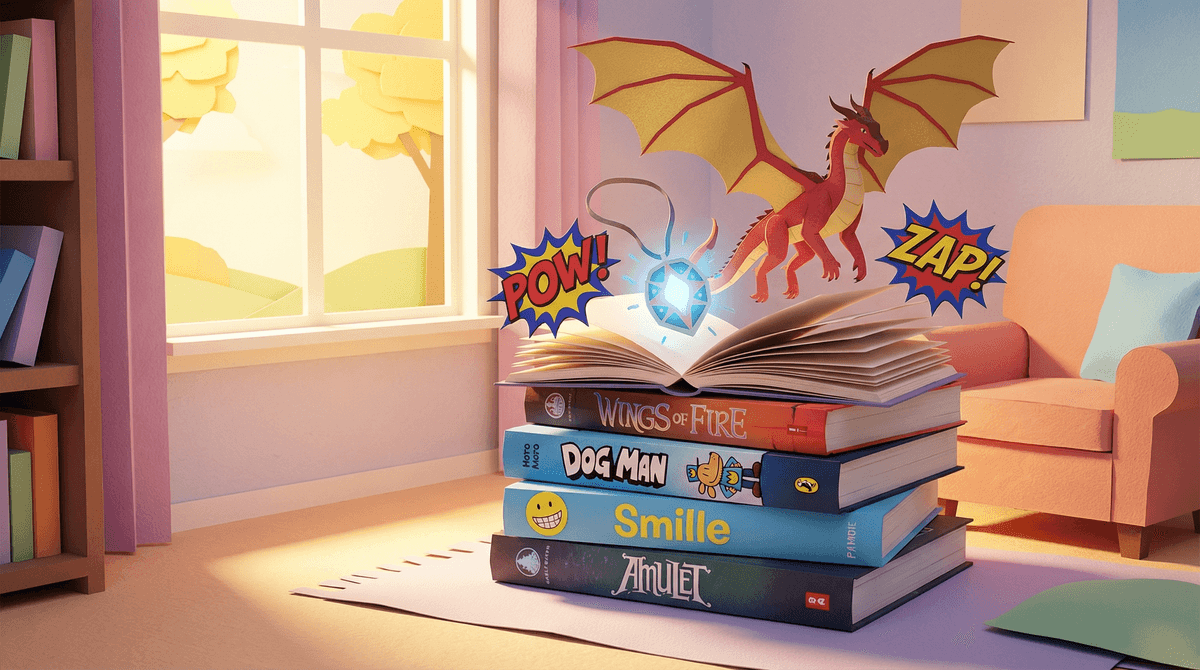
TL;DR: Yes, They Are Real Books
If your kid is currently treating Dog Man like the literal Bible and refusing to touch anything without a speech bubble, take a deep breath. You aren't failing. In fact, research shows that kids who read graphic novels are twice as likely to say they actually enjoy reading compared to those who don't. These books aren't "cheating"—they’re a bridge to complex literacy, visual spatial reasoning, and a massive vocabulary.
Quick Links to Fan Favorites:
- Best for Laughs: InvestiGators or Cat Ninja
- Best for Drama/Middle School Vibes: Smile by Raina Telgemeier or Twins
- Best for Fantasy Fans: Wings of Fire (Graphic Novel) or Amulet
- Best Digital Platforms: Epic! or Sora
I get it. You grew up reading Bridge to Terabithia or The Chronicles of Narnia, and you’re waiting for that moment where your kid hunker downs with a 300-page block of text. Instead, you're looking at a pile of Dav Pilkey books that seem to be 90% "poop" jokes and "Flip-O-Ramas."
It feels like "reading lite." It feels like brain rot.
But here’s the no-BS truth: Graphic novels are often more linguistically demanding than prose. A famous study found that comic books average 53.5 "rare" words per thousand, while average children’s fiction only has about 31. Because the pictures handle the "where" and "what," the text is free to use much more descriptive, punchy, and sophisticated language.
In a world of TikTok-speed dopamine, a traditional page of text can feel like a desert. Graphic novels provide "visual scaffolding."
When a kid reads The Bad Guys, their brain is doing double duty: decoding the text while simultaneously interpreting facial expressions, pacing, and tone through the art. This is visual literacy, and in 2026, it’s arguably as important as textual literacy.
Community data shows that about 50% of kids in grades 3-5 are reading graphic novels daily. It’s the dominant language of their generation. If we fight it, we just make reading feel like a chore. If we lean in, we keep them in the "reader" category for life.
For the "I Just Want to Laugh" Crowd
If your kid likes slapstick and fast-paced chaos, these are the gold standard.
- Think James Bond but with alligators in vests. It’s pun-heavy and actually quite clever.
- The gateway drug for reluctant readers. It’s absurd, but it teaches empathy and redemption in ways that honestly surprise me.
- Originally a digital hit on Epic!, this series has amazing action sequences that help kids understand pacing.
For the "Deep Feelings & Drama" Crowd
These are the books that help tweens navigate the absolute minefield of middle school.
- The GOAT of the genre. It deals with dental drama, friend drama, and growing up. Every girl (and many boys) in 4th grade has read this three times.
- A great look at identity and how it feels when your "other half" starts to change.
- Part of the Sunny series, these books tackle slightly heavier family themes (like a sibling’s struggle with addiction) in a way that is age-appropriate and visually clear.
For the "Epic Adventure" Crowd
If they want world-building and high stakes, go here.
- The prose books are great, but the graphic novels make the dragon world of Pyrrhia feel massive. It’s a great "bridge" to the prose series.
- Stunning, Ghibli-esque art. It’s darker and more serious, perfect for the kid who thinks they’ve "outgrown" comics.
Eventually, the physical book stack gets too high (or too expensive), and kids move to screens. This is where you need to pay attention.
- Epic!: This is the "Netflix of books." It’s fantastic for elementary kids. It tracks what they read and offers thousands of high-quality titles. It's almost entirely "safe" territory.
- Sora: Most schools use this. It’s basically a digital library. If your kid has a school ID, they probably have access to a massive graphic novel collection for free.
- Webtoon: Proceed with caution here. Webtoon is where older kids (13+) go. It uses a vertical scrolling format. While there are great stories like Heartstopper, there is also a LOT of mature content, romance, and violence. It is not a "kids' app."
Learn more about the differences between reading apps
- Ages 6-8: Focus on humor and simple layouts. Narwhal and Jelly is perfect for this.
- Ages 9-12: This is the "Golden Age" of graphic novels. They can handle complex themes in books like El Deafo or New Kid.
- Ages 13+: They might start moving into Manga. Naruto or Demon Slayer are huge. Just be aware that Manga is often rated for older audiences (check for the "T" for Teen rating).
If you're still worried they'll never read a "real" book, try the Hybrid Strategy. Look for books that mix heavy illustrations with prose.
- The Last Kids on Earth
- Diary of a Wimpy Kid
- The Wild Robot (The illustrations are sparse but vital)
These books "trick" the brain into reading longer blocks of text by promising a visual payoff every few pages.
Find "bridge book" recommendations
Stop worrying about the format and start celebrating the stamina. If your kid is sitting still for 45 minutes devouring a book, they are building the "reading muscle."
The goal isn't to get them to read War and Peace by 5th grade; it's to make sure they don't associate books with boredom. If Dog Man is what keeps them off YouTube for an hour, that is a massive win in my book.
- Audit the Stack: Look at what they're reading. Is it all humor? Try introducing a non-fiction graphic novel like Nathan Hale's Hazardous Tales.
- Go Digital (Carefully): If they're out-reading your budget, set them up with Sora through their school library.
- Read Together: Grab a copy of Smile and read it yourself. You might be surprised at how much "real" story is actually there.