The "Parlor Wall" prophecy
If you want to blow your teenager’s mind, point out that Bradbury wrote about "parlor walls"—giant, immersive screens that people talk to and treat as family—decades before VR headsets and TikTok influencers existed. The most uncomfortable part of reading this in 2026 isn't the book burning; it's the description of a society that has voluntarily traded its attention span for constant, shallow stimulation.
Montag’s wife, Mildred, isn't a villain. She’s a victim of a world that optimized for "happiness" by removing anything that requires deep thought. If you’re trying to navigate the books adults think kids should read vs. the books children actually enjoy, this is the rare classic that bridges the gap because it explains why we're all so distracted. It’s a meta-commentary on the very struggle of getting a teen to put down a phone and pick up a paperback.
It’s not just the government
A common mistake is thinking this book is only about a big, bad government coming for your library. Bradbury’s actual point is more scathing: the people stopped reading long before the firemen started burning. Society got too "busy," things got too fast, and people didn't want to be offended or made to feel "un-fun" emotions.
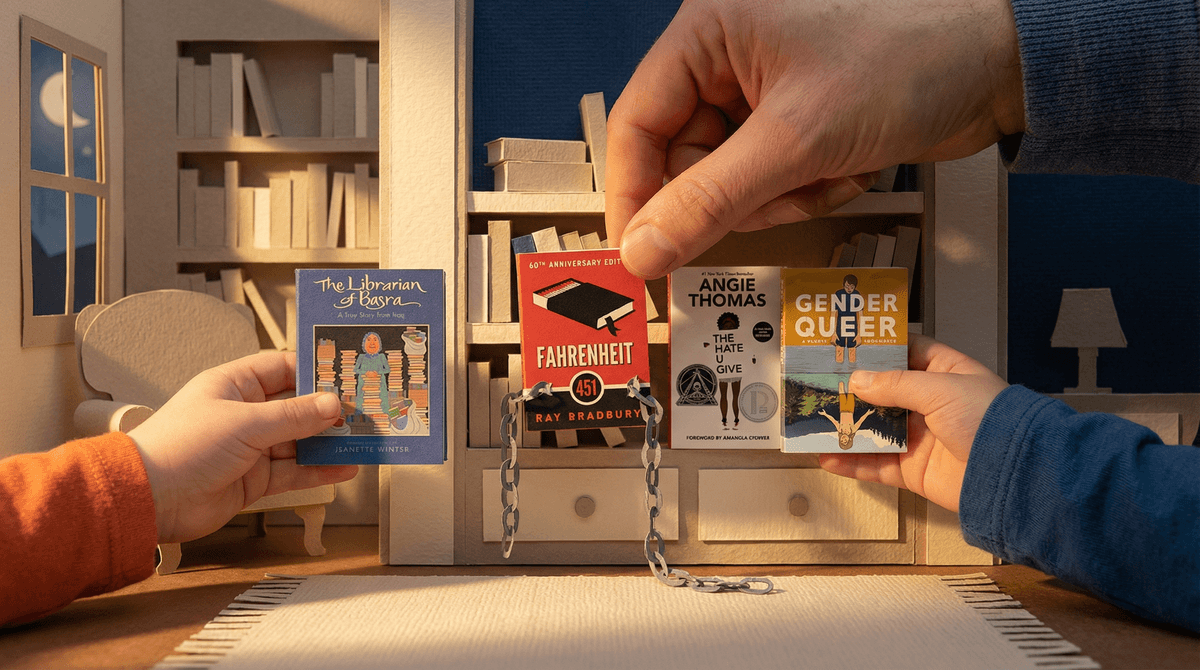
This makes it a perfect entry point for books about book banning because it shows that censorship often starts with the audience, not the authorities. It’s about the "nickeling and diming" of the mind. If your teen is active on social media, they’ll recognize the pressure to keep things short, punchy, and uncontroversial.
The Mechanical Hound and the "Ick" factor
For kids who find 1950s literature "boring," lean into the sci-fi horror elements. The Mechanical Hound is basically a nightmare version of a Boston Dynamics robot—a multi-legged killing machine that tracks you by your chemical signature. It provides a genuine sense of dread that keeps the middle section of the book moving.
The violence isn't "action movie" violence. It’s cold and weird. People drive cars at 100 miles per hour just to hit animals or pedestrians for a laugh. It’s a bleak look at what happens when humans lose their empathy. If your kid liked the "social credit" or "tech-gone-wrong" vibes of Black Mirror, they will find the DNA of those stories here.
How to handle the "slow" parts
The prose is dense. Bradbury was a poet at heart, and he spends a lot of time on metaphors that might make a kid used to modern YA pacing roll their eyes. If they’re struggling, remind them it’s under 200 pages. It’s a sprint, not a marathon.
You might suggest they look at it as a survival story rather than a lecture. Montag is a man waking up from a trance in a world designed to keep him asleep. That’s a trope every teenager understands. It’s one of those books all teens should read because it gives them a vocabulary to talk about their own digital lives. When Montag realizes he’s not actually "happy" despite being constantly entertained, it’s a lightbulb moment that usually sticks with a reader long after the final page.