

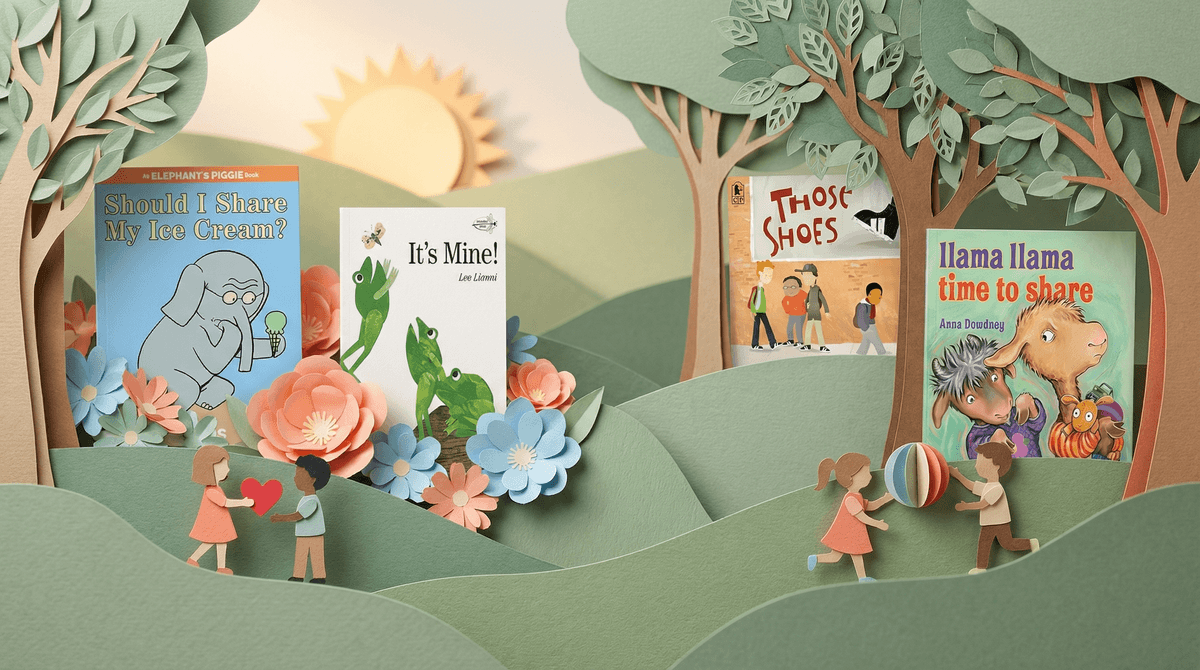
Books about sharing are children's stories that explore themes of generosity, cooperation, and navigating the deeply human tension between "mine!" and "ours." They range from simple board books for toddlers learning the concept exists, to nuanced chapter books for older kids grappling with fairness, equity, and what it means to be a good friend.
The best sharing books don't just preach "sharing is caring" — they acknowledge that sharing is hard, that it requires emotional regulation, empathy, and sometimes creative problem-solving. They show characters working through real conflicts, experiencing genuine feelings, and finding solutions that feel satisfying rather than forced.
Here's the thing: sharing is one of those foundational social skills that sounds simple but is actually incredibly complex. It requires impulse control, perspective-taking, delayed gratification, and negotiation skills. It's basically a full workout for developing brains.
And in our current digital landscape, where kids are increasingly spending time in parallel play on screens rather than collaborative play with physical objects, the opportunities to practice sharing in real-time are actually decreasing. Books become one of the few spaces where we can slow down, talk through scenarios, and build that emotional vocabulary around generosity and boundaries.
Plus, let's be honest — the "share everything always" messaging that many of us grew up with is... not great. Kids need to learn that sharing is important and that they're allowed to have boundaries, special things, and feelings about giving up what's theirs. The right books can help navigate that nuance.
Ages 2-4: The "Mine!" Phase
This is peak possessiveness territory. Books for this age should be simple, repetitive, and acknowledge that sharing feels impossible.
- Llama Llama Time to Share — Classic for a reason. Llama doesn't want to share his toys with Nelly Gnu, has big feelings about it, and works through it with Mama's help.
- Mine! A Backpack Baby Story — Super simple board book that just... gets it. The whole book is basically "MINE!" and then learning that "ours" can be okay too.
- Should I Share My Ice Cream? — Mo Willems' Elephant & Piggie series is gold. Gerald overthinks whether to share, the ice cream melts, and Piggie shows up with two cones. Perfect for showing that sharing isn't always required, but generosity feels good.
Ages 4-7: Understanding Fairness
Kids this age are developing a strong (sometimes rigid) sense of fairness and can handle more complex scenarios.
- The Rainbow Fish — Controversial take: this book is kind of problematic if you read it as "give away your special things to make people like you." But if you frame it as "sometimes generosity opens doors to connection," it works. Just... be ready to have conversations.
- It's Mine! by Leo Lionni — Three frogs fight over everything until a flood forces them to share their island. Less preachy than it sounds, and the illustrations are gorgeous.
- Those Shoes — This one hits different. Jeremy wants the expensive shoes everyone has, gets cheap ones instead, and ultimately gives them to a friend who needs them more. It's about empathy, economic realities, and generosity that costs something. Prepare for feelings.
Ages 7-10: Nuanced Sharing Scenarios
Older kids can explore sharing in contexts beyond physical objects — sharing space, time, attention, credit, and emotional labor.
- Wonder by R.J. Palacio — While not explicitly about sharing, it's fundamentally about sharing space, sharing kindness, and what it means to make room for people who are different. Essential reading.
- The Hundred Dresses — About a girl who's bullied for wearing the same dress every day. It's really about sharing empathy, sharing social capital, and the cost of not doing so.
- Each Kindness — Heartbreaking in the best way. A girl refuses to share friendship with a new student, who eventually leaves. The opportunity for kindness is gone. This book doesn't offer easy redemption, which makes it powerful.
Don't force performative sharing. The research is pretty clear that forcing kids to share on demand doesn't actually teach generosity — it teaches compliance and resentment. Books can help you have conversations about why sharing matters, not just that it's a rule.
Acknowledge that some things don't need to be shared. Kids are allowed to have special toys, treasured books, or items they're not ready to share. Books like My Special Stuffy can help establish that boundaries are healthy.
Use books as conversation starters, not lectures. Ask questions: "How do you think the character felt when...?" "What would you do in that situation?" "Do you think that was fair?" Let your kid guide the discussion.
Look for books that show sharing as a choice, not an obligation. The most effective sharing books show characters who choose generosity and experience the natural consequences — connection, friendship, good feelings — rather than being forced to share and then receiving external rewards.
Consider your family's values around stuff. If you're trying to raise kids who aren't obsessed with material possessions, choose books that emphasize sharing experiences, time, and attention rather than just toys. The Giving Tree is a classic, though fair warning — some people read it as a beautiful story about unconditional love, others see it as a cautionary tale about boundary-less giving. Know your audience.
Books about sharing are doing way more work than just teaching kids to hand over their toys. They're building empathy, emotional regulation, and the understanding that we live in community with others — skills that are increasingly critical in our disconnected digital age.
The best sharing books acknowledge the tension, validate the feelings, and show that generosity is hard but worthwhile. They don't shame kids for wanting to keep what's theirs, and they don't glorify self-sacrifice to the point of erasure.
Start with books that meet your kid where they are developmentally, read them multiple times (repetition is how these concepts sink in), and use them as launching pads for real conversations about what sharing looks and feels like in your family.
Build a sharing library. Keep 3-5 books about sharing in regular rotation, especially during developmental phases where possessiveness spikes (spoiler: this is basically ages 2-4 and then again around 6-7 when fairness becomes everything).
Connect books to real life. When sharing conflicts arise, reference the books: "Remember how Llama Llama felt when he had to share with Nelly Gnu? I wonder if you're feeling that way right now."
Model your own sharing. Talk through your own sharing decisions out loud: "I'm going to share my cookie with you because I want you to try it and I have enough for both of us." Or even: "I'm not going to share my coffee because it's my special morning thing and I need it to be just mine." Kids learn more from what we do than what we say.
Check out books about emotions and books about friendship — they're closely related and often cover similar ground around empathy and connection.
And remember: if your kid is struggling with sharing, they're not broken or selfish. They're learning one of the hardest human skills there is. Give them time, give them language, and give them stories that show the way.