

TL;DR: The Quick List
If you’re looking to pull the kids away from Skibidi Toilet and actually engage their brains, these are the heavy hitters for deductive reasoning:
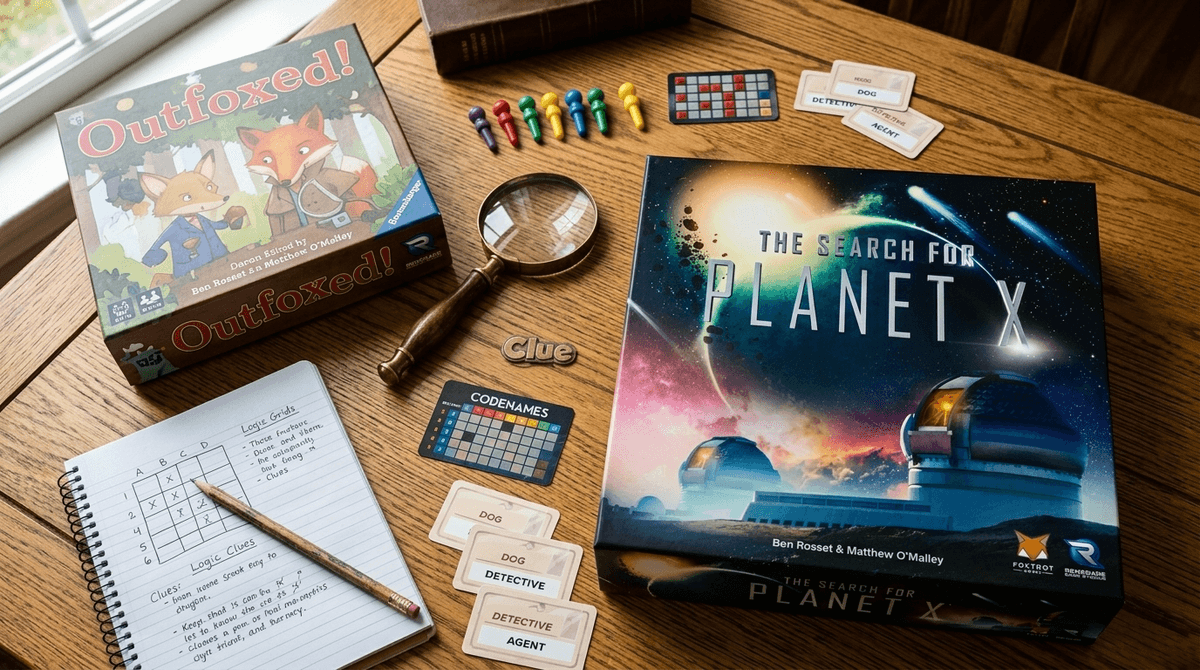
- Best for Ages 5-8: Outfoxed! — A cooperative "whodunit" that won’t end in tears.
- Best for Logic Puzzles (Solo): Rush Hour — Perfect for quiet time or long car rides.
- Best for Social Deduction: Codenames — The ultimate bridge for kids who love Among Us.
- Best for Visual Detectives: MicroMacro: Crime City — Like Where’s Waldo but you’re solving murders.
- Best for Serious Strategy: The Search for Planet X — High-level logic that makes you feel like a literal rocket scientist.
Find more board game recommendations based on your child's favorite video games
We talk about "critical thinking" a lot, but deductive reasoning is the specific superpower of taking a set of rules or facts and narrowing them down until only one conclusion is possible. It’s the "If A and B are true, then C must be true" logic.
In the digital world, kids are often passively consuming content that does the thinking for them. Board games that focus on deduction force them to do the "processing" themselves. It’s the difference between watching a YouTuber solve a puzzle and being the one who has to figure out which suspect stole the pot pie before the fox reaches the exit.
Let’s be real: Roblox is great for "entrepreneurship" (if you count begging for Robux as a business model), but it’s not always great for focused, linear logic. Deductive reasoning games are the "anti-brain-rot." They require a level of concentration and "if/then" mapping that builds the same neural pathways used in coding, math, and high-level reading comprehension. Plus, it’s a way to have a "real" conversation that isn't about what’s "Ohio" or which MrBeast video just dropped.
Outfoxed! (Ages 5+)
If you grew up on Guess Who?, this is the modern, vastly superior upgrade. In Guess Who?, you're just asking "Does he have a hat?" until someone wins. In Outfoxed!, the players work together to find clues using a "clue decoder" to eliminate suspects. It’s cooperative, so you don’t have to deal with a 6-year-old flipping the board because they lost. It teaches the basics of "process of elimination" in a way that feels like a real mystery.
Mastermind (Ages 8+)
This is pure, unadulterated logic. One player creates a secret code of colored pegs, and the other has to guess it. The feedback is binary: you have the right color, or you have the right color in the right place. It’s basically a physical version of Wordle but with colors. It’s short, punchy, and forces kids to look at their previous guesses to inform their next move.
Codenames (Ages 10+)
If your kids are obsessed with Among Us, they will likely love Codenames. It’s about making associations between words while avoiding the "assassin." It requires deductive reasoning to figure out which words your teammate is trying to link with a single-word clue. It’s also a great way to see how your kid’s brain categorizes information.
MicroMacro: Crime City (Ages 10+)
This game is a massive, incredibly detailed paper map. You get a deck of cards for a specific crime, and you have to find the characters on the map to see what they were doing at different points in time. It’s "visual deduction." You see a guy with a hat at the park, then you find him five blocks away without the hat, and you have to deduce what happened in between. Note: Some of the crimes involve "adult" themes (infidelity, murder), so check the "WISE" rating on our media page if you’re sensitive to that.
The Search for Planet X (Ages 12+)
This is the "Final Boss" of deduction games. You are astronomers looking for a hidden planet. You use an app (yes, a little bit of screen time, but it’s a tool, not a distraction) to scan sectors of space. The game gives you rules like "Comets cannot be adjacent to Asteroids." You have to map out the entire sky based on these constraints. It is incredibly satisfying when you finally "locate" the planet based on nothing but pure logic.
- Clue: The classic. It’s still good, though it can feel a bit slow for kids raised on high-speed internet.
- Turing Machine: A literal analog computer made of punch cards. It’s brilliant for kids who like math.
- Chronicles of Crime: Uses VR (via your phone) to search crime scenes. Very immersive.
When introducing these games, the biggest hurdle isn't the logic—it's the frustration. Deductive reasoning is a "hard" skill. If a kid makes a wrong deduction early in a game like Clue or The Search for Planet X, the whole house of cards falls down.
- Ages 5-8: Stick to cooperative games. The goal is to learn how to use the tools of deduction without the pressure of competition.
- Ages 9-12: This is the sweet spot for "Social Deduction." They are starting to understand how other people think (and how to lie to them), which is its own form of reasoning.
- Ages 13+: They can handle "Heavy" deduction. These games can take 60-90 minutes, so make sure they have the attention span for it before you drop $50 on a complex board game.
Deduction games are inherently "quiet" games. Unlike Exploding Kittens or Uno, which are loud and chaotic, deduction requires a bit of a "library" vibe.
Also, be aware of "Alpha Gaming" in cooperative titles like Outfoxed!. This is when one person (usually the parent or the oldest sibling) starts telling everyone else what to do because they've already solved the puzzle in their head. Don't do this. Let the kids make the wrong deduction. Let the fox get away. The learning happens in the mistake, not in you winning the game for them.
After the game, it’s worth a quick "post-game show" conversation. You don't have to be a nerd about it, but asking things like:
- "What was the clue that finally made it click for you?"
- "When did you realize it couldn't be the Bear?"
- "How did you know I was lying about having the 'Blue' card?"
This helps them internalize the process of thinking, rather than just the result of winning.
If you’re worried about "brain rot" or the fact that your kid can name every Skibidi Toilet character but can't find their own shoes, deductive reasoning board games are a fantastic intervention. They are fun, they are social, and they build the kind of rigorous thinking skills that the digital world often bypasses.
Start with something cooperative like Outfoxed! and work your way up. Even if they don't become the next Sherlock Holmes, they'll at least learn that "because I said so" isn't a valid logical deduction.
- Pick one game from the list above based on your child's age.
- Schedule a "Digital Sabbath"—even just two hours on a Sunday—where the phones go in the basket and the board games come out.
- Check the Screenwise community data to see which games other parents in your school district are playing. (Are they all playing Catan? Maybe it’s time to start a neighborhood tournament).