

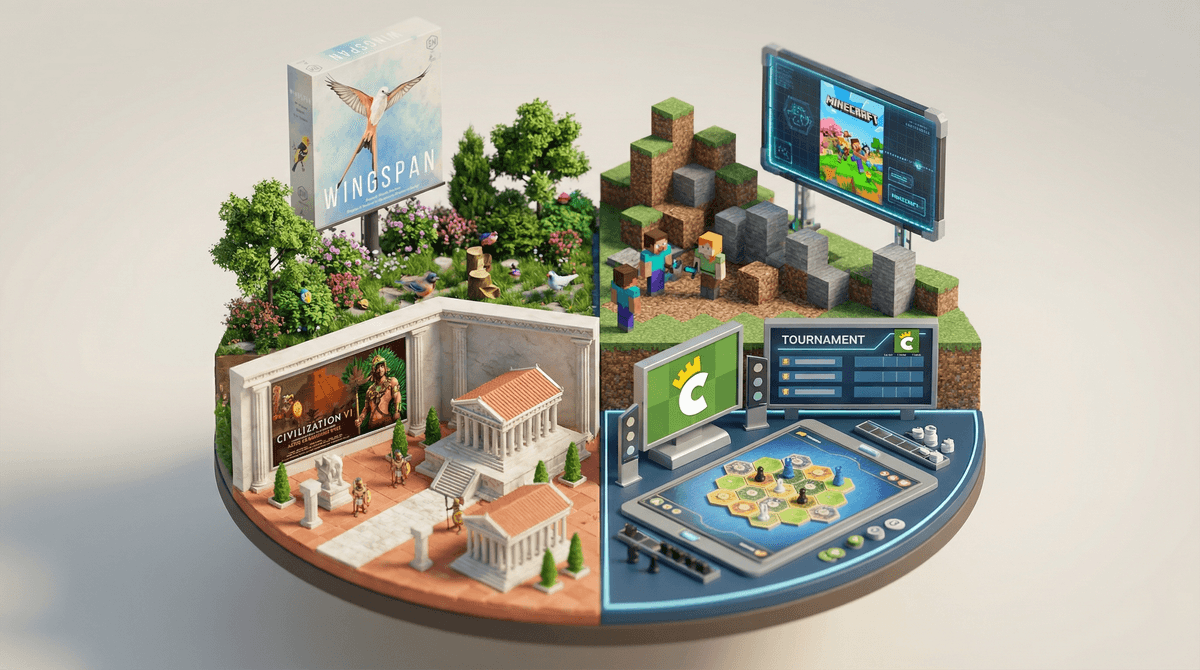
Strategy games are exactly what they sound like: games where winning requires actual thinking, planning, and problem-solving rather than just fast reflexes or button-mashing. We're talking about games where kids need to manage resources, think several moves ahead, adapt to changing situations, and make decisions with real consequences.
And here's the thing — not all strategy games are created equal. Some are genuinely brilliant at teaching executive function skills. Others just feel educational while basically being dressed-up time sinks. Let's talk about the ones that actually deliver.
Look, I get it. When your kid asks for "just one more turn" at 9 PM on a school night, it's hard to see the educational value. But good strategy games really do build cognitive skills that transfer to real life:
- Planning and sequencing - Breaking big goals into smaller steps
- Resource management - Understanding trade-offs and opportunity costs
- Adaptive thinking - Adjusting when plans don't work out
- Pattern recognition - Spotting cause-and-effect relationships
- Delayed gratification - Making short-term sacrifices for long-term gains
The research here is actually pretty solid. Studies show that strategy game players show improvements in working memory, spatial reasoning, and problem-solving. Not brain-training-app nonsense, but actual transferable skills.
That said, time still matters. A kid spending 4 hours a day on even the best strategy game is missing out on other important experiences. Balance is still the goal.
Ages 6-8: Building the Foundation
[Chess for Kids](https://screenwiseapp.com/media/chess-for-kids-game (App) Yes, actual chess. But modern chess apps for kids are way better than the dusty board in your closet. Apps like Chess for Kids and ChessKid have adaptive lessons, fun animations, and matchmaking that keeps games appropriately challenging. Chess is basically the OG strategy game, and it's still one of the best for teaching planning ahead and considering consequences.
Minecraft (Game, Creative Mode) In Creative Mode, Minecraft is less about survival and more about planning builds, managing inventory, and executing complex projects. Kids learn spatial reasoning and project management. Just... maybe steer them away from YouTube tutorials that are 40% someone screaming "GUYS THIS IS INSANE."
Rush Hour (Board Game) This physical puzzle game has kids planning multiple moves ahead to get the red car out of a traffic jam. It's basically coding logic without a screen, and the difficulty ramps up beautifully. Great for car rides or waiting rooms.
Ages 9-12: Leveling Up
Civilization VI (Game) This is the gold standard of turn-based strategy. Kids build civilizations from the Stone Age to the Space Age, managing resources, diplomacy, technology, and military. It's genuinely educational — my friend's 11-year-old can now name more world leaders than most adults.
Warning: Games can take HOURS. Set time limits before starting, or you'll be the bad guy interrupting at a "critical moment" (which is always).
Into the Breach (Game) A brilliant tactical strategy game where you control mechs defending cities from giant monsters. What makes it special: you can see exactly what enemies will do next turn, so success is about perfect planning, not luck. Games are short (30-60 minutes), and failure teaches genuine lessons about decision-making.
Settlers of Catan (Board Game) The gateway drug to modern board gaming. Kids learn resource management, negotiation, and strategic planning. Plus it's actually fun for adults, so you won't want to fake a sudden work emergency when they ask to play. The [app version](https://screenwiseapp.com/media/catan-boardgame is solid too if you want to practice before buying the physical game.
Bloons TD 6 (Game) Tower defense games are underrated strategy teachers. Kids need to plan placement, manage budgets, and adapt to increasingly difficult waves. Bloons TD 6 is colorful, has no violence beyond popping balloons, and offers genuine strategic depth. Fair warning: it has in-app purchases, but they're not pushy.
Ages 13+: Real Complexity
StarCraft II (Game) The game is literally used in cognitive research studies. It requires insane multitasking, resource management, and strategic thinking. The base game is free, and the campaign mode is genuinely excellent storytelling. The competitive scene can be intense, so maybe start with campaign mode and co-op missions.
Factorio (Game) This is basically "what if engineering was a game?" Kids build increasingly complex automated factories, solving logistics puzzles and optimizing production chains. It teaches systems thinking and problem decomposition. Also, it's one of the highest-rated games on Steam ever, so teens will actually want to play it.
Wingspan (Board Game) A beautiful engine-building game about birds. Players collect birds, lay eggs, and build habitats while learning actual bird facts. It's strategic without being cutthroat, and the [digital version](https://screenwiseapp.com/media/wingspan-boardgame is excellent for learning the rules before playing physically.
XCOM 2 (Game) Turn-based tactical combat where you command a squad fighting an alien invasion. Every decision matters — soldiers can permanently die, resources are scarce, and you're always making tough trade-offs. It's rated T for Teen (violence is present but not graphic), and it teaches risk assessment and consequence management better than any lecture ever could.
Not all "strategy" games are equal. Games can slap "strategy" on the label while really being about grinding or waiting for timers. Real strategy games have you making meaningful decisions with clear consequences, not just clicking through menus.
The best strategy games are hard. Your kid will fail. They'll make bad decisions and lose. This is actually the point — learning from failure in a low-stakes environment is incredibly valuable. Resist the urge to jump in and fix everything.
Multiplayer can be great... or terrible. Playing strategy games with friends teaches negotiation and social strategy. Playing with random internet strangers can expose kids to toxic behavior. For online games, use parental controls and keep communication features limited for younger kids. Here's how to manage online gaming safely.
Time management is still your job. "Just one more turn" is the battle cry of strategy gamers everywhere. Games like Civilization have no natural stopping point. Set clear time limits before starting, maybe use a timer, and stick to it.
Physical strategy games matter too. Don't sleep on board games. They teach the same skills without screens, plus they involve face-to-face social interaction and reading physical cues. Games like Ticket to Ride, Splendor, and Azul are all excellent strategy games that work for family game night.
Some games market themselves as "strategy" but are really just dressed-up slot machines:
- Pay-to-win mechanics - If spending money gives strategic advantages, it's not really strategy
- Wait timers - Real strategy games don't make you wait 4 hours unless you pay
- Loot boxes - Random rewards teach gambling, not strategy
- Energy systems - Limiting play sessions to push purchases isn't strategic design
Games like Clash of Clans or most mobile "strategy" games fall into these traps. They're not evil, but they're not building the cognitive skills we're talking about here.
Strategy games can genuinely build cognitive skills — but only if they're actually good strategy games, and only in reasonable doses. The games listed here are the real deal: they require actual thinking, teach transferable skills, and respect players' intelligence.
Start with age-appropriate options, play together when possible, and use these games as conversation starters about decision-making and planning. When your kid explains their strategy for defeating the alien invasion or optimizing their factory, they're practicing the same skills they'll need for school projects, career planning, and life decisions.
Just... maybe hide Civilization until after finals week.
Want to explore more? Check out our guides on the best puzzle games for kids and building games that teach creativity.
Worried about gaming taking over? Read about setting healthy gaming boundaries and how to know if gaming is a problem.
Got a specific game question? Find out if any game is right for your kid to get personalized guidance for your family.