

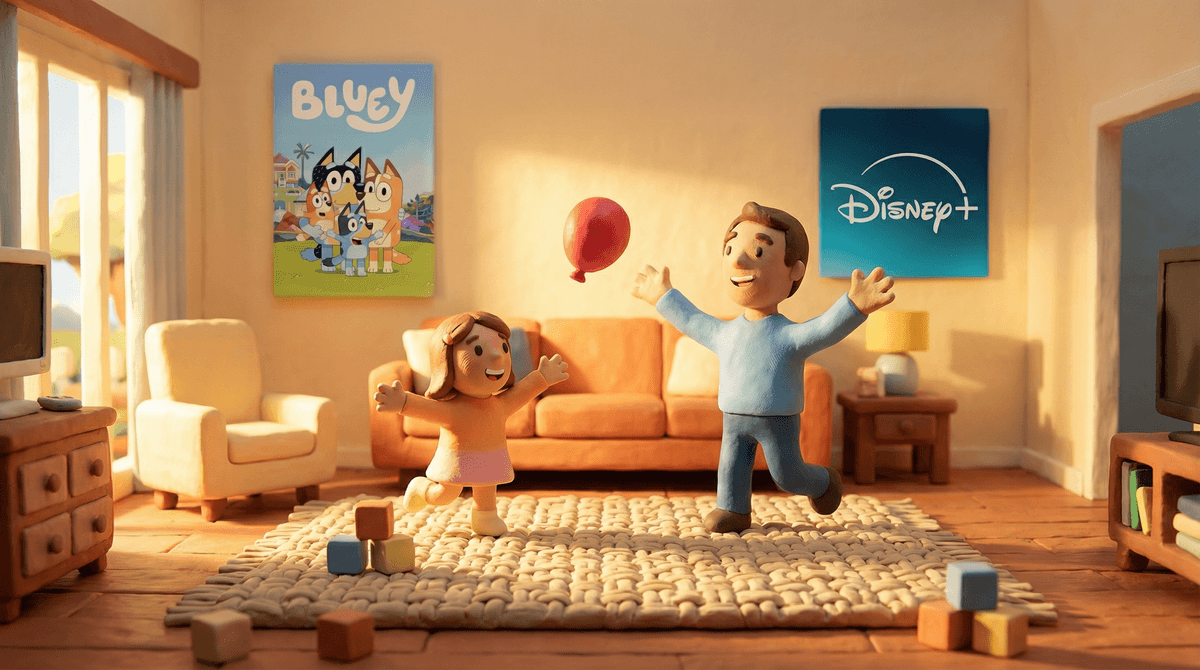
Bluey is an Australian animated series that follows a 6-year-old Blue Heeler puppy named Bluey, her 4-year-old sister Bingo, and their parents Bandit and Chilli. Each 7-minute episode centers on imaginative play, family dynamics, and the small but meaningful moments of childhood. It airs on Disney+ and has become a global phenomenon since 2018.
Here's what makes it different from most kids' TV: the parents are actually present, engaged, and realistically imperfect. Bandit gets tired during long play sessions. Chilli sometimes needs space. The kids don't always get what they want. And somehow, it's become appointment viewing for adults who claim they're "just putting it on for the kids."
Kids love Bluey because it validates their world. The show takes children's games seriously—whether it's "Keepy Uppy" (keeping a balloon in the air) or "Magic Xylophone" (a toy that freezes people in place). The conflicts are real to their experience: sharing toys, feeling left out, wanting to stay up late, navigating friendships.
Parents love it because it's genuinely funny and doesn't talk down to anyone. The show acknowledges that parenting is exhausting and that you won't always get it right. There's an episode called "Onesies" where Chilli just wants five minutes to herself at a party, and if you've ever hidden in a bathroom at a family gathering, you get it.
The animation is beautiful, the Australian accents are charming, and the emotional beats hit surprisingly hard. Episodes like "Sleepytime" and "Baby Race" have made grown adults cry into their coffee.
Ages 2-5: This is the sweet spot. Preschoolers see themselves in Bluey and Bingo's adventures. The episodes model healthy emotional regulation, creative play, and sibling relationships. The 7-minute runtime is perfect for short attention spans.
Ages 6-8: Still highly engaging. Kids this age start picking up on the more subtle humor and can relate to the school and friendship episodes. They might start mimicking the games from the show (which is actually a win—more on that below).
Ages 9+: Many kids will naturally age out, though some still enjoy it as comfort viewing. The parent humor might land better with this age group if they're watching with younger siblings.
Parents: You're going to watch this whether you plan to or not. The good news? It's actually worth your attention. Many episodes offer genuine parenting insights wrapped in a kids' show format.
The Screen Time Paradox
Bluey is about playing away from screens. Nearly every episode ends with the kids running outside or diving into imaginative play. It's one of the few shows that might actually inspire kids to turn off the TV and recreate what they just watched. If your kid starts playing "Grannies" or building a "Hotel" out of couch cushions after watching, that's the show working as intended.
The Parenting Pressure
Let's address the elephant in the room: Bandit sets an unrealistic standard. He's an archaeologist who seems to have infinite time and energy for elaborate games. Most of us are not doing full-body puppet shows after a long work day, and that's okay.
The show actually addresses this in episodes like "Stumpfest", where Bandit admits he doesn't always want to play. The message isn't "be a perfect parent"—it's "show up when you can, be present when you're there, and it's okay to have boundaries."
Content Notes
Bluey is remarkably wholesome, but a few things to know:
- Some episodes deal with heavier themes like miscarriage (implied in "The Show"), infertility, and loss. These are handled gently but might prompt questions.
- A few episodes have been pulled or edited in the US for various reasons—mostly harmless content that Disney deemed too mature. You can learn more about which episodes and why
 .
. - The Australian slang is delightful but occasionally confusing. "Dunny" means bathroom, "capsicum" is a bell pepper, and "bin night" is trash day.
The Merchandise Industrial Complex
Like any popular kids' property, there's a tsunami of Bluey merchandise. The good news? Most of it encourages active play—plush toys, figurines, playsets. The bad news? Your kid will want all of it. The show itself doesn't feel overly commercialized, which is refreshing.
Co-viewing opportunity: Bluey is genuinely designed for family viewing. The episodes work on multiple levels, and there's real value in watching together and talking about what happens.
Play inspiration: After watching, try playing the games from the show. "Shadowlands" (only stepping in shadows) is great for outdoor play. "The Quiet Game" is a parenting superpower. "Shops" or "Restaurants" can occupy kids for hours.
Conversation starters: Episodes like "Copycat" (dealing with death) or "Bumpy and the Wise Old Wolfhound" (accepting change) open doors to bigger conversations in age-appropriate ways.
Unlike Cocomelon or Ms. Rachel, which are more educational/developmental, Bluey focuses on emotional intelligence and family relationships. It's less frenetic than Paw Patrol and more grounded than PJ Masks.
If you're looking for similar quality content, consider Daniel Tiger's Neighborhood for younger kids or Hilda for slightly older ones.
Bluey is about as good as screen time gets for young kids. It's well-made, emotionally intelligent, encourages active play, and doesn't make parents want to throw the remote out the window. The 7-minute episodes make it easy to set boundaries ("one more episode" is actually manageable), and the content holds up to repeated viewing—which is good, because your kid will want to watch "Grannies" 47 times.
The real gift of Bluey isn't that it's "educational" in the traditional sense—it's that it reminds both kids and parents that the best childhood moments come from presence, imagination, and connection. Even if you're too tired to be Bandit, you can still show up for your kids in meaningful ways.
- Set up a family media plan that includes Bluey as part of balanced screen time
- Try playing one Bluey game with your kids this week—even just 10 minutes of "Keepy Uppy" counts
- Explore other quality shows if you want to expand beyond Bluey
- Use Screenwise to see how your family's screen time compares to others in your community and get personalized recommendations
Remember: you don't have to be Bandit to be a great parent. Sometimes just sitting on the couch watching Bluey together is enough.