

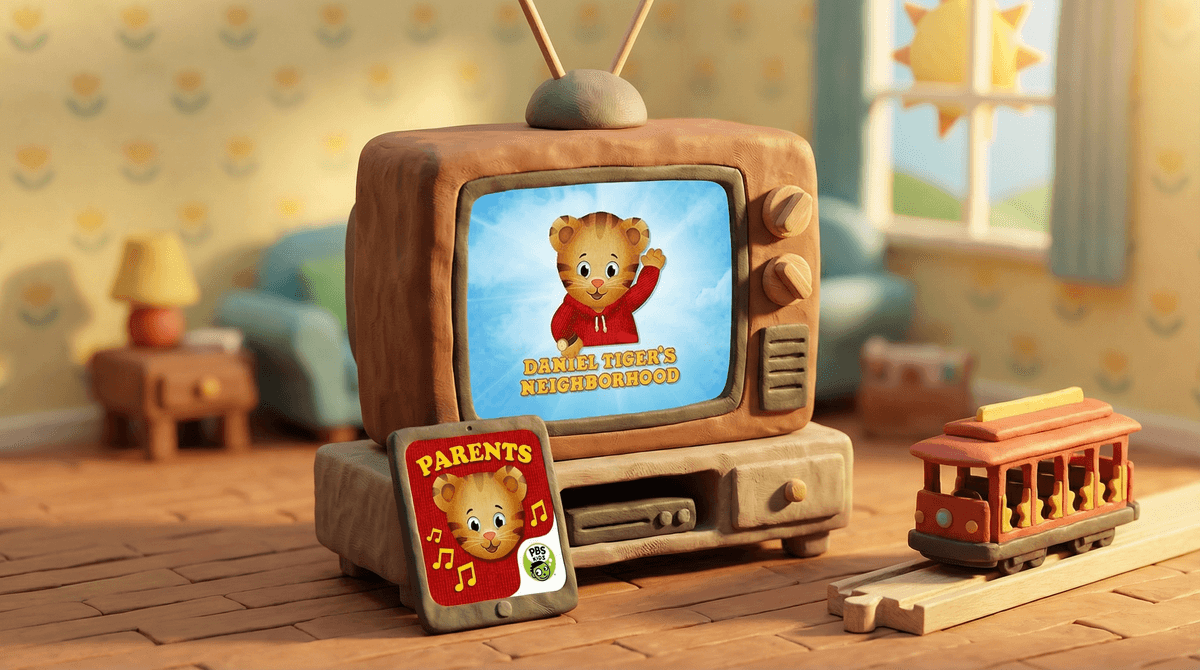
TL;DR: Daniel Tiger's Neighborhood is the gold standard for social-emotional learning (SEL) in the preschool years. It’s low-stimulation, intentionally paced, and provides "strategy songs" that actually help parents manage real-world meltdowns. If you’re looking for a show that isn't "brain rot" and actually makes your job as a parent easier, this is it.
Quick Links:
If you grew up with Fred Rogers, you already know the DNA of this show. Daniel Tiger's Neighborhood is the animated spin-off of the classic Mister Rogers' Neighborhood. It follows 4-year-old Daniel Tiger (the son of the original Daniel Striped Tiger puppet) as he navigates the high-stakes world of preschool: sharing toys, trying new foods, and handling the absolute devastation of a dropped ice cream cone.
Each episode is structured around a "strategy song"—a catchy, repetitive earworm designed to give kids (and parents) a tool to use when big feelings hit. It’s produced by Fred Rogers Productions, and they haven't lost the "slow TV" magic that makes their content so distinct from the neon-colored, fast-cut chaos of modern toddler YouTube.
We talk a lot about "brain rot" in the Screenwise community, usually referring to the hyper-stimulating, dopamine-loop content like Skibidi Toilet or the relentless pacing of Cocomelon.
The "Daniel Tiger Effect" is essentially the opposite of that.
Research into children’s media often points to "pacing" as a key factor in how kids process information. Shows with fast cuts (changes in camera angle every 2-3 seconds) can leave a preschooler’s brain feeling fried, leading to the "screen time hangover" meltdowns we all dread.
Daniel Tiger's Neighborhood uses a slow, deliberate pace. Daniel looks directly at the camera and pauses, giving your child time to actually think and respond. It’s the digital equivalent of a deep breath.

The real reason parents love this show isn't just because it's "safe"—it's because it’s a manual for parenting. When you’re in the trenches of a Level 10 tantrum because the blue bowl is in the dishwasher, you don't need a lecture on child psychology. You need a jingle.
The strategy songs are short, musical "life hacks" for toddlers.
- For transitions: "It’s almost time to stop, so choose one more thing to do."
- For anger: "When you feel so mad that you want to roar, take a deep breath and count to four."
- For trying things: "You gotta try new food 'cause it might taste good."
- For disappointment: "When something seems bad, turn it around and find something good."
These aren't just cute; they are based on actual behavioral therapy techniques. By the time your kid has seen the "stop and go right away" episode three times, the song is lodged in their brain. When it’s time to leave the park, you don't have to be the bad guy—you just have to start the song.
While we see a "learning tool," kids see a friend who gets them. Daniel Tiger is vulnerable. He gets scared of the dark, he gets jealous of his baby sister, and he sometimes forgets to use his words.
Unlike some older media where the child characters are perfectly behaved, Daniel is a work in progress. Kids in the 2-5 age range see their own struggles reflected in him. Plus, the show leans into the "Neighborhood of Make-Believe" elements that have sustained the franchise for decades—Trolley is still there, and the music is genuinely high-quality.
Learn more about how Daniel Tiger compares to other PBS shows
If you're ready to lean into the Daniel Tiger ecosystem, here is how to do it without overdoing the screen time.
The core show. It’s best consumed in 20-minute chunks. Each episode has two stories that revolve around the same theme, reinforcing the "strategy" of the day.
This is actually an app for you, not the kids. It’s a library of the strategy songs and videos. When you're at a restaurant and your kid is about to lose it, you can pull up the "Waiting is tough" video. It’s a literal parenting toolkit in your pocket.
If your child is starting to show interest in "playing games" but isn't ready for the complexity (or the economy) of Roblox, the PBS Kids website has excellent, browser-based Daniel Tiger games that are free, educational, and have zero "in-app purchases" to worry about.
Think of Bluey as the "graduate school" version of Daniel Tiger. While Daniel focuses on the mechanics of feelings, Bluey focuses on the nuance of play and family dynamics. Most kids transition from Daniel to Bluey around age 4 or 5.
- Ages 2-3: This is the sweet spot. The repetition is exactly what their developing brains need. Watch with them if you can, so you learn the songs too.
- Ages 4-5: Still very relevant, especially for kids starting preschool or kindergarten who are dealing with new social hierarchies and "big school" nerves.
- Ages 6+: You might start hearing that Daniel Tiger is "for babies." This is the natural progression. By this age, they are likely moving toward Minecraft or more complex shows like The Wild Robot.
One thing to watch out for: Daniel Tiger is very "gentle." If your parenting style is more "stop crying and put your shoes on," the show might feel a bit saccharine to you. However, even the most "no-nonsense" parents usually find that the strategy songs are more effective than yelling.
Also, be aware that while the show is low-stimulation, it is still screen time. It’s easy to let the PBS Kids app auto-play for two hours because "it's educational." Even with good content, the "too much of a good thing" rule applies.
Check out our guide on setting healthy screen time limits for preschoolers
The best way to use Daniel Tiger is to bring it into the "offline" world.
- In the moment: When your child is struggling to share, don't just tell them to share. Ask, "What does Daniel Tiger do when he wants a toy that someone else is using?" (The answer: "You can take a turn, and then I'll get it back.")
- During play: Use their stuffed animals to role-play the scenarios from the show.
- The "Ohio" Factor: If your older kids are starting to use Gen Alpha slang like "Ohio" or "Rizz" around their younger siblings, you can use Daniel's straightforward communication style as a baseline for "real talk" vs. "internet talk."
Daniel Tiger's Neighborhood is one of the few pieces of media that actually gives back more than it takes. It doesn't just entertain your kid for 20 minutes; it gives your entire family a vocabulary for handling the emotional rollercoaster of early childhood.
It’s not "brain rot." It’s not a bank-account-draining trap like some mobile games. It’s just good, intentional storytelling that respects your child’s intelligence and your sanity.
- Download the songs: Get the Daniel Tiger for Parents app and familiarize yourself with 3-4 key songs (Anger, Transitions, Trying New Things).
- Curate the queue: If you use the PBS Kids website, show your child how to find the Daniel Tiger section specifically.
- Watch an episode together: Pick a topic your child is currently struggling with (like a new sibling or potty training) and watch that specific episode together to start a conversation.