

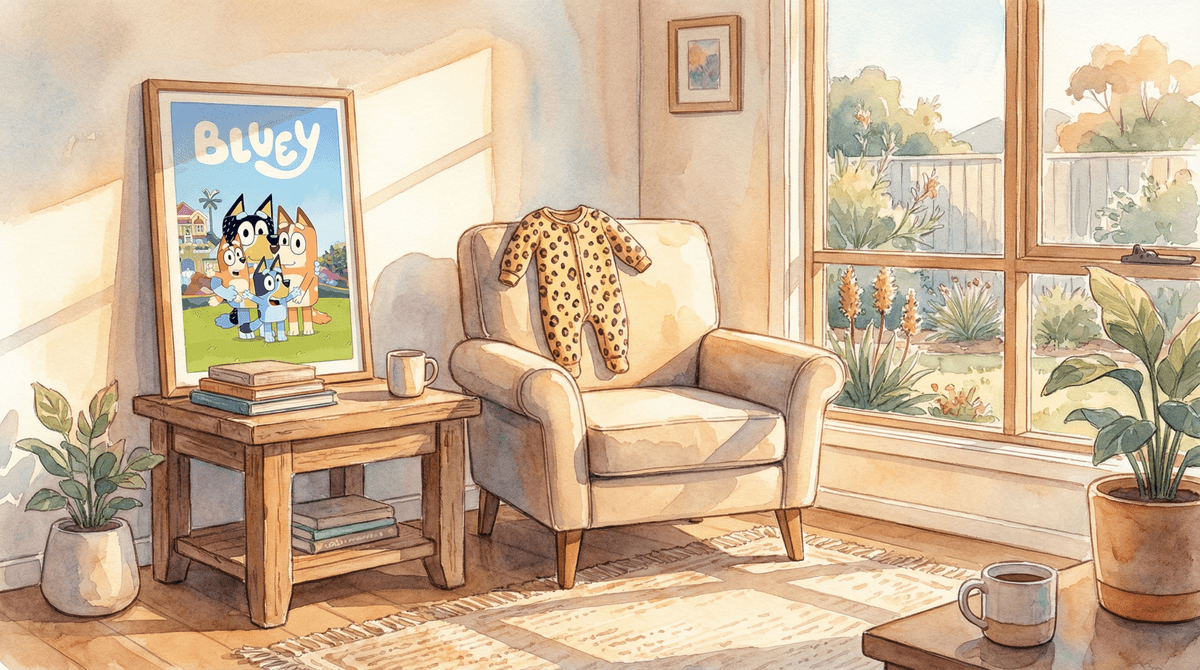
TL;DR: The Bluey episode "Onesies" is a masterclass in tackling "grown-up" grief through a child’s lens. It uses a chaotic cheetah costume to explain why some people can’t have the families they want, making it a perfect jumping-off point for talking about infertility, empathy, and why Aunt Brandy hasn't visited in four years. If you’re looking for more ways to use media to build emotional intelligence, check out our guides on using Bluey to teach empathy and best shows for emotional intelligence.
If you haven't seen it yet, "Onesies" (Season 3, Episode 31) introduces us to Chilli’s sister, Brandy. She hasn't visited the Heeler home in four years, and the tension is palpable from the moment she steps out of the car. She brings "onesies" for Bluey and Bingo. Bluey’s fits fine, but Bingo’s cheetah onesie turns her into a literal wild animal.
While the kids are focused on Bingo’s "cheetah" antics, the adults are watching a much more subtle, heartbreaking story. We learn that the reason Brandy stayed away wasn't because she didn't love her nieces—it’s because seeing them was a painful reminder of the one thing she wants but can’t have: a child of her own.
We talk a lot about "brain rot" in the digital wellness world—the kind of hyper-stimulating, low-substance content found on YouTube Kids or certain Cocomelon loops that just numb the brain. Bluey is the literal opposite of that.
"Onesies" matters because it respects children's ability to understand complex emotions. It doesn't use the word "infertility," but it perfectly illustrates the feeling of it. It teaches kids that:
- Adults have big feelings too.
- Sometimes people stay away because they are hurting, not because they are mad.
- Life isn't always fair, and that’s okay to talk about.
For parents, it’s a relief. It’s a show that actually helps us do the heavy lifting of parenting instead of just keeping the kids quiet while we try to answer emails.
While we’re over here crying into our coffee, the kids are losing their minds because Bingo is acting like a feral cat. This is the brilliance of Joe Brumm’s writing.
Bingo "becomes" the cheetah. She’s fast, she’s uncontrollable, and she’s essentially unreachable. This mirrors Brandy’s desire—a child is something "wild" and beautiful that she wants to catch, but it keeps slipping through her fingers. When Bingo finally slows down and Brandy gets to hold her, it’s a moment of temporary catharsis for a character who has been grieving in silence for years.
If your family loved the depth of "Onesies," you might be looking for other media that handles tough topics with the same level of grace. Here are a few top-tier picks:
This is the gold standard for explaining how emotions work. It’s particularly good for kids ages 5-12 who are starting to feel the "mix" of joy and sadness. It pairs perfectly with the themes in "Onesies" about why we feel sad even when we should be happy.
This is a phenomenal book for younger kids (ages 2-6) about grief and support. When something goes wrong, everyone tries to tell Taylor how to fix it, but the rabbit just sits and listens. It’s a great way to explain Brandy’s need for space and Chilli’s role as a supportive sister.
Don't sleep on the classics. Sesame Street has been doing this since the 70s. Whether it’s explaining Mr. Hooper’s death or introducing Karli, a character in foster care whose mother is dealing with addiction, they never pull their punches while remaining age-appropriate.
For your older kids (tweens and up), this show explores ethics, life, death, and what it means to be a "good" person. It’s funny, smart, and handles existential dread better than almost anything else on TV.
How you talk about "Onesies" depends entirely on where your kids are at. Here’s a breakdown of how to navigate the conversation:
- Ages 3-5: Focus on the "cheetah." Talk about how Bingo was being silly and how Brandy was happy to finally get a hug. If they ask why Brandy was sad, you can say, "She was sad because she wants a family like ours, but it’s very hard for her to have one. Sometimes that makes people feel a bit lonely."
- Ages 6-9: You can be more direct. Explain that Brandy wants to be a mommy but her body won't let her. This is a great age to introduce the concept that "not all families look the same" and that some people use adoption or other ways to build families, but for some, it just doesn't happen.
- Ages 10+: At this point, they’ve likely picked up on the nuances. You can talk about the rift between the sisters. Why did Brandy stay away for four years? Was it "fair" to Chilli? This opens up conversations about boundaries and self-care in relationships.
If the episode sparks a deeper conversation, or if your family is personally dealing with reproductive grief, here are a few ways to frame it:
- Use the "Something you want but can't have" line. Chilli says this in the episode, and it’s perfect. It’s a concept every child understands (from wanting a toy at the store to wanting a later bedtime). It scales the massive grief of infertility down to a size a child can grasp.
- Validate the sadness. Don't try to "fix" Brandy's sadness for your kids. Let them see that it’s okay for an adult to be sad about something they can't change.
- Explain "The Gap." Sometimes there’s a gap between what we want and what we have. That gap is where big feelings live.
You might be thinking "is it okay to let my kids see me cry during Bluey?"
"Onesies" isn't just a "good episode" of a kids' show; it’s a tool for intentional parenting. It proves that screen time doesn't have to be "passive" or "rotting." When we choose high-quality media like Bluey, we aren't just distracting our kids—we’re giving them a vocabulary for the hardest parts of being human.
In a world full of Roblox scams and TikTok challenges, finding a 7-minute cartoon that can explain the complexity of a broken heart is a rare gift. Watch it with them, let them see you get a little misty-eyed, and use it to build a bridge to the conversations that actually matter.
- Watch the episode together. If you’ve been scrolling on your phone while they watch, put it down for this one.
- Check out our guide on co-viewing benefits to see why watching with your kids changes how they process content.
- Explore more "Big Feeling" shows. Check out our list of alternatives to Bluey if you’ve already seen every episode twenty times.