

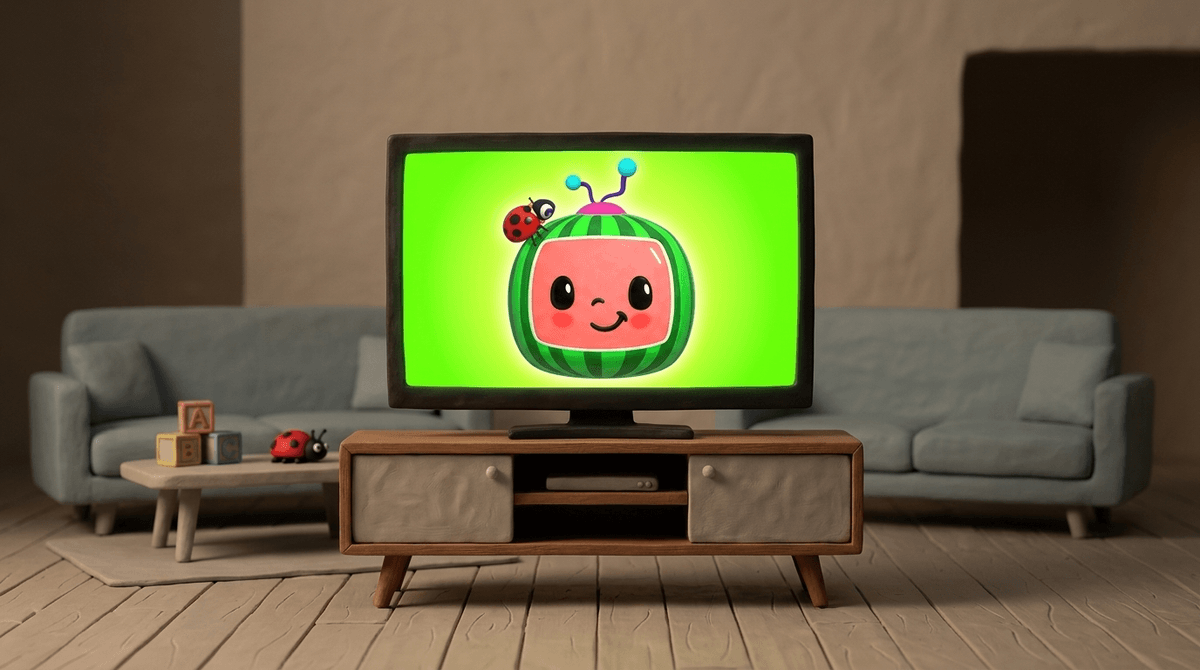
CoComelon: The Colorful Preschool Phenomenon Parents Love to Debate
TL;DR: CoComelon is the most-watched preschool content on the planet, and it's driving a wedge through parent groups everywhere. Some swear by its educational songs and counting lessons. Others call it "digital crack" for toddlers. Child development experts from the AAP have raised concerns about its rapid pacing and overstimulation. Here's what the research actually says, what you need to know, and how to find balance if your kid is already hooked.
The bright colors. The nursery rhymes that burrow into your brain like invasive species. That perpetually cheerful family with their perfectly round heads. If you have a toddler, you know exactly what I'm talking about.
CoComelon has become the defining preschool media experience of this generation—racking up billions of views on YouTube and dominating Netflix's kids section. It's also become one of the most polarizing topics in modern parenting. According to our Screenwise data, 92% of families use streaming TV services, and a huge chunk of that toddler viewing time goes straight to CoComelon.
But should it?
CoComelon is an animated YouTube channel (now also on Netflix) that features 3D-animated nursery rhymes and educational songs. The show centers on a family—JJ, his siblings, and their parents—as they navigate everyday toddler experiences: potty training, going to the doctor, sharing toys, learning colors and numbers.
Each episode is packed with bright, high-contrast visuals, catchy songs set to familiar nursery rhyme melodies, and rapid scene changes that keep young eyes glued to the screen. And I mean glued. Like, you could probably perform minor surgery on your toddler while CoComelon is playing and they wouldn't notice.
That hypnotic quality? That's exactly what has parents—and experts—worried.
There's a reason CoComelon captures toddler attention like nothing else. The show is engineered—and I use that word intentionally—to hit every neural button in a developing brain:
- High-contrast colors that naturally attract young eyes
- Scene changes every 2-3 seconds (compared to 8-10 seconds in shows like Bluey)
- Repetitive melodies that activate the brain's reward centers
- Familiar situations that toddlers recognize from their own lives
- Constant stimulation with no quiet moments or pauses
As one parent review on Common Sense Media put it: "My child is literally hypnotized by this show." Another noted that their toddler would have "complete meltdowns" when CoComelon was turned off.
Sound familiar?
Here's where things get real. Child development experts have been increasingly vocal about CoComelon's potential downsides.
The American Academy of Pediatrics (AAP) has specifically criticized CoComelon for having "too fast a pace" and features that "capture a child's attention but don't let it go naturally." This matters because healthy attention development requires kids to practice sustaining focus on slower-paced content, not just being captured by rapid stimulation.
Multiple studies have found connections between fast-paced media consumption in early childhood and shorter attention spans later. Parents Magazine reports that experts are concerned about how the show's pacing affects cognitive development.
On Reddit's babysitting community, one user noted: "There are serious scientific studies that have found that Cocomelon is damaging to kids' attention spans and cognitive development."
But (and this is important): CoComelon isn't poison. It's not going to ruin your kid if they watch it occasionally. The concern is about excessive use and the pattern it creates.
CoComelon does teach things. The songs cover:
- Numbers and counting
- Colors and shapes
- Social-emotional concepts (sharing, feelings)
- Daily routines (brushing teeth, bedtime)
- Basic vocabulary
Today's Parent notes that "the song's repetitious melody and lyrics help early learners to memorize and count with early numbers."
So yes, there's educational content. But here's the thing: the delivery method matters as much as the content itself. A toddler who's in a passive, hypnotized state isn't actively learning—they're just absorbing stimulation. Real learning happens through interaction, conversation, and active engagement.
Compare this to shows like Bluey, which teach the same concepts but with slower pacing, natural pauses, and storylines that invite conversation between parent and child. Or Daniel Tiger's Neighborhood, which explicitly builds in time for kids to respond to questions.
From a content safety perspective, CoComelon is squeaky clean. IMDB's parent guide rates it as having zero concerning content across all categories: no violence, no profanity, no scary scenes, nothing inappropriate.
This is actually one area where CoComelon deserves credit—it's genuinely age-appropriate content for toddlers. The problem isn't what it shows, but how it shows it.
The parent community is deeply divided:
Team CoComelon says:
- "It's the only thing that keeps my toddler calm during diaper changes"
- "The songs are actually educational and my kid learned to count from them"
- "It's harmless—parents are overreacting"
Team Anti-CoComelon reports:
- "My child becomes a different person when watching it"
- "The meltdowns when we turn it off are unlike anything else"
- "I noticed my kid's attention span getting shorter"
- "It feels more like a drug than a show"
Both perspectives are valid. CoComelon is a tool, and like any tool, it can be used well or poorly.
Under 18 months: The AAP recommends no screen time at all (except video chatting). CoComelon definitely falls outside this guideline.
18 months - 2 years: If you do use screens, the AAP recommends high-quality programming watched with a caregiver who can help them understand what they're seeing. CoComelon's rapid pacing makes this co-viewing nearly impossible—there's no time for conversation.
Ages 2-5: This is CoComelon's target demographic. If you choose to use it:
- Limit to 15-20 minutes max (not the auto-play rabbit hole)
- Watch together when possible and talk about what you're seeing
- Balance it with slower-paced content like Bluey or Sesame Street
- Notice behavioral changes—if you see the "zombie effect" or intense meltdowns, that's your signal
According to our Screenwise data, families average 4.2 hours of screen time daily across all devices. For toddlers and preschoolers, the AAP recommends no more than 1 hour of high-quality programming per day. CoComelon should be a small fraction of that hour, not the whole thing.
If you're looking to reduce CoComelon dependence or find better options, try:
- Bluey: Slower pacing, genuine humor, teaches the same concepts through storytelling
- Daniel Tiger's Neighborhood: Explicitly educational, manageable pace, interactive elements
- Sesame Street: The gold standard for educational preschool content
- Puffin Rock: Gentle, nature-focused, calming
- Tumble Leaf: Science concepts, beautiful animation, thoughtful pacing
Explore more toddler-friendly shows that prioritize healthy development.
About 42% of families in our Screenwise data allow solo YouTube usage, while 38% use supervised viewing. Here's what matters for CoComelon:
YouTube: The auto-play feature is dangerous. Your kid starts with one CoComelon video and suddenly they're 47 videos deep, two hours later. Plus, YouTube's algorithm can serve up CoComelon knock-offs that aren't as carefully produced.
YouTube Kids: Better controls, but still has auto-play. Only 20% of families in our data use YouTube Kids.
Netflix: Gives you more control over viewing time. You can play one episode and be done. No algorithm rabbit hole.
If you're going to allow CoComelon, Netflix is the safer choice. Better yet, download specific episodes so you control exactly what plays.
If your toddler is already deep in the CoComelon zone and you want to dial it back:
-
Go gradual: Cold turkey often backfires with toddlers. Reduce by 5-10 minutes every few days.
-
Replace, don't just remove: Have alternatives ready. A Daniel Tiger episode, an interactive book, a sensory bin.
-
Prepare them: "We're going to watch one CoComelon song, then we're going to read books." Set the expectation before you start.
-
Use visual timers: Toddlers can't tell time, but they can watch a timer count down. It makes the transition less jarring.
-
Expect pushback: There will be meltdowns. That's normal. Hold the boundary consistently.
-
Increase physical activity: Often, CoComelon fills the gap when kids are understimulated. More outdoor play = less screen dependency.
CoComelon isn't inherently evil, but it's not the harmless educational tool it appears to be either. It's designed to capture and hold attention in ways that don't support healthy development when used excessively.
The occasional 15-minute CoComelon session while you need to make dinner or take a work call? That's not going to damage your kid. But hours of daily viewing, or using it as the primary babysitter, or watching your toddler zone out in that distinctive CoComelon trance? That's worth reconsidering.
The best children's media invites interaction, allows for natural pauses, and creates opportunities for parent-child connection. CoComelon does none of these things. It's a tool for keeping kids quiet and occupied—and sometimes that's exactly what you need. Just be honest about what it is.
Your toddler will survive either way. The goal isn't perfection—it's intentionality.
- Track your family's actual CoComelon usage for a week (you might be surprised)
- Try one alternative show from the list above and see how your kid responds
- Set a specific time limit before you press play, not in the moment when they're melting down
- Notice the behavioral patterns: Does CoComelon make transitions harder? Does it affect sleep or attention span?
Get help managing your specific situation for personalized guidance.
The fact that you're reading this guide means you're already being intentional. That matters more than any single show choice.