

Action Games for Kids: Finding the Right Balance Between Excitement and Overwhelm
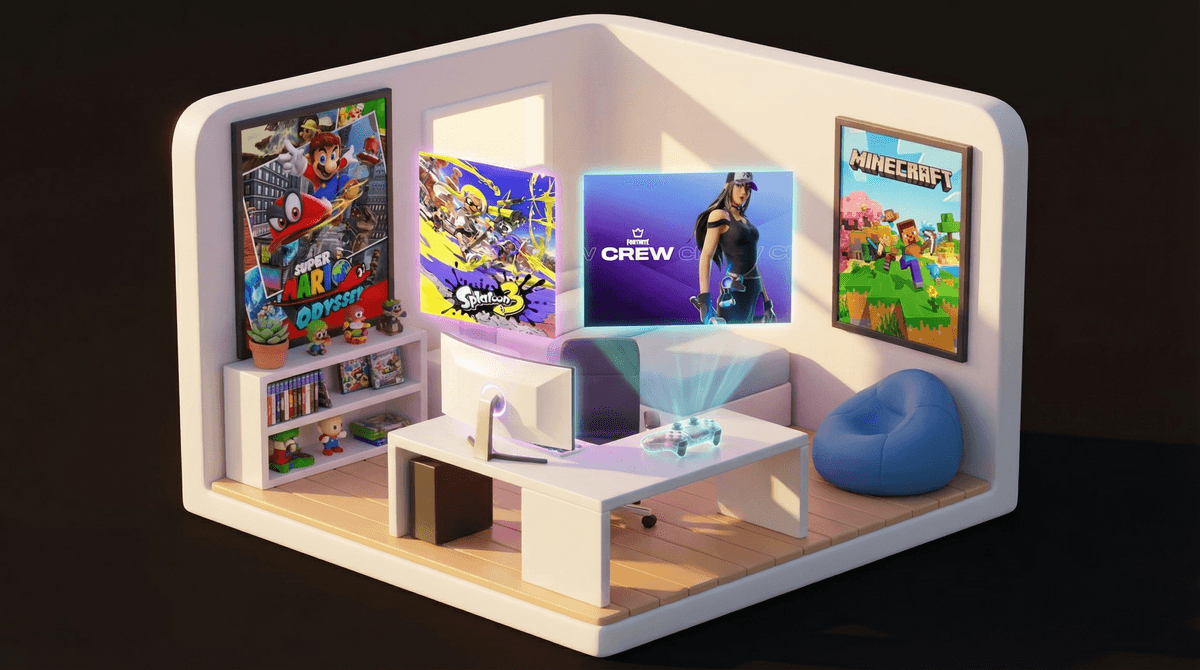
Action games are basically the adrenaline junkies of the gaming world. They're fast-paced, require quick reflexes, and usually involve some combination of jumping, shooting, fighting, or dodging. Think Fortnite, Minecraft (yes, it counts when you're fighting off Creepers), Super Mario Odyssey, or Splatoon.
The genre is massive and ranges from cartoon platformers where you're collecting coins and bopping enemies on the head, to intense battle royales where 100 players fight until one remains, to hack-and-slash adventures with actual combat mechanics. The common thread? Things happen fast, and your kid needs to react faster.
Let's be real: action games hit differently than puzzle games or cozy life sims. There's an immediate dopamine rush from the speed, the challenge, the victory. Your brain lights up when you nail a difficult jump sequence or clutch a win in the final seconds.
For kids specifically, action games offer:
Immediate feedback loops - You know instantly if you succeeded or failed, which is satisfying in a way that real life rarely is (looking at you, homework that doesn't get graded for a week).
Mastery and progression - These games reward practice. Kids can literally feel themselves getting better, which builds confidence.
Social currency - Like it or not, being decent at Fortnite or knowing how to speedrun a Mario level gives kids something to talk about with peers. Around 50% of kids ages 10-12 are playing battle royale games , so this is real playground social capital.
Controlled risk-taking - Action games let kids experience danger, failure, and triumph in a safe environment. That's actually developmentally valuable.
Here's where parents get tripped up: not all action games are created equal. The intensity spectrum is WIDE.
On one end, you've got something like Kirby and the Forgotten Land - technically an action-platformer, but it's pastel pink, forgiving, and you literally play as a cute blob that inhales enemies. Your 6-year-old can handle this.
On the other end? Call of Duty. Realistic military violence, blood, mature themes, voice chat with strangers who definitely shouldn't be talking to your kid. This is not for children, full stop.
In the middle, you've got games like Zelda: Breath of the Wild - fantasy violence, some intense moments, but stylized and part of a heroic narrative. Or Rocket League - technically action-sports, fast-paced and competitive, but you're literally playing soccer with cars. Zero violence.
The question isn't "are action games okay?" - it's "which action games match my kid's age, temperament, and our family values?"
Ages 5-7: Gentle Action
At this age, look for games with:
- Forgiving gameplay (lots of lives, easy difficulty options)
- Minimal or cartoonish "violence" (bopping, not blood)
- Slower pace with room for mistakes
- Clear, simple objectives
Good fits: Super Mario 3D World, Sonic Mania, Lego games (which have action but are humorous and cooperative).
Ages 8-10: Building Skills
Kids this age can handle:
- More complex controls and mechanics
- Light competition (racing, sports games)
- Fantasy combat with stylized violence
- Some mild frustration (they're building resilience)
Good fits: Mario Kart, Splatoon 3 (you shoot ink, not bullets), Minecraft on survival mode, Spyro Reignited Trilogy.
Ages 11-13: Teen Territory
This is where it gets nuanced. Some kids this age are ready for:
- Competitive multiplayer games
- More intense action sequences
- Strategic combat
- Games with mild violence in a heroic context
Good fits: Fortnite (with proper parental controls), Zelda: Breath of the Wild, Rocket League, Hades (for mature 13-year-olds - it's rated Teen).
Still not appropriate: Realistic military shooters, M-rated games with gore, anything with unmoderated voice chat with strangers.
Overwhelm and Overstimulation
Some kids thrive on fast-paced action. Others get genuinely overwhelmed by the speed and intensity. Watch your kid, not just the screen. Are they having fun or are they stressed? Are they learning to manage frustration or melting down every time they lose?
If your kid is consistently dysregulated after playing action games - irritable, can't transition away from the game, physically wound up - that's data. Maybe they need slower-paced games, shorter sessions, or more breaks.
The Competitive Trap
Action games, especially multiplayer ones, can become intensely competitive. This can be great for some kids (learning sportsmanship, working toward goals) and toxic for others (rage-quitting, trash talk, self-worth tied to performance).
The culture around competitive gaming can be rough. If your kid is playing online, you need to know about voice chat settings, reporting features, and how to talk about winning and losing.
Time Suck Factor
Action games are designed to keep you playing. The "just one more round" effect is real. These games don't have natural stopping points like a TV episode or a chapter in a book.
You need external boundaries. Use timers, set clear expectations before they start playing, and help them practice stopping mid-game (yes, even if their team needs them - learning to disappoint people is a life skill).
Let's talk about the good stuff, because it's real:
Hand-eye coordination and reaction time - Action games legitimately improve these. Studies back this up.
Problem-solving under pressure - Figuring out how to beat a boss or win a match requires strategic thinking and adaptability.
Persistence and resilience - Action games are hard. Kids fail repeatedly and learn to try again. This is valuable.
Spatial reasoning - Navigating 3D environments, judging distances, understanding perspective - all developing actual cognitive skills.
The key is balance. Action games can be part of a healthy media diet, but they shouldn't be the whole meal.
Action games aren't inherently good or bad - they're tools that can be used well or poorly. The right action game for the right kid at the right age, with appropriate boundaries and parental involvement, can be genuinely positive.
Your job isn't to ban action games or let your kid play whatever they want. Your job is to be intentional.
Know what your kid is playing. Play with them sometimes (even if you're terrible - they'll love it). Talk about what they're experiencing. Set limits that make sense for your family. And remember that every kid is different - what works for your friend's 10-year-old might not work for yours.
-
Check what they're already playing: Look up the games on your kid's device and actually read about the content. Search for any game on Screenwise to see ratings, parent reviews, and age recommendations.
-
Set up parental controls: If your kid plays Fortnite, Roblox, or Minecraft, spend 20 minutes setting up proper controls. It matters.
-
Talk to your kid: Ask them what they love about their favorite action game. You'll learn a lot about what appeals to them (is it the competition? the story? playing with friends?) and that helps you make better decisions.
-
Find alternatives if needed: If the action games your kid wants feel too intense, explore alternatives
that scratch the same itch with less intensity.
You've got this. And remember: you're allowed to say no to games that don't feel right for your family, even if "everyone else" is playing them. That's not being overprotective - that's being a parent.