

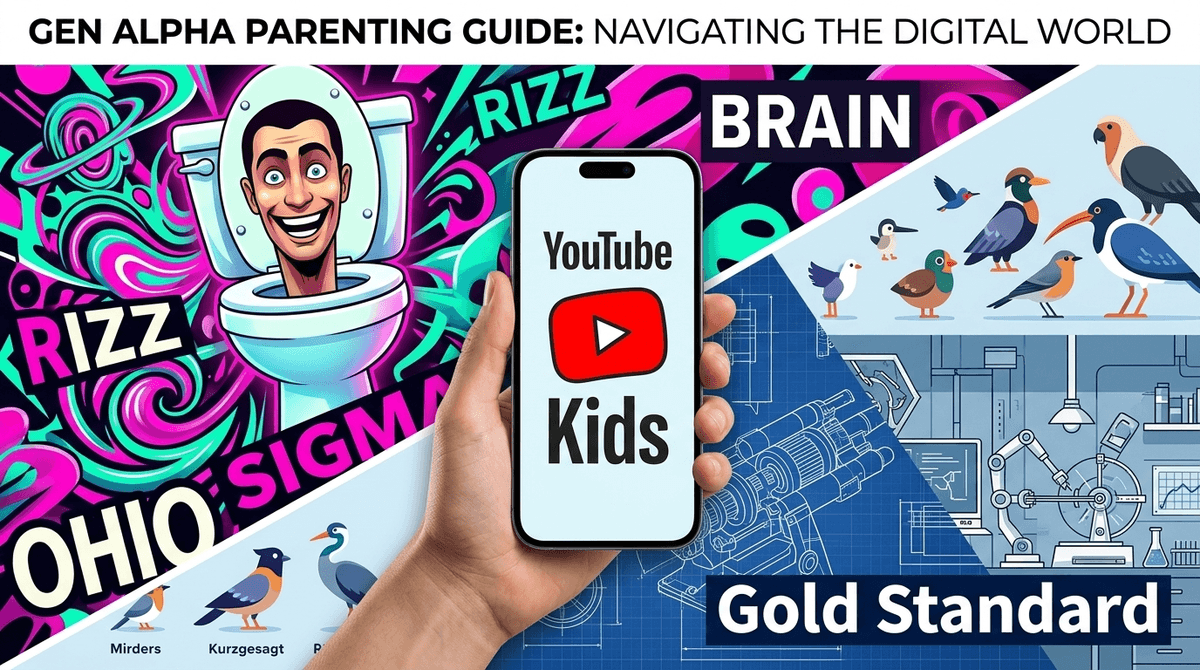
TL;DR: If your kid is shouting "Skibidi!" or calling everything "Ohio," you’ve officially hit the "Brain Rot" era of YouTube. While mostly harmless surrealist humor, the hyper-stimulating pacing of these videos can turn your kid's brain into mush for an hour. We recommend swapping the high-octane junk for Mark Rober or Kurzgesagt.
Check out our guide on managing YouTube's algorithm
Find the best educational YouTube channels
If you’ve spent any time near a child between the ages of 5 and 12 recently, you’ve probably heard it. A rhythmic, slightly off-key song about a toilet. Or maybe your son just looked at a burnt piece of toast and said, "That is so Ohio."
Welcome to the weird, wild, and occasionally nauseating world of Gen Alpha YouTube.
As intentional parents, we’re trying to raise kids who are thoughtful, focused, and maybe—just maybe—don't think a singing head in a toilet is the peak of Western civilization. But here we are. Between Skibidi Toilet and the rise of "Brain Rot" content, the YouTube Kids app has become a surrealist fever dream.
Let’s break down what this stuff actually is, why your kids are obsessed with it, and how to steer them toward content that won't leave them with the attention span of a goldfish.
It sounds like a joke, but Skibidi Toilet is a legitimate cultural phenomenon. Created by a YouTuber named DaFuq!?Boom!, it started as a short video of a head popping out of a toilet singing a mashup of "Give It To Me" and "Skibidi Dop Dop Yes Yes."
It has since evolved into a massive, wordless saga involving a war between the "Toilets" and the "Cameraheads" (men with cameras for heads).
The No-BS Take: It’s weird. It’s loud. It’s gritty. It’s basically "Michael Bay meets a plumbing nightmare." While it’s not inherently "evil," it is the definition of high-stimulation content. There’s no dialogue, just constant action and loud noises. It’s the visual equivalent of eating a bag of Sour Patch Kids for breakfast.
You might hear the term "Brain Rot" used by older kids (and even the creators themselves) to describe this specific genre of YouTube. It refers to content that is nonsensical, fast-paced, and designed purely to trigger dopamine hits.
Here is your quick Gen Alpha to English dictionary:
- Ohio: Used to describe something weird, cringey, or chaotic (e.g., "Only in Ohio").
- Rizz: Short for "charisma" (specifically romantic appeal).
- Sigma: Someone who is "alpha" or "cool" but independent (often used ironically).
- Fanum Tax: Stealing a bit of someone’s food (don't ask, it’s a Twitch thing).
- Gyatt: A slang exclamation often used inappropriately regarding someone's appearance (this is one to watch out for).
When kids consume hours of LankyBox or PrestonPlayz, they start talking in these memes. It’s a way of signaling they are part of the "in-group" of the internet.
Kids have always loved potty humor. From Captain Underpants to Ren & Stimpy, the "gross-out" factor is a developmental rite of passage. It feels rebellious and silly.
However, the difference today is the delivery mechanism.
On YouTube, the algorithm is designed to keep kids watching. If they watch one Skibidi Toilet video, they’ll get ten more. This creates a "loop" where the brain gets used to a level of stimulation that real life—and even high-quality TV like Bluey—simply can’t match.
The concern isn't just the toilets; it's the pacing. Research suggests that hyper-fast editing and constant "jumpscares" can make it harder for kids to focus on slower, more meaningful tasks (like reading a book or finishing a puzzle).
Not all YouTube is created equal. Here’s a breakdown of what’s currently trending and where it lands on the "Brain Rot" scale.
The "Brain Rot" Tier (Proceed with Caution)
- Ages 9+ (mostly because of the eerie visuals and violence). It’s surreal and addictive. It’s not educational, and the "lore" is paper-thin. It’s the ultimate "junk food" media.
- Ages 5-10. These guys are the kings of high-energy screaming. They react to games like Roblox and Garten of Banban. Honestly? It’s exhausting to watch as an adult. It’s incredibly loud and focuses heavily on "clickbait" thumbnails.
- Ages 0-3. Even for the littles, the pacing here is controversial. It’s been called "toddler crack" because of the fast scene cuts.
The "Better" Tier (Engaging but Quality)
- Ages 10+. While still very high-energy and "stunt" focused, there’s often a narrative of philanthropy or massive creativity. It’s still "fast food," but maybe it’s a decent burger instead of a bag of sugar.
- Ages 6+. Great "clean" entertainment. It’s trick shots and friendly competition. It’s high energy, but it encourages kids to actually go outside and try things.
The "Gold Standard" Tier (Actually Good for Them)
- Ages 8+. Former NASA engineer making science incredibly cool. This is the antidote to brain rot. It’s smart, funny, and educational.
- Ages 10+. Beautifully animated videos about science, space, and philosophy. It moves at a pace that allows for actual thought.
- Ages 3-8. Famous actors reading children's books. It’s calm, literary, and a perfect use of a screen.
If your kid is already deep in the toilet-head trenches, don't panic. You don't have to go full "tech-prohibitionist," but you can set some guardrails.
- Use the "Block" Feature Ruthlessly: On YouTube Kids, you can block specific channels. If LankyBox makes your kid act like a caffeinated squirrel, block it.
- Switch to "Approved Content Only": In the settings of YouTube Kids, you can change the setting so your child can only watch channels you have hand-selected. This is a game-changer for intentional parents.
- Talk About the "Why": Ask your kid, "Why do you think that’s funny?" or "How do you feel after watching 30 minutes of that?" You’d be surprised—sometimes they realize it makes them feel "fuzzy" or "grumpy" too.
- The "One for One" Rule: For every "Brain Rot" video they watch, they have to watch one educational or high-quality video (like National Geographic Kids).
Skibidi Toilet and its "Brain Rot" cousins are a weird byproduct of an algorithm that rewards the loudest, strangest content. It’s the modern version of the gross-out cartoons we probably watched as kids, just accelerated to warp speed.
The goal isn't necessarily to ban it—which often just makes it more alluring—but to contextualize it. It’s digital candy. A little bit is a treat; a diet of nothing else will make them sick.
Keep the conversation open, keep the "Approved Content" list updated, and maybe, just maybe, we’ll survive the "Ohio" era together.
- Audit their feed: Spend 10 minutes sitting with them while they scroll. What's the "vibe" of the recommendations?
- Set a "Fast" vs. "Slow" media balance: Encourage "slow" media like The Wild Robot by Peter Brown to balance out the YouTube Shorts.
- Update your settings: If you haven't checked your YouTube parental controls in a while, now is the time.