The 200-billion-view juggernaut of 3D nursery rhymes that hypnotizes toddlers into brushing their teeth while driving adults slowly up the wall.
Cocomelon
YouTube
2006, "nursery, rhymes"
48%
WISE Score
199.0M
Subscribers
The 200-billion-view juggernaut of 3D nursery rhymes that hypnotizes toddlers into brushing their teeth while driving adults slowly up the wall.
Jump to
Also rated on
199.0M
Screenwise Verdict
With nearly 200 million subscribers and over 212 billion views, CoComelon is the undisputed heavyweight champion of toddler hypnosis. The premise is dead simple: big-headed 3D baby JJ and his family sing cheerful, repetitive songs set to nursery rhyme melodies about eating vegetables, taking baths, and going to the doctor. If you need fifteen uninterrupted minutes to make dinner or trim a squirming toddler's fingernails, it works like a tranquilizer dart.
The trade-off is that it is engineered like a slot machine for two-year-olds. Every shot pans, zooms, or cuts every couple of seconds, and the colors are cranked to maximum saturation. It is not dangerous, and the lessons are entirely benign, but it is pure sensory overload with zero storytelling nutrition. If it is in your rotation, treat it like a specific tool—put on a single three-minute song about brushing teeth or use the audio-only versions—rather than letting the YouTube algorithm feed them a two-hour compilation.
Age Fit
Built strictly for the 1-to-4 crowd. By age 4 or 5, kids almost universally age out of the babyish repetition and want real stories, and no adult on earth is putting this on for their own enjoyment.
WISE Breakdown
Wholesome
68
The content itself is pure preschool friendliness—JJ, Cody, and Nina sing about eating vegetables, sharing, and brushing teeth with zero mean-spiritedness. The score takes a hit for the relentless, hyper-saturated pacing and rapid camera cuts, which are engineered to glue toddlers to the screen rather than offer a calm, balanced viewing experience.
Imaginative
25
Formulaic, assembly-line 3D animation paired with endlessly recycled public-domain nursery rhyme melodies. It models literal daily routines rather than sparking curiosity, creative play, or original storytelling.
Safe
82
The videos themselves are completely G-rated and built specifically for toddlers, with zero inappropriate themes, scares, or mature humor. However, watching it on standard YouTube introduces platform baggage: ad breaks, endless marathon compilations, and autoplay that can easily drift into weird knockoff nursery rhyme channels if not locked down on YouTube Kids or Netflix.
Enriching
40
There is basic utility here for toddlers learning words, colors, and hygiene habits like potty training or handwashing. Beyond those surface-level routine songs, it is cognitive empty calories with no narrative depth or emotional complexity.
Parent Info
✓
Why It Might Be Great
Routine reinforcement is the channel's real superpower: songs about potty training, eating peas, and getting into bed give toddlers catchy mantras for daily transitions they usually fight.
Zero scary surprises inside the actual episodes, where characters like JJ, Cody, and Nina live in a relentlessly cheerful world of primary colors and polite cooperation.
Early vocabulary repetition pairs simple, visual actions with basic words and counting, which can help young toddlers map words to everyday objects.
⚠
What to Watch For
Relentless camera movement and 1-to-3-second cuts keep the screen in constant motion, creating a hypnotic trance that makes turning the screen off much harder than with slower-paced preschool shows.
Hour-long marathon compilations on the YouTube channel string three-minute songs into endless loops, bypassing natural stopping points.
Copycat channels in the YouTube sidebar mimic the exact 3D art style to catch autoplay drift, so watching via standard YouTube without curation can quickly lead off-brand.
Conversation Starters
"JJ was nervous about his first day of school in that song—what helps you when we go somewhere new?"
"Let's sing the clean-up song together while we put these blocks in the bin."
"Which song should be our last one before we turn the TV off and go outside?"
Deep Dive
Why toddlers stare at it like zombies
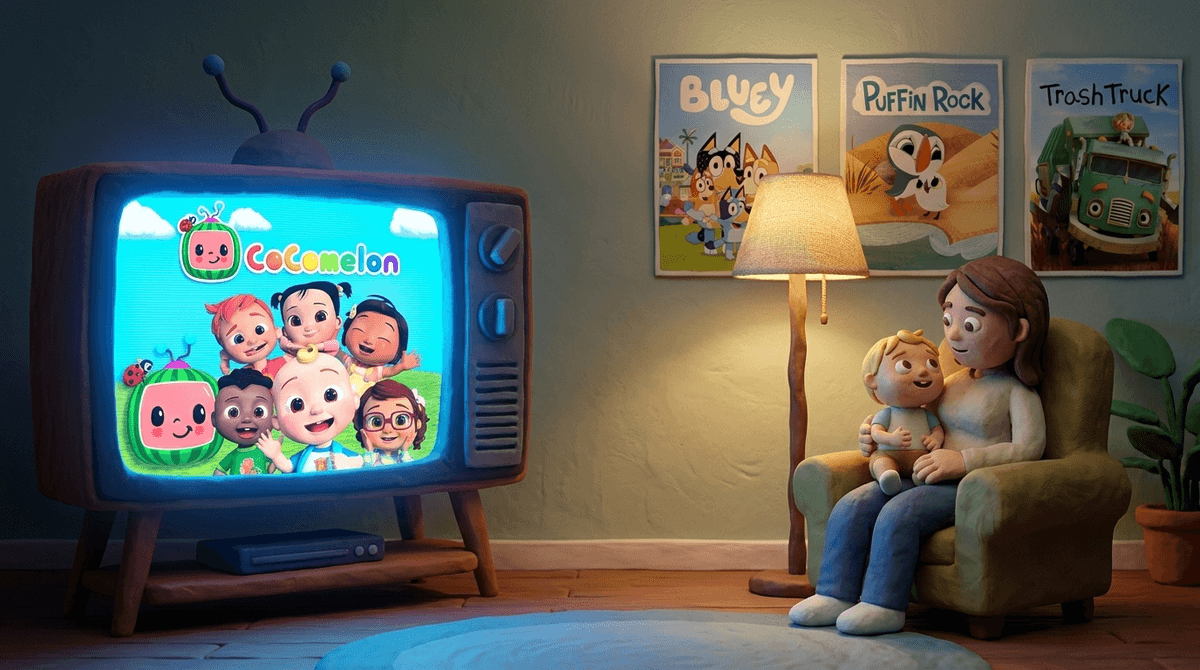
Put CoComelon next to Bluey, Daniel Tiger, or Trash Truck, and the difference isn't the morals—it's the editing bay. Traditional preschool television holds a static camera shot for five to ten seconds so a young kid's brain can process where characters are in the room and what they are feeling. CoComelon rarely sits still for more than two or three seconds. Even when nobody is moving, the virtual camera is constantly drifting, zooming in on JJ's giant eyes, or bouncing to the beat.
That constant visual refresh triggers a toddler's orienting response—the involuntary reflex to look at new movement. That is why a kid watching CoComelon often looks completely zoned out, and why they get so irritable when you hit pause. The show isn't teaching them to follow a story; it is just ping-ponging their visual cortex.
How to use it without losing your mind
If CoComelon is already a staple in your house, you don't need to panic, and you don't need to stages a dramatic ban. A few practical tweaks change how it lands:
Use the audio album instead of the video. The songs are on Spotify and Apple Music. Playing the "Yes Yes Vegetables" or "Bath Song" track through a speaker gives you all the routine-reinforcement magic without the hyperactive 3D visuals.
Get off the main YouTube app. On standard YouTube, CoComelon's channel defaults to massive compilation videos and ad breaks. If they are going to watch, pull up a single short playlist, or watch it on a platform where you can set an episode limit.
Pivot to slower alternatives. If you want the same gentle, zero-scare preschool vibe with pacing that lets a kid breathe, try Ms. Rachel for real human faces and speech modeling, Trash Truck or Puffin Rock for calm storytelling, or Super Simple Songs for 2D nursery rhymes that don't cut every two seconds.