

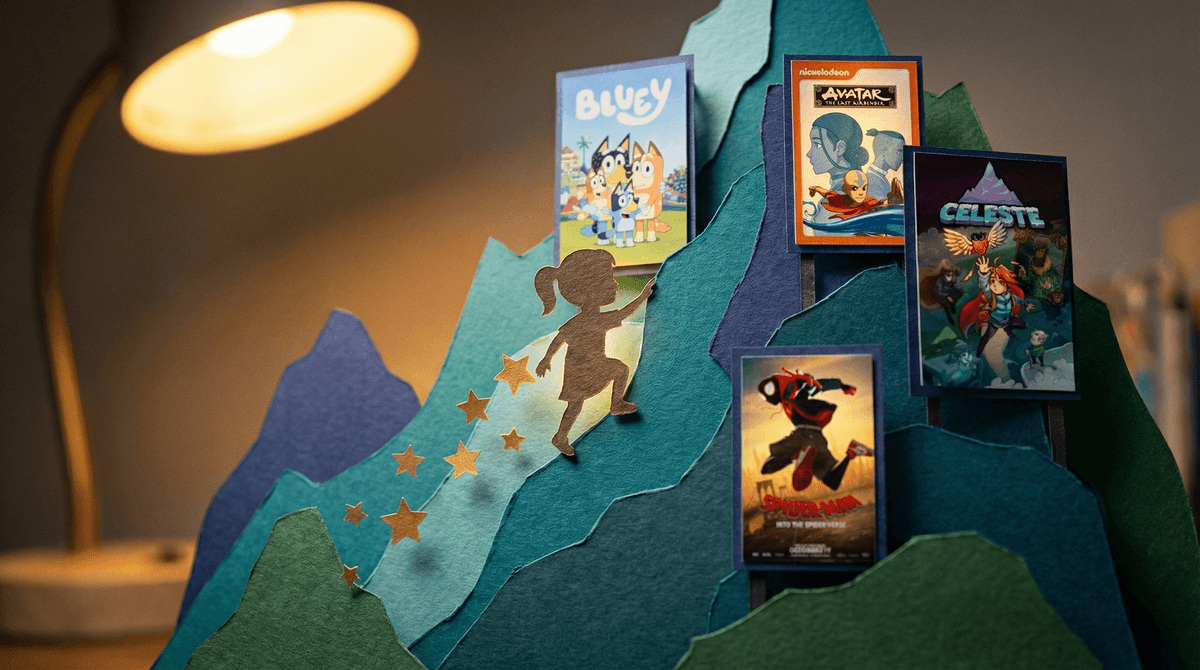
Look, we all know the guilt spiral: They're watching TV again. They're on their iPad. They've been gaming for an hour. But here's something that might ease the mental load a bit—screen time doesn't have to be a character-building black hole. Actually, the stories our kids consume through media can be incredibly powerful teaching tools for perseverance, grit, and bouncing back from failure.
The trick isn't eliminating screens (because, let's be real, that's not happening). It's about being intentional with what they're watching and playing, and then—this is the key part—actually talking about it with them.
Stories have always been how humans teach values. We just used to do it around campfires instead of 65-inch TVs. The reason media is so effective for teaching perseverance is that kids get to see failure and struggle in a safe context. They watch characters mess up, feel the emotional weight of it, and then witness the process of trying again.
Plus, kids are way more likely to open up about hard stuff when you're talking about a character's problems instead of their own. "Wow, Moana really didn't give up even when she failed at sailing" is a much easier conversation starter than "So, tell me about why you quit soccer after one hard practice."
Not all screen time is created equal here. You want stories where:
- Failure is part of the plot, not just a quick bump resolved in 30 seconds
- Characters have to practice or train to get better at something
- Success isn't immediate or magical—there's actual work shown
- Emotions around failure are realistic—frustration, disappointment, wanting to quit
- The "trying again" part is explicit, not just implied
Basically, you're looking for the opposite of those shows where the protagonist is naturally gifted at everything and wins without effort. (Looking at you, 90% of Disney Channel originals.)
Ages 4-7: Building the Foundation
Bluey is genuinely brilliant for this age. Episodes like "Bike" (where Bluey learns to ride without training wheels) and "Hammerbarn" show realistic frustration and the messy process of learning. The show doesn't shy away from kids getting upset when things are hard.
Encanto gives you Mirabel dealing with not having powers in a family where everyone else does—talk about perseverance in the face of feeling "less than." The whole movie is about her not giving up on herself or her family.
Daniel Tiger's Neighborhood is almost aggressively educational about this stuff, with literal songs about "keep trying, you'll get better." It's not subtle, but for this age group, that's actually perfect.
Ages 8-12: Getting Real About Struggle
Hilda on Netflix shows a protagonist who constantly gets in over her head and has to figure things out. She makes mistakes, faces real consequences, and keeps going. Plus it's just beautifully made.
The Mitchells vs. The Machines is about a family that's kind of a disaster, and they have to work together despite failing repeatedly. Katie's journey as a filmmaker who keeps creating despite rejection is particularly good.
Avatar: The Last Airbender (the show, not the movie—the movie is simply unwatchable) is the gold standard here. Aang has to master four elements, and we watch him struggle, fail, get frustrated, and keep training. Zuko's entire arc is about perseverance through failure and redemption.
Inside Out and Inside Out 2 both deal explicitly with uncomfortable emotions and working through hard situations rather than avoiding them.
Ages 13+: Complex Perseverance
The Queen's Gambit shows Beth studying, practicing, losing games, and dealing with addiction—it's not a simple "talent wins" story. (Note: has mature content, but most teens can handle it with context.)
Spider-Man: Into the Spider-Verse and Across the Spider-Verse explicitly show Miles learning to be Spider-Man through repeated failure. "Anyone can wear the mask" is literally about perseverance.
Ted Lasso is surprisingly great for this—it's about a coach (and team) that loses constantly but keeps showing up with optimism and effort. Has some language and adult themes, but seasons 1-2 are genuinely uplifting.
Okay, controversial take incoming: video games might actually be better than passive media for teaching perseverance. Why? Because kids have to actively engage with failure and trying again. They can't just watch someone else do it.
Celeste is literally about climbing a mountain while dealing with anxiety and depression. You die hundreds of times. The game counts your deaths and treats them as part of the journey, not failures. It's a masterclass in perseverance.
Minecraft in survival mode teaches resource management, planning, and recovering from setbacks (like when a creeper blows up your house—we've all been there).
Stardew Valley is about slowly building a farm through daily effort. Progress is incremental and requires sustained attention over time.
The Legend of Zelda: Breath of the Wild or Tears of the Kingdom let kids tackle challenges in different ways, fail, and try new approaches. The games reward experimentation and persistence.
Even Roblox obbys (obstacle courses) are basically perseverance training—kids fail the same jump 47 times until they get it right.
The media itself isn't enough. You need to create space for reflection and conversation. Here's how to do it without your kid rolling their eyes into another dimension:
During or Right After Watching/Playing
- Point out the struggle: "Whoa, she really messed that up, huh?"
- Name the emotion: "He looks so frustrated right now."
- Predict what might happen: "What do you think she'll do next?"
The Follow-Up Conversation (Keep It Light)
- "What was the hardest thing [character] had to do?"
- "How many times did they fail before they got it?"
- "What would have happened if they'd given up?"
- "Have you ever felt like that?"
Connect It to Real Life (But Not Immediately)
Don't do the thing where you immediately pivot to "Just like when YOU quit piano!" That's a trap. Instead, wait for a natural moment days later when they're struggling with something: "Remember how Moana had to learn to sail? This reminds me of that."
This isn't a magic fix. Watching Rocky won't suddenly make your kid a gritty go-getter. But repeated exposure to stories about perseverance, combined with conversations that help them process those stories, absolutely does build mental frameworks for handling their own challenges.
Your own commentary matters. If you're constantly saying "This is taking forever" or "Why is this so hard?" during your own tasks, that undercuts everything. Kids are watching how YOU handle frustration and failure too.
Some kids need more processing time. Not every kid wants to have a deep conversation right after finishing a show. Some need to sit with it for a while. That's fine. Plant the seed and let them come back to it.
Be honest about entertainment value. Not everything has to be a teaching moment. Sometimes they're just watching Nailed It! because it's funny (though that show is actually great for normalizing failure in a low-stakes way). Balance is key.
Screen time gets a bad rap, and sure, mindless consumption isn't great. But intentionally chosen media, combined with actual parental engagement, can be a legitimate tool for teaching perseverance. The key word there is intentional.
You're not trying to turn every episode into a life lesson. You're just being thoughtful about what stories are entering your kid's brain and occasionally helping them connect those stories to their own lives.
- Pick one show or game from the list above that fits your kid's age and interests
- Watch or play it together (at least the first episode or session)
- Try one conversation starter from the list—just one, don't overdo it
- Notice what your kid gravitates toward in terms of characters and storylines
- Build from there
Want more specific recommendations based on your kid's interests? Find media that teaches perseverance for personalized suggestions.
And if you're wondering whether all this screen time is still "too much" overall, check out our guide on healthy screen time limits by age—because context matters.