

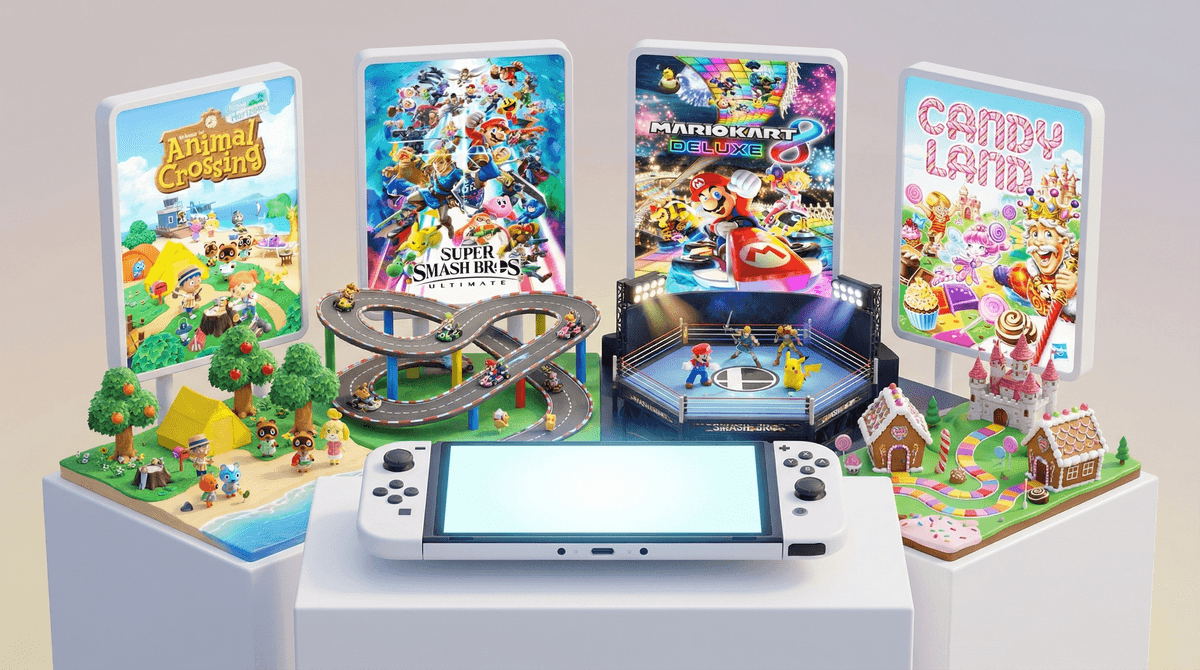
The Nintendo Switch is that hybrid gaming console that's been dominating wish lists since 2017. It works as both a home console (plugged into your TV) and a portable handheld device, which is honestly genius from a "keeping kids entertained on road trips" perspective.
Unlike PlayStation or Xbox, Nintendo has always leaned into family-friendly gaming, which means the Switch library is packed with games that won't make you cringe when you walk by the screen. But here's the thing: not all Switch games are created equal, and "family-friendly" doesn't automatically mean "worth your money or your kid's time."
The Switch comes in a few versions: the original Switch (docks and goes portable), the Switch Lite (handheld-only, cheaper), and the Switch OLED (prettier screen, more expensive). Any version can play the same games, which makes your buying decision more about budget and whether portability matters to your family.
Let's be real: kids love the Switch because it's actually portable (unlike those "portable" gaming laptops that weigh 10 pounds), has games their friends are playing, and Nintendo knows how to make games that are genuinely fun without relying on loot boxes and battle passes.
The social aspect is huge too. Games like Mario Kart 8 Deluxe and Super Smash Bros. Ultimate are go-to choices for playdates and family game nights. Multiple kids can play together on one Switch (with extra controllers), or they can connect multiple Switch consoles for multiplayer chaos.
Also? The Switch doesn't have the always-online, voice-chat-with-strangers setup that makes platforms like Roblox or Fortnite feel like parenting minefields. Most Switch games are single-player or local multiplayer experiences, which means less stranger danger and more actual gameplay.
Ages 4-7: Gateway Games
Mario Kart 8 Deluxe - This is the gold standard starter game. The "auto-accelerate" and "smart steering" features mean even preschoolers can actually play without constant frustration. Plus, you can turn these assists off as kids get better, so the game grows with them.
Kirby and the Forgotten Land - Adorable, forgiving, and has a co-op mode where a second player can help without the game becoming impossible. Kirby games are designed for younger players but don't feel condescending.
Pokémon: Let's Go, Pikachu/Eevee - Simplified Pokémon mechanics, cute graphics, and less overwhelming than the mainline Pokémon games. Good for kids who are into collecting and light strategy.
Paw Patrol games - Look, these aren't going to win Game of the Year awards, but if you have a Paw Patrol-obsessed kid, these games are fine. They're simple, they work, and they'll buy you 30 minutes of peace.
Ages 8-11: Building Skills
Minecraft - Yes, it's on Switch, and yes, it's still the creativity powerhouse you've heard about. The Switch version is great because it's portable but also has split-screen multiplayer on the TV. Learn more about Minecraft here.
The Legend of Zelda: Breath of the Wild - This is where things get serious. BOTW is one of the best games ever made (full stop, not just for kids), and it teaches problem-solving, exploration, and persistence. There's combat, but it's not graphic. Best for confident readers and kids who don't get frustrated easily. Some 8-year-olds are ready, some 11-year-olds aren't—you know your kid.
Animal Crossing: New Horizons - The cozy game that took over 2020. Kids design their island, catch bugs, fish, and interact with adorable animal villagers. It's creative, it's chill, and there's no way to "lose." The real-time clock mechanic (the game matches real-world time) can be either charming or annoying depending on your family's schedule.
Super Mario Odyssey - Classic 3D platforming that's accessible but has depth. Younger kids can enjoy exploring and collecting, while older kids can chase the harder challenges. This is the game that justifies buying a Switch.
Splatoon 3 - Nintendo's take on online multiplayer shooters, except you're shooting ink, not bullets, and you're playing as squid kids. It's colorful, fast-paced, and actually requires strategy. Note: This one does have online play, so you'll want to use Nintendo's parental controls to manage who kids can interact with.
Ages 12+: Leveling Up
The Legend of Zelda: Tears of the Kingdom - The sequel to Breath of the Wild, and somehow even better. This is a 100+ hour epic adventure with complex physics puzzles and creative problem-solving. If your kid loved BOTW, this is the next step.
Hollow Knight - A challenging, beautiful exploration game. Fair warning: this game is HARD. It requires patience, pattern recognition, and the ability to handle failure. Not for every kid, but for the right kid, it's incredible.
Stardew Valley - Farming simulator meets life sim meets dungeon crawler. It's cozy like Animal Crossing but with more depth and systems. Kids can farm, fish, mine, build relationships, and design their farm. Hundreds of hours of gameplay for $15.
Hades - A roguelike action game with Greek mythology themes. There's combat (stylized, not realistic), some mild language, and mature themes. But the storytelling is phenomenal, and the gameplay loop is incredibly satisfying. For mature 12+ kids who can handle the difficulty and themes.
The Nintendo Switch Online subscription ($20-$50/year depending on the plan) is required for most online multiplayer, but honestly, many of the best Switch games don't need it. If your kid just wants to play Mario Odyssey, Zelda, and local multiplayer Mario Kart, you don't need the subscription.
Physical vs. digital games: Physical cartridges can be shared, traded, and resold. Digital games are convenient and can't be lost, but they're tied to your account forever. For younger kids who might lose things, digital makes sense. For older kids who want to trade games with friends, physical is better.
Parental controls are actually good: Nintendo's parental control app (free) lets you set daily play limits, restrict online features, and get reports on what your kids are playing and for how long. It's not perfect, but it's better than most gaming platforms. Set up parental controls here.
Screen time reality check: The Switch doesn't have the same addictive, never-ending content loops as free-to-play games. Most Switch games have natural stopping points—you finish a level, you complete a quest, you save your progress. This makes it easier to enforce "one more level, then we're done" boundaries.
The eShop is full of garbage: Nintendo's digital store has thousands of games, and many of them are low-quality shovelware. Stick to games with good reviews or recommendations from trusted sources (like, you know, Screenwise). Just because it's $2 doesn't mean it's worth your kid's time.
Fortnite on Switch - Yes, it's free. Yes, it's popular. But the Switch version runs poorly compared to other platforms, and you're still dealing with all the Fortnite concerns about microtransactions, voice chat, and endless gameplay loops. If your kid is going to play Fortnite, the Switch is honestly the worst way to do it.
Most movie/TV tie-in games - With rare exceptions, these are cash grabs. The Paw Patrol games are fine for really young kids, but most licensed games are low-effort and overpriced.
Anything with loot boxes or gacha mechanics - These are less common on Switch than on mobile or PC, but they exist. If a game is free-to-play on the Switch, it's probably built around getting kids to spend money on random chance rewards. Hard pass.
The Nintendo Switch is probably the best gaming console for families right now. The game library is genuinely excellent, the parental controls actually work, and the hybrid portable/TV setup is more useful than you'd think.
The sweet spot: Get the regular Switch (not the Lite) so you have flexibility, start with Mario Kart 8 Deluxe and Super Mario Odyssey, and then add games based on your kid's interests and skill level.
Budget reality: Switch games rarely go on sale, and first-party Nintendo games stay at $60 basically forever. But these games also hold their value, so you can resell physical copies when your kids are done with them. Or, you know, just keep them for the next kid or for yourself, because honestly, these games are fun for adults too.
The Switch isn't going to teach your kid to code or solve world hunger, but it's going to give them actually enjoyable screen time that doesn't make you feel like a bad parent. And in 2026, that's worth something.
- New to Switch? Start with this guide to setting up your Switch for kids
- Want more game ideas? Check out alternatives to Minecraft or cozy games for kids
- Worried about screen time? Read about how to set healthy gaming boundaries