

TL;DR
Gaming isn't the brain-melting "rot" we were told it was. Recent research (like the massive ABCD Study) suggests gaming can actually boost IQ by about 2.5 points and improve spatial memory. But—and it's a big "but"—the business of gaming, specifically the "freemium" models in apps like Roblox, is designed to turn your kid into a mini-gambler.
Quick Recommendations:
- For Creativity: Minecraft
- For Logic & Physics: Portal 2
- For Emotional Regulation: Stardew Valley
- For High-Speed Coordination: Rocket League
If you’ve ever wondered why your kid is willing to spend three hours "working" a virtual pizza oven in Roblox but won't unload the actual dishwasher, you're not alone.
For kids today (Gen Alpha and Gen Z), gaming isn't just a hobby; it’s their social infrastructure. About half of all American kids under 16 are on Roblox every month. It’s where they hang out, where they learn the slang (yes, including "Ohio" and "Skibidi"), and where they establish their social hierarchy.
But as parents, we're constantly oscillating between "Wow, look at that elaborate castle they built!" and "If I hear that 'Oof' sound one more time, I’m throwing the iPad into the sun."
Let’s look at what’s actually happening in that developing brain.
The research has shifted significantly in the last few years. We used to worry that gaming made kids "zombie-like." Now, neuroscientists are finding that active gaming—where the kid is making decisions, not just passively watching—is a workout for the frontal lobe.
A massive 2024 study of nearly 10,000 children found that those who played video games for at least an hour a day showed higher gains in general intelligence (about 2.5 IQ points) over a two-year period compared to kids who didn't play. This isn't because the games are "teaching" them facts, but because they are practicing visual-spatial processing, working memory, and flexible thinking.
Games like The Legend of Zelda: Tears of the Kingdom or LEGO Builder's Journey require kids to fail. A lot. They have to troubleshoot, iterate, and try again. This builds a "growth mindset" in a low-stakes environment. When they finally beat that boss or finish that bridge, the sense of competence and autonomy is a massive boost to their psychological well-being.
This is where we have to be the "no-BS" friend. While the act of gaming can be great, the economics of modern games are often predatory.
The Robux Trap
Is Roblox teaching entrepreneurship? Technically, yes—kids can learn to code in Lua and design their own "experiences." But for 99% of kids, it’s a sophisticated system designed to drain the bank account.
The use of virtual currency like Robux is a "dark pattern." It creates a psychological barrier between the kid and the actual money. When they spend 400 Robux on a "Limited Edition" digital hat, they don't feel the "sting" of spending $5.00.
Learn more about how Robux is in fact real money
The Dopamine Loop
Many mobile games are built on "the grind." They use variable reward schedules—the same mechanism used in slot machines—to keep kids coming back. If your kid is getting aggressive or "hangry" when it’s time to get off the screen, it’s often because the game is artificially spiking their dopamine, making the real world feel incredibly dull by comparison.
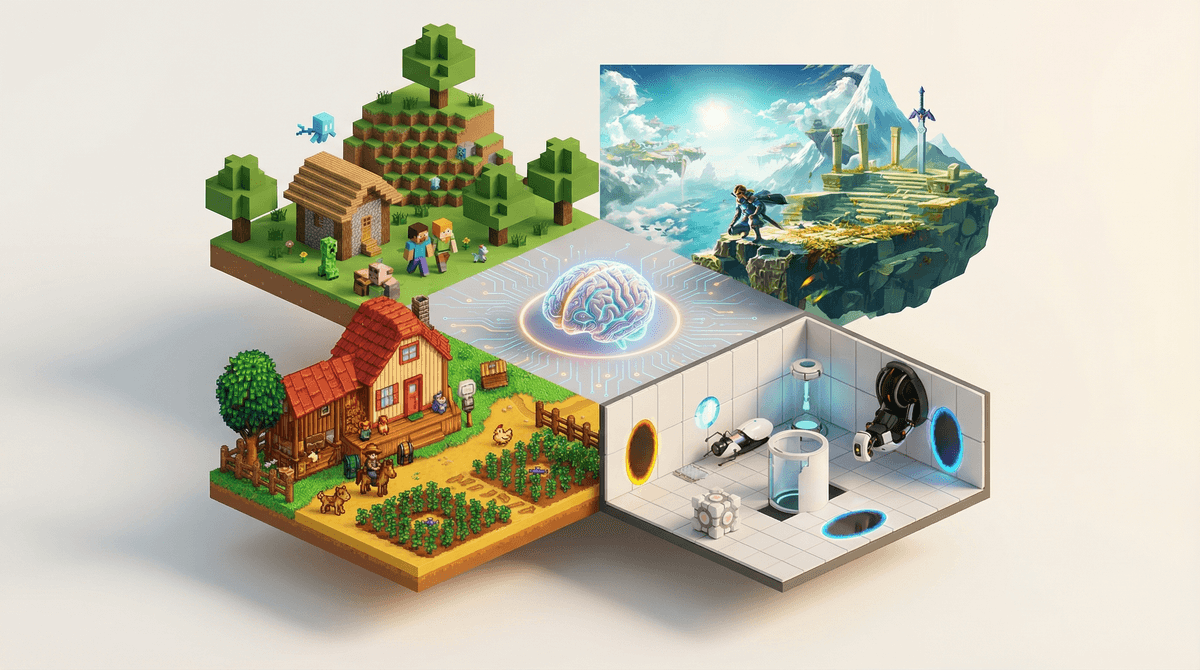
If you want to move your kid away from "brain rot" and toward games that actually offer developmental value, here are our top picks:
Minecraft (Ages 7+)
The gold standard. It’s essentially "Digital Legos." Whether they are playing in Creative Mode (building) or Survival Mode (resource management and logic), they are engaging the creative parts of their brain.
- Best for: Spatial awareness, geometry, and collaboration.
Portal 2 (Ages 10+)
This is arguably one of the best puzzle games ever made. It requires kids to think in 3D and understand physics-based momentum. Plus, the humor is actually funny for adults, too.
- Best for: Critical thinking and logic.
Stardew Valley (Ages 8+)
A "cozy game" where you run a farm. It’s slow-paced, requires long-term planning, and focuses on building relationships with NPCs (non-player characters).
- Best for: Emotional regulation and delayed gratification.
Rocket League (Ages 6+)
Soccer with cars. It’s fast, it’s difficult to master, and it requires intense hand-eye coordination. It’s also one of the few "eSports" that is truly age-appropriate for younger kids.
- Best for: Motor skills and teamwork.
- Ages 5-8: Focus on local co-op (playing together on the couch). Games like Mario Kart 8 Deluxe are perfect for this. Limit "unboxed" social platforms like Roblox.
- Ages 9-12: This is the peak "Roblox and Fortnite" era. Set hard boundaries on in-app purchases. Use this time to introduce games with a beginning, middle, and end (narrative games) so they learn that gaming doesn't have to be an endless loop.
- Ages 13+: They will likely be playing whatever their friends are playing. Focus on digital citizenship—how they treat people in voice chat and how they manage their own time.
The biggest risk isn't the game itself—it’s the opportunity cost. If gaming is replacing sleep, exercise, or face-to-face social time, that’s when development takes a hit.
Watch out for:
- Loot Boxes: These are essentially gambling. If a game asks for money for a "chance" to get a rare item, it’s a red flag.
- Unmoderated Chat: In games like Roblox, "bad actors" are a real concern.
- The "Never-Ending" Game: Games that don't have a natural stopping point (like Fortnite) are much harder for kids to walk away from than a level-based game.
Instead of "Get off that game, it's rotting your brain," try:
- "Show me what you built in that world today." (Validates their effort)
- "That game seems really frustrating right now. Do you need a 'reset' break?" (Teaches emotional awareness)
- "How much does that skin cost in real dollars? Is it worth two movie tickets?" (Teaches financial literacy)
Gaming is a tool. In the right hands (and with the right titles), it’s a powerful engine for IQ growth, spatial reasoning, and social connection. In the wrong hands (predatory developers), it’s a vacuum for your time and money.
Your job isn't to be the "screen police"—it's to be the curator. Move them toward games that respect their time and challenge their brains, and keep a very close eye on the "free" games that come with a hidden price tag.
- Audit the "Grind": Check if your kid is playing games that feel like a job (daily login bonuses, endless tasks).
- Play Together: Sit down for 20 minutes of Minecraft. You’ll learn more about their digital world in those 20 minutes than in any blog post.
- Set a "No-Buy" Rule: Make in-game purchases a "birthday or chore money only" thing to break the impulse-buy habit.