

TL;DR: The Quick List
If you’re looking to swap "zombie scrolling" for actual cognitive heavy lifting, here are the heavy hitters:
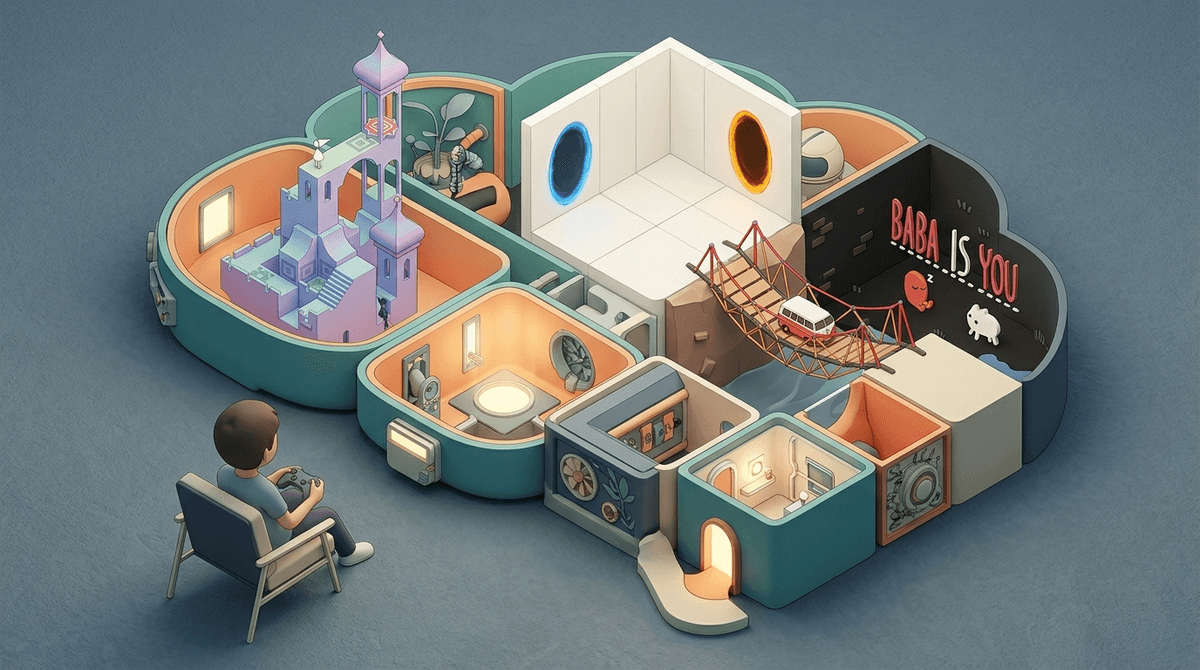
- Best for Spatial Logic: Portal 2 (Ages 10+)
- Best for Coding Mindsets: Baba Is You (Ages 7+)
- Best for Engineering & Physics: Poly Bridge 3 (Ages 9+)
- Best for Visual Puzzles: Monument Valley (Ages 5+)
- Best for High-Stakes Logic: Return of the Obra Dinn (Ages 13+)
Find a game recommendation based on your kid's interests
We’ve all been there: you look over at your kid and they are deep in the "Skibidi" trenches. Their eyes are glazed over, they’re watching a YouTube Short of someone playing a mobile game while a split-screen shows a person reacting to a sandwich being made, and you’re wondering if their frontal lobe is just... melting.
But then there’s the other kind of screen time. The kind where they’re staring at a bridge that keeps collapsing in a simulator, muttering about "structural integrity" and "load-bearing joints." That’s the sweet spot.
Single-player games are often the unsung heroes of digital wellness. While multiplayer games like Roblox or Fortnite offer social connection (and a lot of "Ohio" memes), they also bring the stress of toxic lobbies and the pressure to buy the latest skins. Single-player games, however, are a private laboratory for the brain. They teach the "grit" we’re always hearing about—the ability to fail, analyze why, and try again without a 12-year-old in another state calling you "trash" in a headset.
Most viral mobile games are designed around dopamine loops—quick, shallow rewards that keep you clicking. Problem-solving games are designed around the "flow state." This is that magical zone where a challenge is just hard enough to be frustrating but just easy enough to be solvable.
When a kid beats a level in Portal 2, they aren't just getting a digital trophy; they are proving to themselves that they can wrap their head around complex 3D physics. That "aha!" moment is the ultimate antidote to brain rot.
Ages 10+ If there is a "Gold Standard" for problem-solving, this is it. You have a "portal gun" that shoots two connected holes in space. You go in the blue one, you come out the orange one. It sounds simple until you’re falling through the ceiling to gain enough momentum to launch yourself across a massive chasm.
- The Skill: Spatial reasoning and physics. It forces kids to think in three dimensions and understand "momentum" in a way a textbook never could.
- The Vibe: Hilarious, slightly dark (the AI, GLaDOS, is a masterpiece of passive-aggressive humor), and incredibly rewarding.
Ages 7+ This game looks like it was made on a Commodore 64 in 1985, but don’t let the simple graphics fool you. It’s a logic puzzle where the rules of the game are physical objects you can move. If the screen says "Wall is Stop," you can move the blocks so it says "Wall is Push," and suddenly you can walk right through the scenery.
- The Skill: Computational thinking and "breaking the box." It’s essentially coding for kids without the actual syntax. It teaches them that the rules of a system can be manipulated if you understand the logic behind them.
- The Vibe: Quiet, intense, and occasionally makes you feel like the smartest person on earth—or the dumbest, until it clicks.
Ages 5+ This is the perfect "entry-level" problem solver. It’s based on M.C. Escher-style impossible geometry. You rotate the world to create paths that shouldn't exist.
- The Skill: Visual perception and perspective-shifting.
- The Vibe: Extremely "cozy." There’s no timer, no "Game Over," and the music is incredibly soothing. It’s the digital equivalent of a Zen garden.
Ages 9+ You are given a budget and some materials (wood, steel, cable) and told to get a car from point A to point B. Then the car gets heavier. Then a boat needs to pass under the bridge.
- The Skill: Engineering and resource management. Kids have to balance "Will this hold?" with "Can I afford this?" It’s a fantastic lesson in trial and error.
- The Vibe: Satisfyingly nerdy. Watching your bridge crumble into the water is actually half the fun because the physics engine shows exactly where the "stress" was too high.
Ages 12+ You’re dropped on a deserted island filled with hundreds of line puzzles. There are no instructions. You have to learn the "language" of the puzzles by observing the environment.
- The Skill: Pattern recognition and inductive reasoning. It’s one of the few games that treats the player like a genius, and kids often rise to the occasion.
- The Vibe: Beautiful, silent, and very challenging. Note: This one can be polarizing. Some kids love the mystery; others find the lack of direction "mid."
Ages 7+ You are the city planner. You have to draw roads to connect houses to businesses. As the city grows, traffic starts to back up. If the commute takes too long, the city shuts down.
- The Skill: Systems thinking. It’s about managing flow and anticipating problems before they become catastrophes.
- The Vibe: Clean, minimalist, and surprisingly stressful in a "just one more try" kind of way.
Check out our guide on the best strategy games for middle schoolers
When picking a game, consider your kid's frustration threshold.
- Ages 5-8: Stick to games like Monument Valley or Donut County. These are "low stakes"—you can’t really "lose," you just keep playing until you find the path.
- Ages 9-12: This is the prime time for Portal 2 or Minecraft (specifically Redstone engineering). They are starting to handle the "grit" of failing a level 10 times before succeeding.
- Ages 13+: They can handle the complex logic of Baba Is You or the narrative deduction of Return of the Obra Dinn.
If you see them stuck, the urge to jump in and show them the solution is real. Resist it. The learning isn't in the solution; it's in the struggle.
Instead of saying "Move the blue portal there," try:
- "What’s the actual goal of this level?"
- "What have you tried that didn't work? Why didn't it work?"
- "Do you think the environment is giving you a hint you haven't seen yet?"
If they get truly tilted (screaming at the screen, throwing the controller), it’s time for a "tactical break." Research shows that our brains often solve puzzles in the background while we’re doing other things. Tell them to go get a snack and come back in 20 minutes. Nine times out of ten, they’ll solve it within two minutes of sitting back down.
Not all screen time is created equal. While we tend to lump "gaming" into one big category, there is a massive difference between the passive consumption of TikTok and the active, rigorous mental workout of a top-tier puzzle game.
By steering our kids toward single-player games that reward logic, patience, and creative thinking, we’re not just giving them a hobby—we’re giving them a toolkit for solving problems in the real world. Because eventually, they’re going to run into a "Wall is Stop" situation in real life, and we want them to have the confidence to figure out how to change the rules.
- Pick one game: Based on the ages above, download one of these to a tablet or console.
- Play together (at first): Sit with them for the first 15 minutes. Let them be the "driver" while you act as the "navigator."
- Check the stats: Use Screenwise to see how other parents in your community are balancing these games with other activities.