

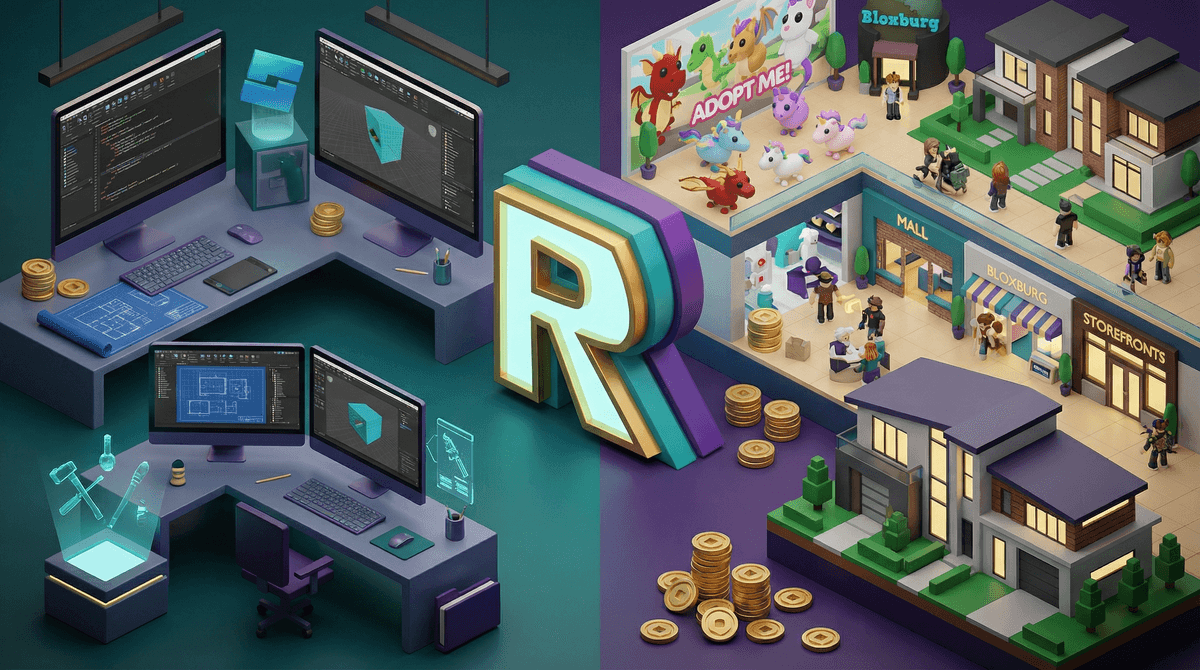
TL;DR
If you’re looking for a quick "yes" or "no" on whether Roblox is worth the screen time, the answer is: It’s a high-risk, high-reward digital ecosystem.
The ROI (Return on Investment) isn't found in the mindless "obby" (obstacle course) games or the latest "Skibidi Toilet" roleplay. The real value is found when kids move from being consumers to creators. If they are learning Roblox Studio or managing a complex social economy in Welcome to Bloxburg, they’re gaining real-world skills. If they’re just begging for Robux to buy a "preppy" skin or a virtual pet, you’re just funding a very sophisticated digital dopamine loop.
Quick Links for the ROI-Focused Parent:
- Best for Coding: Roblox Studio
- Best for Economy/Math: Welcome to Bloxburg
- Best for Creativity: Build a Boat for Treasure
- The Money Sink: Adopt Me!
Think of Roblox less as a game and more as a digital shopping mall/arcade hybrid where the stores are built by other kids and young adults. It is an engine that hosts millions of individual user-created experiences.
In your kid's grade, the data is likely staggering: roughly 75% of U.S. children ages 9–12 are on this platform. If your kid feels like "everyone" is on it, they aren't exaggerating. It’s the town square for Gen Alpha. They aren't just playing; they are hanging out, showing off "drip" (outfits), and speaking a language that sounds like "Ohio rizz" and "gyatt" (don't ask, or actually, Get a translation of Gen Alpha slang ).
).
The most legitimate "Return on Investment" for screen time in Roblox is technical literacy.
While most kids just play games, Roblox provides a free professional-grade development tool called Roblox Studio. It uses a coding language called Lua.
- The Skill: Logic, 3D modeling, and scripting.
- The ROI: This is a direct pipeline to computer science. A kid who spends three hours figuring out how to make a door open when a player touches a button is doing more for their brain than a kid doing a "math facts" worksheet.
- Next Step: If your kid loves Roblox, challenge them to build their own "obby." Check out our guide on moving from player to creator.
This is essentially "The Sims" inside Roblox. To build a house, you have to work a "job" (like delivering pizzas) to earn in-game currency.
- The Skill: Budgeting and delayed gratification.
- The ROI: They learn that if they want the "luxury" mansion, they have to grind for virtual hours. It’s a surprisingly effective lesson in labor vs. reward.
Now for the "BS" part. Roblox is built on Dark Patterns—design choices intended to trick or pressure users into spending money.
The primary currency is Robux. Because $1 doesn't equal 1 Robux (it’s more like 80-100 Robux per dollar depending on the pack), kids lose the "anchor" of what things actually cost. This is intentional.
This is one of the most popular games on the platform, and frankly, it's a masterclass in predatory design. It uses "loot boxes" (eggs) where you don't know what pet you'll get.
- The Risk: It creates a gambling-adjacent mindset. The "Legendary" pets are rare, creating a social hierarchy where kids who don't have the "Neon Shadow Dragon" feel inferior.
- The ROI: Zero. This is pure consumption and social signaling.
You’ll often hear parents say gaming teaches "leadership." In Roblox, this is true—if they are involved in complex roleplay or group management.
In games like Brookhaven, kids often organize elaborate social scenarios. While it might look like they're just driving virtual cars around, they are often navigating:
- Conflict Resolution: "No, you can't be the baby, I'm the baby this time."
- Social Hierarchy: Understanding group dynamics and digital etiquette.
- Entrepreneurship: Some kids actually "hire" other kids to work in their virtual cafes or help build their houses, paying them in Robux or in-game favors.
Roblox is rated E10+, but that's a bit of a joke because the content is user-generated. You can find everything from a "Pet Simulator" to a "Squid Game" recreation with blood and violence.
- Ages 6-9: High supervision. Use the "Account Restrictions" to limit them to curated, safe games. Keep chat off.
- Ages 10-12: This is the peak Roblox age. Focus on "Digital Citizenship." Talk about why someone might try to "scam" them for their pets.
- Ages 13+: If they are still on it, they should be moving toward Roblox Studio or exploring more complex games like Phantom Forces (a shooter, be warned).
The real danger in Roblox isn't usually a "predator in the bushes" (though that exists, and the chat filters are constantly being bypassed by "slender" avatars using "bypassed" language).
The real danger is financial exploitation and toxic social pressure.
- Scams: "Trust trades" where a kid gives away a pet hoping to get a better one back. They will get scammed at least once. Use it as a teaching moment about "if it sounds too good to be true..."
- The "Preppy" vs. "Bacon" Dynamic: Kids are bullied based on their avatar's appearance. "Bacon hairs" (the default free avatar) are often mocked. This is a digital version of the "wrong brand of sneakers" in the school hallway.
You’ve probably heard the term "Brain Rot" applied to things like Skibidi Toilet. There are thousands of Roblox games dedicated to these memes.
Our Take: These games are the digital equivalent of eating a giant bag of Skittles. They provide a quick hit of weird humor but have zero ROI. If your kid is spending 5 hours a day in "Skibidi Toilet Morphs," it’s time to pivot them toward something like Minecraft or Scratch, where the cognitive load is higher.
Instead of saying "Get off that garbage," try asking these three questions to gauge the ROI:
- "What are you trying to achieve in this game right now?" (Are they working toward a goal or just wandering?)
- "Did you make anything today, or just play what someone else made?" (Encourages the creator mindset.)
- "How do you feel when you run out of Robux?" (Starts a conversation about the emotional manipulation of the currency.)
Roblox is a tool.
- Used as a creative outlet (Roblox Studio), the ROI is massive—it’s a career-starting skill.
- Used as a social hangout (Brookhaven), the ROI is moderate—it’s just digital "playing outside."
- Used as a consumer trap (Adopt Me!), the ROI is negative—it’s draining your wallet and conditioning them for gambling.
If you want to move your kid from "Bank Account Drainer" to "Future Engineer," your job is to push them toward the creation side of the platform.
Next Steps
- Audit the spending: Look at the "Transaction History" in their Roblox settings. You might be surprised.
- Set a "Creation Ratio": For every hour of playing, they spend 20 minutes in Roblox Studio.
- Explore Alternatives: If Roblox is becoming too toxic, check out cozy games for kids or alternatives to Minecraft.