

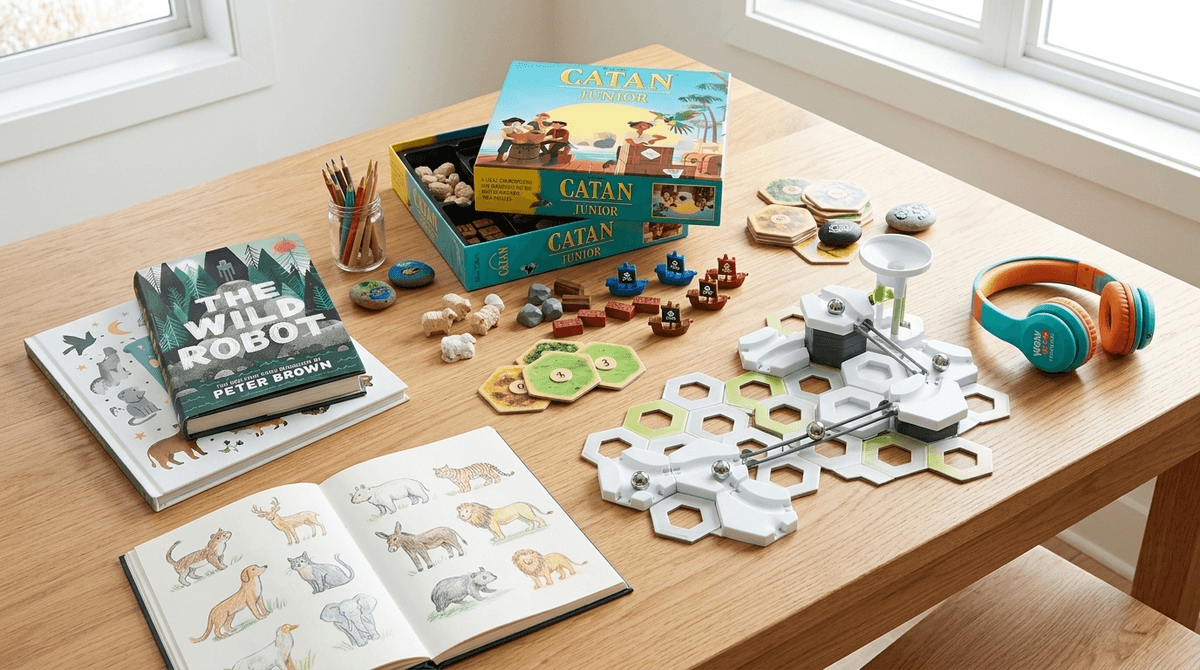
TL;DR: The Quick List If you’re currently hiding in the pantry while your kid asks for the iPad for the 400th time, here are the heavy hitters that actually hold their attention without a charging cable:
- For the Builder: LEGO Sets or GraviTrax
- For the Strategy Junkie: Catan Junior or Exploding Kittens
- For the Story-Obsessed: The Wild Robot by Peter Brown or the Brains On! podcast
- For the "Artist": Smile by Raina Telgemeier (Graphic novels are the ultimate gateway drug to reading)
We’ve all been there. You reach for the "screen-free" Pinterest list and it’s full of suggestions like "make a 1:1 scale model of the solar system using organic felt and hand-dyed chickpeas."
Yeah, no.
In the real world, we need activities that don’t require a 45-minute setup for 10 minutes of engagement. We need hobbies that scratch the same itch as Roblox or Minecraft—autonomy, progression, and maybe a little bit of chaos—but in the physical world.
If your kid is currently speaking in "Ohio" memes and "Skibidi" slang, their brain is wired for high-speed dopamine. To compete with that, we have to offer "sticky" hobbies that provide a different kind of payoff: The Flow State.
The reason kids default to screens is that the "friction" to start is zero. You press a button, you’re in. To make a screen-free hobby stick, we have to lower the friction. If the supplies are locked in a high cabinet or require "parental supervision," the hobby is dead on arrival.
The goal is independence. We want hobbies where they can fail, fix it, and keep going without needing us to be the "Project Manager."
If your kid loves the resource management of Minecraft, they don’t want to play Candy Land. They want strategy. They want to outsmart you.
Ages 6-12+ This is the gold standard for a reason. It teaches resource management and negotiation. Catan Junior is surprisingly robust for the younger crowd (ages 6-9), while the standard Catan is the perfect "Sunday afternoon" time-sink for older kids.
Ages 8+ It’s competitive, it’s visual, and there is a clear "win condition" that feels earned. It’s a great pivot for kids who like world-building games.
Ages 7+ It’s fast-paced, funny, and a little bit mean—exactly what kids who love YouTube "challenge" culture are looking for. It’s also portable, which is a win for restaurant wait times.

Sometimes kids just want to zone out. On a screen, that looks like "brain rot" YouTube shorts. In the real world, that can be high-quality audio. Audiobooks and podcasts allow kids to build "mental movies," which is a massive developmental win for literacy and imagination.
Ages 5-12 This is science, but it’s fast-paced and funny. It respects kids' intelligence without being dry. It’s a great "background" hobby for when they are building with LEGOs or drawing.
Ages 5-10 Guy Raz and Mindy Thomas are basically the "Mr. Beast" of podcasts—high energy, sound effects galore, and genuinely interesting topics.
Ages 7-12 If you want to get them into a book series that feels modern, this is it. It deals with technology, nature, and belonging. It’s been made into a movie, but the book is where the real magic is.
Digital-native kids are used to "building" in 3D spaces. We can translate that into the physical world with systems that allow for "open-world" play.
Ages 8+ Think of this as a modular marble run on steroids. It’s physics-based, highly customizable, and—most importantly—it’s satisfyingly "clicky." It feels like a physical version of a logic game.
Ages 5+ Okay, this is an app, but it’s a tool. It provides 3D instructions for physical LEGO sets. It’s a great bridge for kids who find paper instructions frustrating. It turns building into a guided, interactive experience.
- Grades K-2: Focus on Tactile Play. They need things they can touch, break, and rebuild. Think Magnatiles and Storyline Online (which is a website, but a great "calm down" tool).
- Grades 3-5: Focus on Collection and Strategy. This is the age of Pokemon Cards and complex building sets. They want to master systems.
- Grades 6+: Focus on Utility and Social Connection. Middle schoolers want hobbies that make them feel "cool" or capable. Learning to cook one specific meal, digital photography (with a real camera), or even Dungeons & Dragons for the social strategy.
Here is the no-BS truth: Your kids will be bored for the first 20 minutes.
When you take away the high-dopamine digital hit, there is a "withdrawal" period. They will complain. They will say "this is mid." They will tell you that the board game is "trash."
Hold the line.
Boredom is the precursor to creativity. If you jump in and entertain them the second they complain, they never get to the part where they start inventing their own rules for Uno or building a massive tower out of couch cushions.
Instead of: "No more iPad, go find something else to do," which feels like a punishment.
Try: "The iPad is taking a break to charge. I’m going to set up Catan Junior on the table. If you want to play, I’m down, otherwise, I’m listening to Wow in the World while I fold laundry."
You’re modeling the behavior. You’re showing that screen-free time isn't a "timeout"—it's just a different mode of being.
Screen-free hobbies stick when they offer the same things games do: Challenge, Mastery, and Autonomy.
Don’t aim for perfection. Aim for "good enough to keep them from asking for the password for an hour." Start with one "sticky" item—maybe a graphic novel like Wings of Fire or a strategy game like Ticket to Ride—and see what happens.
- Audit the "Friction": Move the board games to a shelf they can reach. Put the drawing paper on the kitchen table.
- Pick One "Gateway" Hobby: Based on what they play online. (e.g., If they love The Sims, try a physical dollhouse or architecture kit).
- Use Screenwise: Take our survey to see how your kid’s hobby interests align with their digital habits.