

Look, we need to talk about getting your teen to read. And I don't mean assigned reading that they're SparkNoting at 11pm. I mean actual, voluntary, "wait I need five more minutes" reading.
Sci-fi books for teens hit differently than other genres because they're basically asking the big questions while also having cool stuff like spaceships and time travel. We're talking about books that explore identity, power, technology, and what it means to be human—wrapped in stories about dystopian governments, alien encounters, and futures that feel uncomfortably close to our present.
The best part? These books often mirror the exact anxieties teens are already feeling about the real world—climate change, technology taking over, adults making questionable decisions—but in a context that feels safer to explore. It's like therapy, but with laser guns.
Teens are drawn to sci-fi for the same reason they're drawn to questioning literally everything you say: they're trying to figure out how the world works and what their place in it might be.
Sci-fi gives them permission to imagine different worlds. Not just different, but worlds where the rules adults have established don't necessarily apply. Where a teenager might actually be the one who figures things out. Where the systems that feel broken in real life are definitely broken, and someone does something about it.
It validates their "the world is messed up" feelings. Your teen isn't being dramatic when they point out that things feel increasingly dystopian. Sci-fi meets them where they are and says "yeah, let's explore that."
The genre has genuinely evolved. Today's YA sci-fi isn't just "Ender's Game but make it diverse" (though there's nothing wrong with Ender's Game). Modern sci-fi for teens tackles AI ethics, climate futures, neurodiversity, gender identity, and systemic oppression in ways that feel relevant and urgent.
Ages 12-14: The Entry Points
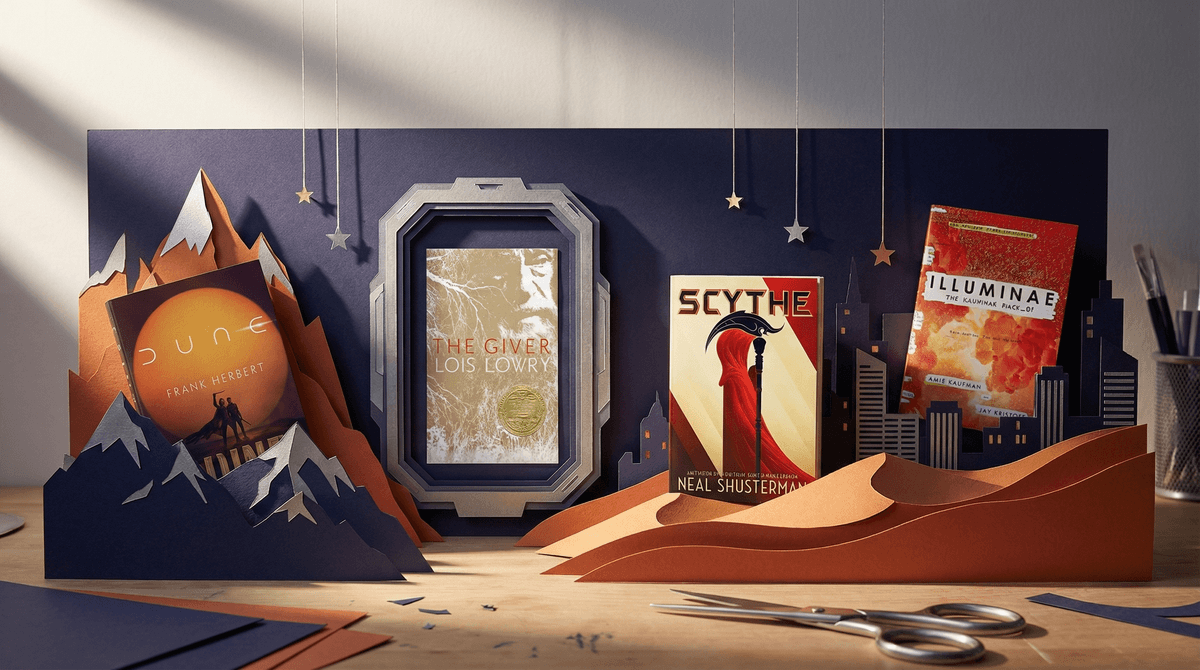
The Giver - Still hits hard. Yes, it's assigned reading in many schools, but if your kid hasn't read it yet, this is the perfect introduction to dystopian fiction. It's short, accessible, and the "wait, WHAT?" ending will stick with them.
A Wrinkle in Time - A classic for a reason. Meg Murry remains one of the best "smart girl who doesn't fit in" protagonists in literature. The sci-fi elements (tesseracts, time travel, other dimensions) are mind-bending without being overwhelming.
Scythe by Neal Shusterman - In a world where death has been conquered, "scythes" must kill to control population. It's dark but not gratuitously so, and it raises fascinating ethical questions. Warning: it's the first in a trilogy, so prepare for your kid to immediately demand books two and three.
Ages 14-16: The Deep Dive
The Hunger Games - Yes, everyone's already read it. But if your teen somehow missed the phenomenon, this trilogy is still the gold standard for dystopian YA. The violence is there but purposeful, and the political commentary is chef's kiss.
Ender's Game - Controversial author aside (and yes, Orson Scott Card's views are problematic), this book about child soldiers, military ethics, and the cost of war remains incredibly powerful. Good opportunity for conversations about separating art from artist.
The Illuminae Files by Amie Kaufman and Jay Kristoff - Told entirely through documents, transcripts, and IMs. It's a space opera with a rogue AI, corporate conspiracy, and a zombie-virus plague. Sounds chaotic because it is, but in the best way. Reluctant readers often devour this because the format feels so different.
Children of Blood and Bone - Okay, technically fantasy, but it has strong sci-fi elements and deals with systemic oppression in a way that feels very now. West African mythology meets magic meets revolution.
Ages 16+: The Sophisticated Stuff
The Handmaid's Tale - Heavy. Dark. Uncomfortably relevant. But if your older teen is ready for it, Margaret Atwood's masterpiece is essential reading. Maybe watch the show together after? (Though fair warning, the show goes darker than the book in places.)
Dune - With the movies reigniting interest, now's a great time. Yes, it's dense. Yes, it's long. But for teens who are ready for complex world-building and political intrigue, this is the Mount Everest of sci-fi. Frank Herbert created an entire universe, and your teen will either bounce off it completely or become obsessed. No in-between.
The Left Hand of Darkness by Ursula K. Le Guin - A planet where people have no fixed gender. Written in 1969, still ahead of its time. Great for teens thinking about gender, identity, and how much of what we consider "natural" is actually cultural.
Neuromancer by William Gibson - If your teen is into cyberpunk aesthetics, this is where it all started. Fair warning: Gibson's writing style is dense and assumes you'll keep up. But for the right reader, it's mind-blowing.
Don't sleep on graphic novels. Some teens who struggle with traditional novels will absolutely devour sci-fi in graphic format.
Saga by Brian K. Vaughan - Space opera meets family drama. Beautiful art, compelling story, but heads up: there's mature content (sex, violence, language). Ages 16+.
Paper Girls - Time travel, mysterious forces, and four girls on paper routes in the 1980s. Think Stranger Things meets Back to the Future. Ages 14+.
"Isn't dystopian fiction too dark?"
Sometimes, yes. But here's the thing: teens are already anxious about the future. Dystopian fiction doesn't create that anxiety—it gives them a framework to process it. The best dystopian novels show characters fighting back, finding agency, making choices. That's actually hopeful.
That said, know your kid. If they're already struggling with depression or anxiety, maybe start with lighter sci-fi like Ready Player One (problematic in its own ways, but fun) before diving into the bleak stuff.
"What about the violence?"
The Hunger Games features children killing children. Ender's Game is about training child soldiers. Violence is part of many sci-fi narratives.
But here's the difference between violence in sci-fi and violence in, say, a slasher film: in good sci-fi, violence has consequences. Characters grapple with what they've done. The books aren't celebrating violence—they're examining it.
If you're concerned, read it first or read it alongside your teen. Then you can talk about it.
"My teen only wants to read books with romance."
Good news: most modern YA sci-fi has romance subplots. The Hunger Games has the whole Peeta/Gale thing. The Illuminae Files is basically a love story set in space. You can absolutely find sci-fi that scratches both itches.
Let them choose. I know you want them to read the classics. They want to read about teenagers overthrowing fascist governments. Meet them where they are.
Don't make it homework. The fastest way to kill a love of reading is to require a book report. If they want to tell you about it, great. If not, also fine.
Model reading. If you're doom-scrolling while telling them to read, they notice. Read your own book while they read theirs.
Audiobooks count. Some teens process better by listening. Audible and Libby (free through your library!) are your friends here.
Connect it to what they already love. If they're obsessed with The Last of Us, try The Girl with All the Gifts. Into Black Mirror? Try Feed by M.T. Anderson.
Sci-fi books for teens aren't just escapism—though there's nothing wrong with escapism. They're tools for processing anxiety, exploring identity, and imagining different futures. They ask "what if?" in ways that help teens think critically about the world they're inheriting.
Start with one book. See what resonates. Follow the threads. Your teen who claims to "hate reading" might just hate being told what to read. Give them a story about a teenager toppling a corrupt government or surviving on Mars, and suddenly reading doesn't feel like a chore.
And hey, worst case scenario? You end up with a stack of excellent books to read yourself.
Want more book recommendations? Check out our guides on fantasy books for teens or graphic novels for reluctant readers.
Looking for book-to-screen adaptations to watch together? We've got you covered with best book adaptations on streaming.
Want to understand your teen's actual reading habits? Take the Screenwise survey to see how your family's media consumption compares to others in your community—including reading time vs. screen time.