If you grew up thinking comics were just for kids, Saga is the book that will permanently break that part of your brain. It is a sprawling, messy, beautiful space opera that feels like the love child of Romeo and Juliet and Star Wars, but with a lot more swearing and zero filters on the biology of life and death.
The reason this series has a nearly perfect 4.9 rating on Amazon isn't because it is "edgy" for the sake of it. It is because Brian K. Vaughan and Fiona Staples are doing something most creators are too scared to try: telling a story about the actual logistics of parenthood while being shot at by bounty hunters on a wooden rocket ship. It is human, even when the characters have horns or TV screens for heads.
The Graphic Novel Trap
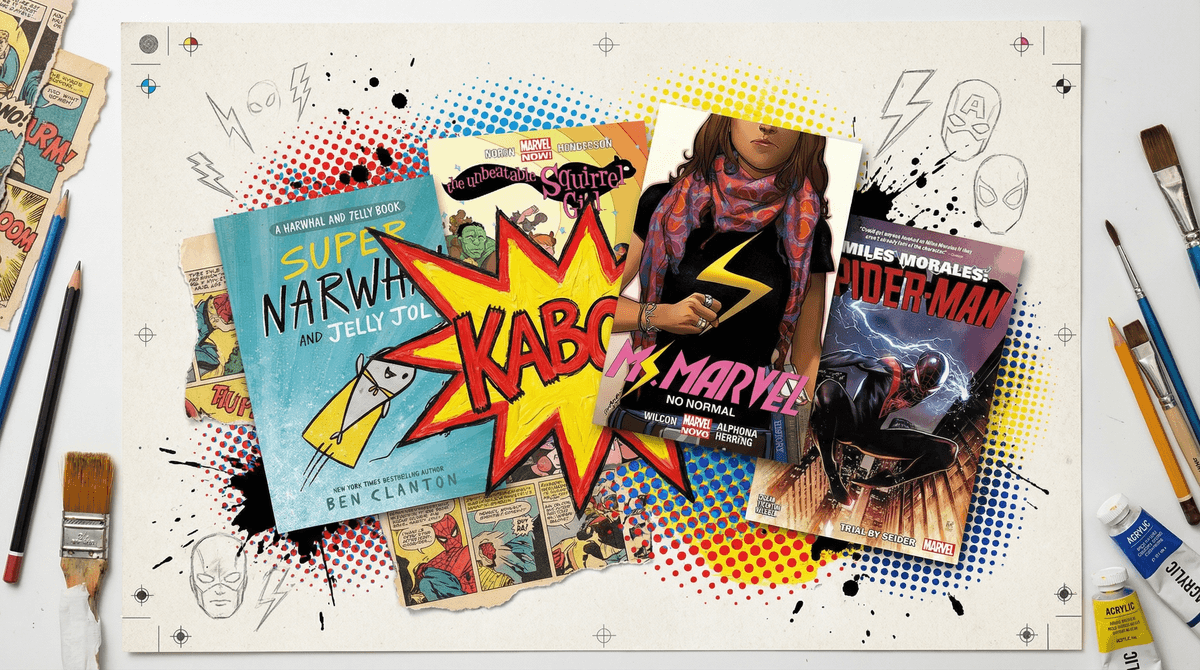
We talk a lot about why visual storytelling is the secret weapon for building literacy, but Saga is the point where that weapon becomes a double-edged sword. Because it is a graphic novel, a parent might see it on a shelf and assume it is a gateway for a 12-year-old who just finished Amulet. It is not.
The art by Fiona Staples is some of the best in the medium, but it is also transgressive. We are not talking about "suggestive" themes. We are talking about full-page, anatomically detailed depictions of sex and violence that would earn an NC-17 rating in a movie theater. If your teen is currently obsessed with the grit of Seinen or the hype of Shonen manga, they might be asking for this. Just know that Saga pushes further than almost anything you will find in the mainstream manga section.
Why the Hype Sticks
What makes Saga work is the narration. The whole story is told from the perspective of Hazel, the child born to these star-crossed soldiers, looking back on her life. It gives the chaos a sense of weight. You are not just watching people run away; you are watching them try to build a family in a universe that wants them dead.
Vaughan’s writing is sharp and funny, but the emotional stakes are what actually leave a mark. It deals with child trafficking, the trauma of war, and the grueling reality of being a refugee. It is "prestige TV" in paper form.
Better Gateway Reads
If your kid is a sci-fi fan but is not ready for the "hard-R" content here, look at our guide to sci-fi books for teens. There are plenty of stories that offer high-stakes world-building without the graphic content that makes Saga such a lightning rod for library challenges.
Save this one for when they are heading off to college. Or better yet, read it yourself first. You will see why it won every Eisner and Hugo award on the shelf, but you will also see why you are keeping it on the high shelf for a few more years.