

TL;DR
If you’re in a rush between soccer practice and making dinner, here are the heavy hitters for 2026:
- Best for Preschoolers: Toca Life World and Bluey: The Videogame.
- Best for Elementary: Minecraft and Super Mario Jamboree.
- The Social Hubs (Ages 10+): Roblox and Fortnite.
- The 2026 Must-Have: Nintendo Switch 2.
- For the Brainy Kids: Scratch and Prodigy Math.
It’s 2026, and the digital landscape for our kids has shifted again. If you feel like you just finally understood what "Skibidi" meant only for your kid to start calling everything "Ohio" or "Sigma" in a way that makes no sense, you’re not alone. The games they play are more than just entertainment; they are the new town squares, the playgrounds, and—occasionally—the source of a very stressed-out credit card statement.
Whether your kid is begging for a [Nintendo Switch 2](https://screenwiseapp.com/media/nintendo-switch-2-app or trying to convince you that Valorant is "basically an educational strategy game" (nice try, kid), here is the breakdown of what is actually happening on those screens.
We used to trade Pokémon cards or talk about what happened on Total Drama Island at the bus stop. Now, if a kid isn't playing Fortnite or Roblox, they are often literally left out of the conversation. These games aren't just "games" anymore—they are social platforms. When your kid says they want to "get on," they usually mean they want to hang out with their friends. Understanding this helps us move from "get off that junk" to "I see you're hanging out with your friends, but we need to head to Grandma's in ten minutes."
Get tips on managing gaming-related social FOMO
At this age, it’s all about fine motor skills and creative play. You want games that don't have high-pressure "game over" screens or aggressive ads.
This is essentially a digital dollhouse. There are no winners or losers, just exploration. It’s great for storytelling, though be warned: the "in-app purchases" for new furniture or characters are tempting.
If your house is a Bluey house, this is a no-brainer. It’s short, sweet, and allows for four-player local co-op, meaning you can play with them. It’s the "low-stakes" entry point into using a controller.
If you want something browser-based that is actually high-quality and free, this is the gold standard. It’s safe, educational, and doesn't feel like "homework."
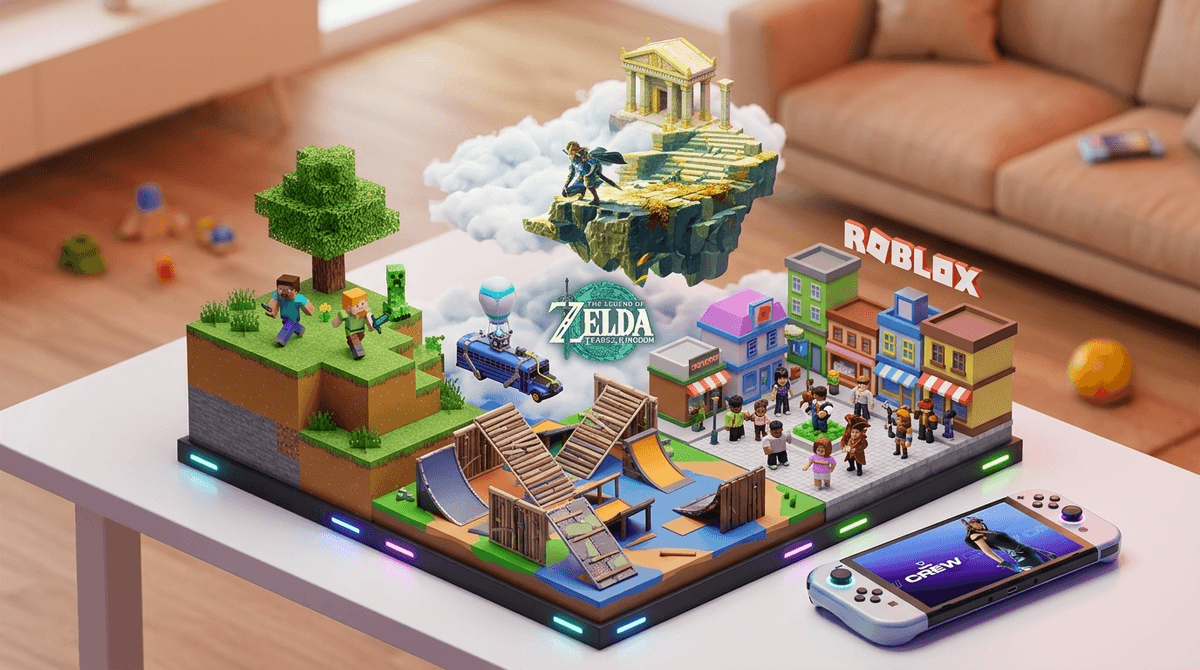
This is the era of the "Big Three": Minecraft, Roblox, and Nintendo. This is also where "brain rot" concerns usually start to creep in.
Minecraft is the "good" game in the eyes of most parents, and for good reason. It’s digital LEGOs. Whether they are in Creative Mode building a scale model of the Eiffel Tower or in Survival Mode fighting Creepers, they are learning resource management and spatial awareness. Check out our guide on Minecraft: Bedrock vs. Java edition
Roblox is not a game; it’s a platform with millions of games inside it. Some are brilliant (like Dress to Impress), and some are... well, garbage.
The Entrepreneurship Hook: Many kids start "working" in Roblox or designing clothes to earn Robux. It can teach basic economics, but it can also lead to "gambling-lite" mechanics with "loot boxes."
Learn more about how Robux is in fact real money
The latest in the Mario Party series. It’s the ultimate family game night choice, though it has been known to cause "sibling rivalries" when someone steals a star at the last second.
This is the "Tween" phase where kids move away from "kiddy" games and toward titles that feel more "mature" (read: they have guns, but usually no blood).
Fortnite is the king of the "Live Service" era. In 2026, it’s more than a Battle Royale; it has LEGO Fortnite for builders and Fortnite Festival for music lovers. The Concern: The "item shop" refreshes daily, creating massive "FOMO" (Fear Of Missing Out). If your kid doesn't have the "cool" skin, they might feel like a "default" (a common school-yard insult).
It’s soccer with cars. It sounds ridiculous, but it’s incredibly high-skill and generally has a much lower "toxicity" level than shooting games. It’s great for kids who love sports.
If you want your kid to spend three hours solving physics puzzles instead of yelling at friends on a headset, this is the one. It’s a masterpiece of game design that encourages "outside the box" thinking.
By high school, kids are usually looking for either high-intensity competition or deep, narrative-driven experiences.
This is a tactical shooter. It’s very popular, but the voice chat can be... intense. This is where you need to have conversations about digital citizenship and how to handle "toxic" players.
The ultimate "cozy game." You inherit a farm, grow crops, and talk to villagers. It’s the perfect antidote to the stress of high school. It’s wholesome, deep, and teaches long-term planning. Read our guide on why Stardew Valley is the perfect stress-reliever for teens
If your teen is a "hardcore" gamer, they’ve probably played this. It’s difficult, dark fantasy, and incredibly rewarding. It’s the modern-day equivalent of beating a really hard level in the original Mario, but with way more dragons.
1. The "Free-to-Play" Trap
Most of the popular games today (Fortnite, Roblox, Brawl Stars are "free." But they aren't charities. They make money through microtransactions. Pro-tip: Never save your credit card info on the console. Use gift cards. It creates a physical "limit" that kids can understand.
2. Voice Chat is the Wild West
Even in "E-rated" games, the people talking in the headset are not necessarily "E-rated." The Fix: Encourage "Party Chat" (where they only talk to friends they know in real life) rather than "Game Chat" (where they talk to everyone in the lobby).
3. The "Switch 2" Factor
With the [Nintendo Switch 2](https://screenwiseapp.com/media/nintendo-switch-2-app now the standard, many older games are getting "remastered." Don't feel the need to buy every new version of a game they already own unless there’s a significant feature upgrade.
Check out our guide on how to set up the new Switch 2 parental controls
Instead of asking "Are you winning?", try these:
- "What are you trying to build/achieve right now?"
- "Who are you playing with today?"
- "Show me the coolest thing you've found in this world lately."
When we show interest in their digital worlds, they are much more likely to listen when we tell them it’s time to close the laptop and rejoin the physical world.
Gaming in 2026 is a mixed bag. It’s a place for incredible creativity and social connection, but it’s also a place designed by psychologists to keep your kid’s attention (and your money).
You don't need to be a "pro gamer" to be an intentional parent. You just need to know which playgrounds they are visiting. If they’re in Minecraft, they’re probably fine. If they’re in a random Roblox server with 50 strangers, it might be time for a check-in.
- Audit the Apps: Check your kid's device for any "hidden" games or apps you don't recognize.
- Set the "Bank": Decide on a monthly "digital allowance" for things like Robux or V-Bucks.
- Play Together: Seriously. Ask them to teach you how to play. You will be terrible at it, they will laugh at you, and it will be the best ten minutes of connection you have all week.