

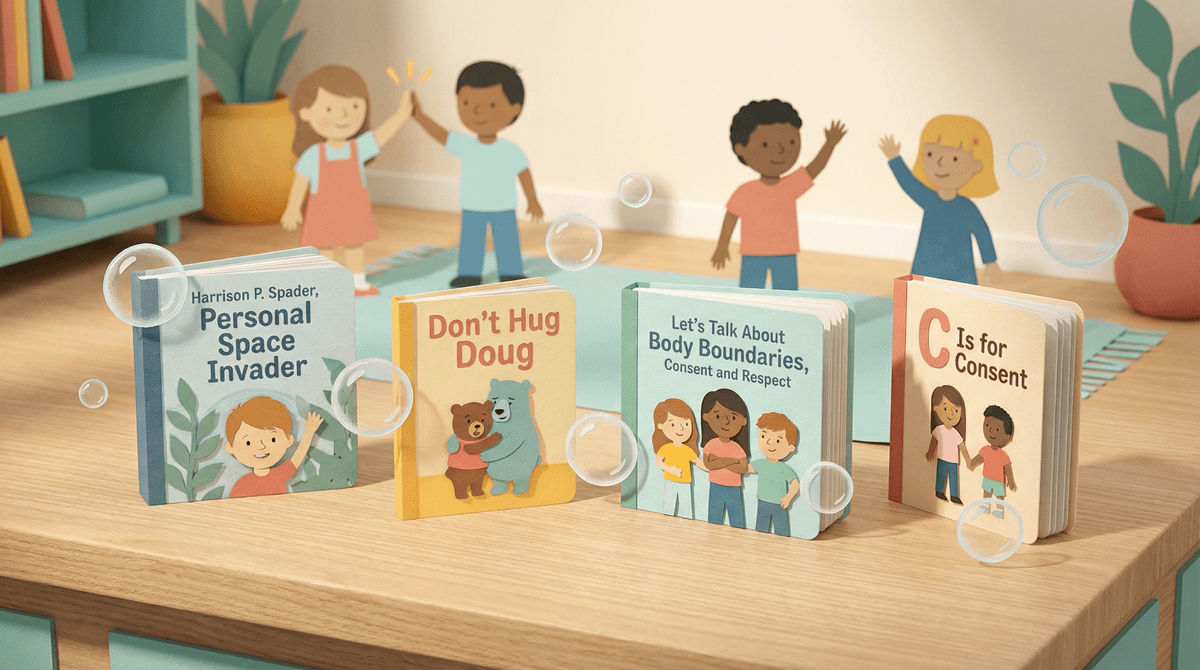
TL;DR: Top Picks for Teaching Boundaries
Teaching boundaries isn't just about preventing "stranger danger"—it's about giving your kid the agency to say "no" to a hug from Great-Aunt Martha and "no" to a weird request in a Roblox lobby. If you’re short on time, start with these:
- Best for Physical Space: Harrison P. Spader, Personal Space Invader
- Best for Consent: Don't Hug Doug
- Best for Body Safety: Let's Talk About Body Boundaries, Consent and Respect
- Best for Younger Toddlers: C Is for Consent
Find a reading list based on your child's age
We’ve all been there. You’re at a family gathering, and a well-meaning relative insists on a "big squeeze" from your kid. Your child is stiffening up, looking at their shoes, and clearly uncomfortable. In that moment, we’re often tempted to say, "Oh, just give them a hug, don't be rude!"
But here’s the no-BS reality: when we force kids to override their physical intuition for the sake of adult politeness, we’re accidentally teaching them that their boundaries don’t matter.
In the digital age, this becomes even higher stakes. If a child doesn't feel empowered to say "no" to a physical hug, they’re going to have a much harder time saying "no" when a stranger on Discord asks for a "face reveal" or when a friend pressures them to watch something that feels like total brain rot on YouTube.
Picture books are the ultimate "low-stakes" way to start these conversations. They provide a shared vocabulary so that when a real-life boundary crossing happens, you can reference the book instead of giving a lecture.
You might wonder why a Screenwise guide is talking about physical picture books. It’s because digital wellness starts with physical autonomy.
Boundary-setting is a muscle. If they practice it with their bodies, they’ll use it with their data. Understanding "personal space bubbles" is the precursor to understanding "data privacy." Understanding consent for a high-five is the precursor to understanding consent for sharing a photo of a friend on Instagram.
Harrison is a lovable little hippo who just... loves too much. He’s a close-talker, a tail-stepper, and a space-invader. This book is fantastic because it doesn't make Harrison a "bad kid." He’s just enthusiastic. It introduces the concept of the "Space Bubble" in a way that’s visual and easy for kids to grasp.
- Ages: 4-8
- Why it works: It’s funny. Kids see themselves in Harrison, and it makes the "Space Bubble" a tool rather than a punishment.
Julia Cook is basically the queen of "social-emotional" picture books. Louis is a "space expert" but he doesn't realize that personal space is different from outer space.
- The No-BS Take: To be honest, Cook’s books can be a bit wordy and "educational-heavy," but the metaphors stick. If your kid is struggling with keeping their hands to themselves in the Minecraft couch-co-op sessions, this is a solid read.
- Ages: 5-9
This is arguably the best book on consent for the preschool set. Doug likes high-fives. He likes low-fives. He likes "side-fives." But he does not like hugs.
- Why it matters: It teaches kids that they don't need a "good reason" to not want to be touched. They just don't have to. It also shows that you can still be friends with someone even if you don't want to hug them.
- Ages: 3-6
This is a board book, so it’s perfect for the "I’m two and I’m learning how the world works" phase. It follows a boy at a party who decides how he wants to greet people.
- The No-BS Take: Some parents think this is "over-parenting" or "too woke." It’s not. It’s basic human respect. Teaching a toddler they have a choice is the best way to prevent them from becoming a "people pleaser" who can't say no later in life.
- Ages: 2-4
If you want one book that covers everything—from "private parts" to "body signals"—this is it. Jayneen Sanders is an expert in child protection, and it shows.
- Why it's a must-have: It uses the correct terminology. It talks about the "butterflies in your tummy" feeling when something is wrong. This is the foundation for grooming prevention.
- Ages: 4-10 (Great for older kids too because the concepts are sophisticated).
Check out our guide on how to talk to kids about body safety
This book moves beyond just physical touch and into social pressure. "No, I don't want to play that game." "No, I don't want to share my snack."
While not strictly about boundaries, understanding emotions is the first step to setting them. If a kid can't identify that they feel "uncomfortable" or "overwhelmed," they won't know when a boundary is being pushed.
- Ages: 2-6
Toddlers (Ages 2-4)
At this age, it’s all about the "Body Bubble." Focus on books like C Is for Consent. Practice "asking for permission" before you tickle them or pick them up. It feels silly, but it builds the habit.
Early Elementary (Ages 5-7)
This is when social boundaries kick in. Use Harrison P. Spader to talk about school and friends. This is also a great time to introduce the idea of "Digital Boundaries"—like asking before taking a picture of a friend on an iPad or Kidizoom camera.
Middle Childhood (Ages 8-10)
By now, they should be reading Let's Talk About Body Boundaries. Start connecting these physical lessons to their online life. If someone in a Minecraft server is "invading their space" or making them feel the "tummy butterflies," they need to know that the same rules apply: they can walk away, and they can say no.
The biggest hurdle to teaching boundaries isn't the kids—it's the other adults. You will likely face pushback from older generations who think you're making kids "soft" or "rude."
The Screenwise No-BS Advice: Your child's safety and sense of autonomy are more important than an adult's feelings. You can be polite but firm: "We're teaching Sam that he's in charge of his body. He'd love to give you a high-five or a wave instead of a hug right now."
This sets a powerful example for your child. They see you standing up for their boundaries, which gives them the courage to do it themselves when you aren't around—like when they're navigating the Wild West of YouTube Kids comments or a Fortnite chat.
When reading these books, don't just read the text. Ask questions:
- "How do you think Doug felt when people hugged him without asking?"
- "What does your 'Space Bubble' feel like? Is it big today or small?"
- "What would you do if someone online asked you for a 'hug' or a picture? Does that feel like a Space Bubble violation?"
Boundaries aren't about building walls; they’re about building gates that the child controls. By using picture books to normalize these conversations early, you’re giving your child the ultimate safety tool. Whether they are on the playground or on Roblox, a child who knows their "No" matters is a child who is significantly safer in the modern world.
- Audit your library: Do you have at least one book that explicitly talks about consent? If not, grab Don't Hug Doug.
- Practice the "High-Five or Hug" choice: Next time you leave a playdate, let your child choose how they say goodbye.
- Bridge to Digital: Next time your child is playing a game like Toca Life World, talk about the characters' boundaries. "Does that character want to be in that house? Did you ask?" It sounds silly, but it builds the empathy and boundary-logic they'll need later.
Check out our guide on the best first apps for kids to practice social skills