

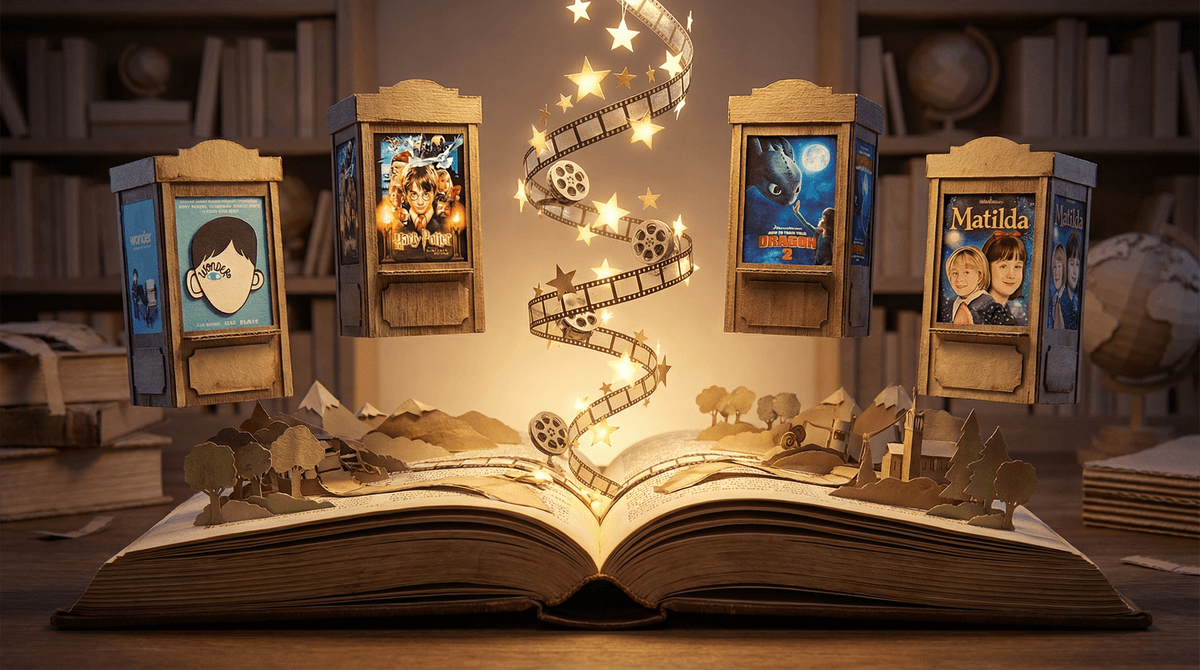
You know that moment when your kid finishes a movie and you casually mention "oh yeah, that was a book first" and their mind explodes? That's the magic we're talking about here.
Book-to-movie adaptations are exactly what they sound like: stories that started as books and got the Hollywood treatment. We're talking everything from Harry Potter to Wonder to The Hunger Games. And honestly? They're one of the best secret weapons in the "how do I get my kid to read" arsenal.
Screenwise Parents
See allThe thing is, most kids don't realize how many of their favorite movies started as books. Matilda? Book. How to Train Your Dragon? Book series. Diary of a Wimpy Kid? Yep, book. Even Jurassic Park was a Michael Crichton novel before it became the dinosaur franchise that won't quit.
Here's the deal: we're living in a time when getting kids to pick up a book feels like an Olympic sport. Between YouTube, Roblox, and whatever new app is rotting their brains this week, books are competing for attention in ways they never had to before.
But book-to-movie adaptations? They're a gateway drug to reading. And I mean that in the best possible way.
When a kid watches a movie they love and then discovers there's a WHOLE BOOK with more details, more backstory, more everything? That's intrinsic motivation you can't manufacture. They're not reading because you nagged them. They're reading because they genuinely want to know what happens next.
Plus, there's this whole critical thinking angle that's actually pretty cool. When kids read the book AND watch the movie, they start naturally comparing them. "Why did they leave out that character?" "The book ending was better!" "Wait, in the book she had a brother!" This is media literacy happening in real time, and it's teaching them to be critical consumers of content—a skill they desperately need in 2026.
Okay, so there's this ongoing debate about which order is better, and honestly? Both work, but for different reasons.
Watch-then-read is great for reluctant readers. The movie gets them invested in the story and characters, and then the book feels like bonus content they actually want. It's less intimidating because they already know the basic plot. For kids who struggle with reading or have learning differences, this can be a game-changer.
Read-then-watch is better for building visualization skills and imagination. When kids create the world in their heads first, they're doing the heavy lifting of imagination. Then the movie becomes this fun "how did they interpret it?" exercise. Fair warning though: this path often leads to "the book was better" syndrome, which... yeah, the book usually IS better, but sometimes it's nice to just enjoy both.
My take? Start with whichever one gets your kid engaged. There's no wrong answer here.
Ages 4-7:
- The Gruffalo - Adorable animated short, perfect picture book
- Where the Wild Things Are - Though heads up, the movie is a bit darker and more emotional than the book
- Paddington - Genuinely delightful, and the books are classics
Ages 8-11:
- Percy Jackson series - The new Disney+ show is actually good (unlike the movies, which... we don't talk about)
- Charlotte's Web - Tissues required for both versions
- The Chronicles of Narnia - The first movie is solid, books are timeless
- Holes - One of those rare cases where the movie is almost as good as the book
Ages 12+:
- The Hunger Games - Just know the books are more intense than the movies
- The Maze Runner - Action-packed both ways
- Everything, Everything - Sweet romance, though the book has more depth
- The Hate U Give - Important story, both versions handle it well
The movies always cut stuff. Always. This is actually a feature, not a bug, because it gives you natural conversation starters. "What did you think they should have kept from the book?" is a way better dinner table question than "how was school?"
Age ratings can differ. Sometimes the book is fine for a 10-year-old but the movie is PG-13 for intensity. Sometimes it's the reverse. The Giver is a great example—the book is commonly read in 6th grade, but the movie is more visually intense. Check both ratings independently.
Some adaptations are... not great. Looking at you, Artemis Fowl. Sometimes the movie is so bad it actually turns kids OFF the book, which is tragic. Read reviews first. Common Sense Media is your friend here.
Graphic novels count too! Dog Man, Amulet, Smile—these are all getting adapted and they're legitimate reading. Don't let anyone tell you otherwise.
Create a family movie-book club. Pick one book-to-movie combo a month. Read it together (or separately), watch it together, then actually talk about it. Make it fun—order pizza, make it an event.
Use the library. Most libraries have "If you liked the movie, read the book!" displays. Librarians are basically book-matching wizards. Use them.
Don't force it. If your kid watches the movie and has zero interest in the book, that's okay. The goal is to plant seeds, not force-feed vegetables.
Try audiobooks for the "reading" part. If your kid struggles with reading or just prefers audio, listening to the book before/after watching the movie absolutely counts. This guide on audiobooks has more on why audiobooks are legit.
Flip the script occasionally. If your kid loves reading, challenge them to read the book first and predict what the movie will change. Make it a game.
Book-to-movie adaptations are one of the few places where screen time and reading time actually support each other instead of competing. They're not just entertainment—they're teaching critical thinking, building media literacy, and potentially turning your kid into a reader without them even realizing it.
Is it going to work for every kid? No. Will your kid sometimes watch the movie and completely ignore the book? Absolutely. But even just knowing that books and movies are connected, that stories exist in multiple forms, that there's always more to discover—that's valuable.
Plus, when your kid inevitably says "the book was better" for the first time, you get to welcome them to the club. That moment alone is worth it.
- Check out alternatives to screen time for more ways to balance media and reading
- Explore age-appropriate books to find your next family read
- Learn more about building reading habits that actually stick