

Look, I get it. When you think about building self-confidence in kids, video games probably aren't the first thing that comes to mind. Maybe you're picturing sports teams, art classes, or those "you are special" affirmations we all tried in the 90s.
But here's the thing: certain games are actually incredible confidence-building machines. Not all games—definitely not the ones where they're just grinding for loot boxes or watching someone else play on YouTube. I'm talking about specific types of games that create genuine moments of "holy crap, I figured that out" and "I made something amazing."
And with 55% of families in your community already gaming, chances are your kids are playing something. The question is whether those games are building them up or just filling time.
Creative Sandbox Games
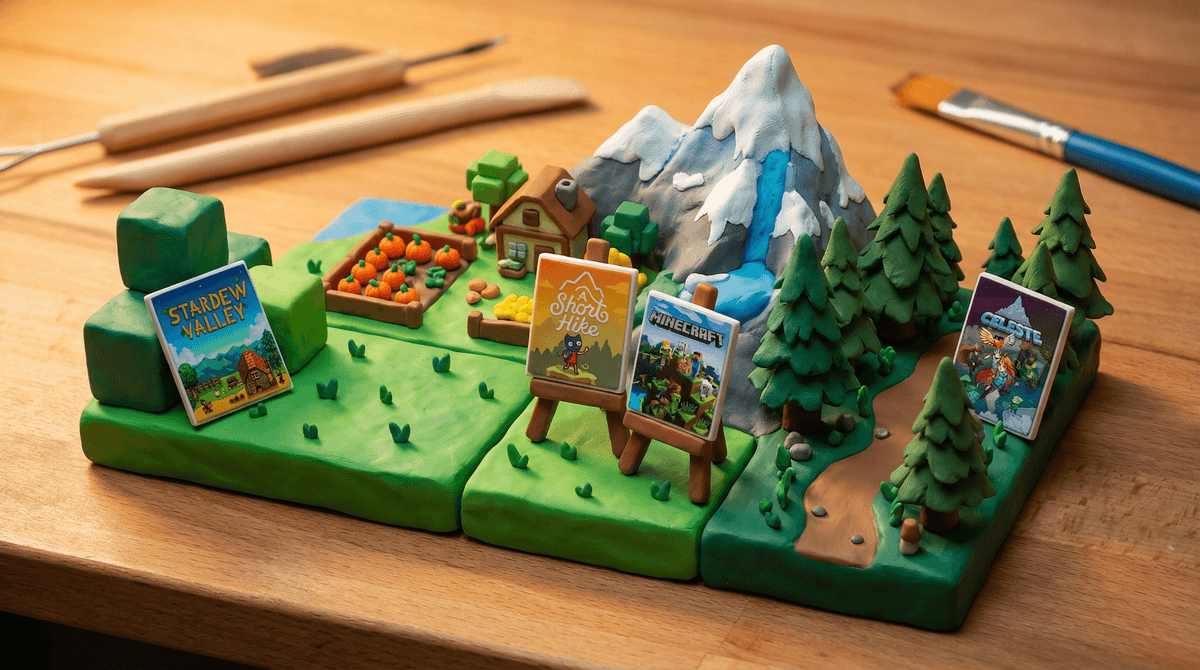
Minecraft is the obvious one here, and for good reason. When kids build something in Minecraft—whether it's a simple house or an elaborate redstone contraption—they're experiencing genuine creative accomplishment. They had an idea, they figured out how to execute it, and now it exists.
About 40% of families in your community don't use Minecraft at all, 35% play offline, and 25% play on servers. If you're in that first group and have kids ages 7+, this might be worth reconsidering. The offline creative mode is where the confidence magic happens.
Stardew Valley is another gem for ages 10+. It's basically a farming simulator where kids manage their own little world. They make decisions, see consequences, adjust strategies, and watch their farm flourish. The confidence comes from autonomy—they're genuinely in control, making meaningful choices without a parent hovering.
Problem-Solving Puzzle Games
Portal 2 (ages 10+) is brilliant for this. Kids work through increasingly complex physics puzzles, and when they finally crack one they've been stuck on? That's pure dopamine from genuine achievement. Not the fake dopamine of a loot box opening—the real stuff that comes from using your brain.
The Witness (ages 12+) takes this even further. It's an island full of puzzles that teach you their own visual language. No hand-holding, no tutorials. Kids have to observe, hypothesize, and test. When they solve a puzzle, they earned it.
Cooperative Challenge Games
It Takes Two (ages 10+) requires two players working together. Parents, this is your chance to play with your kid, not just monitor them. You'll both face challenges that require actual communication and collaboration. When you succeed together, your kid sees themselves as a capable problem-solver and teammate.
Overcooked (ages 8+) is chaotic kitchen management that's way more fun than it sounds. Kids learn to handle pressure, communicate clearly, and recover from mistakes—all while laughing hysterically.
The difference between these games and, say, Fortnite or most Roblox experiences isn't that those games are "bad." It's that these confidence-building games share specific characteristics:
1. Genuine challenge with achievable solutions. Not pay-to-win, not luck-based, not dependent on being better than other players. Just you vs. a problem you can actually solve.
2. Visible progress from your own skills and decisions. When kids succeed, they know it's because they figured something out, not because they got lucky or spent money.
3. Creative expression or meaningful choice. Kids aren't just following a script—they're making something uniquely theirs or choosing their own path.
4. Safe failure. These games let kids try, fail, learn, and try again without social consequences or permanent losses.
Now, about that 60% of families whose kids play Roblox on servers—Roblox can build confidence too , but it's wildly inconsistent. Some Roblox games are creative and challenging. Many are just skinner boxes designed to extract Robux.
If your kid plays Roblox, get good questions to ask them about Roblox. Are they building in Roblox Studio? That's confidence-building. Are they grinding in a simulator to get a slightly better virtual pet? That's... not.
Ages 6-8: Minecraft creative mode, LEGO video games, Unpacking
Ages 8-10: Stardew Valley, Overcooked, A Short Hike
Ages 10-12: Portal 2, It Takes Two, Terraria
Ages 12+: The Witness, Celeste, Outer Wilds
Confidence comes from genuine competence. These games create hundreds of small moments where kids think "I can do hard things." They struggle, persist, figure it out, and feel legitimately proud.
That's different from the hollow "good job!" we give for everything, and it's different from the artificial progression systems in games designed to keep kids playing (and paying) rather than growing.
The best part? You can play many of these games together. Your kid gets to see you struggle and persist too. That's modeling resilience in a way that lectures never could.
-
Look at what your kids are already playing. Are those games building confidence or just burning time?
-
Try one game from the list above together. Make it a weekend thing. You don't need to become a gamer—just be willing to problem-solve together.
-
Get better questions to ask about their gaming
. Not "did you win?" but "what was the hardest part?" and "how did you figure that out?" -
Check out our guides on Minecraft, Roblox, and understanding the gaming landscape to make informed decisions for your family.
Not all screen time is created equal. These games? They're doing something valuable.