

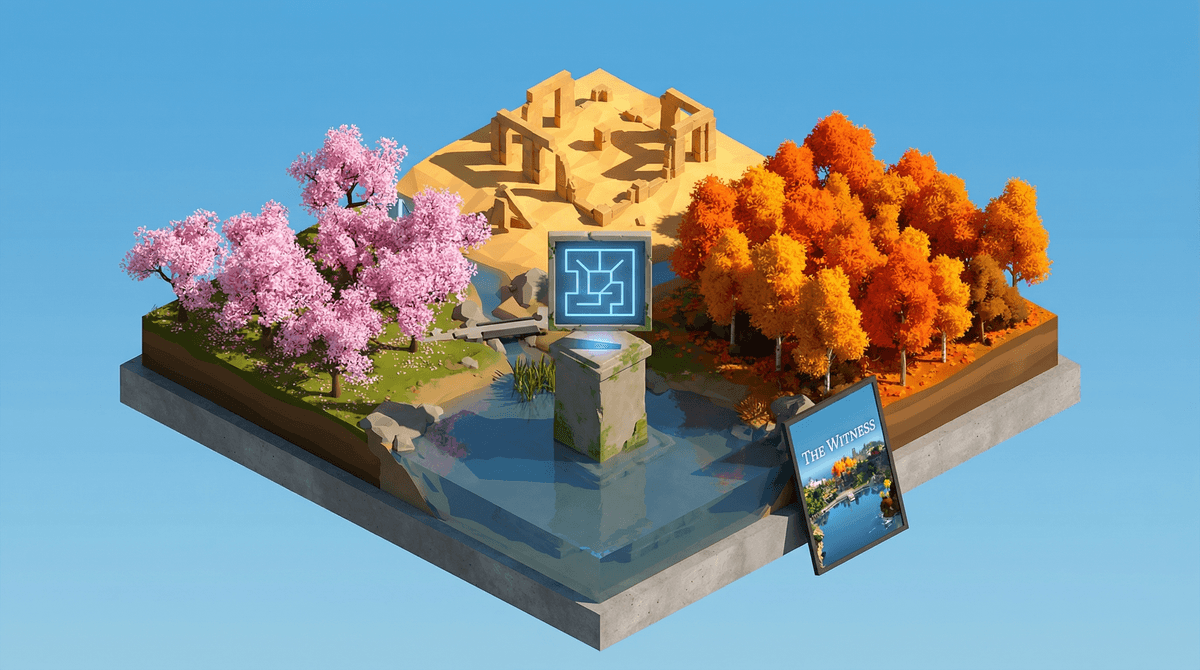
The Witness: When a Puzzle Game Becomes a Philosophy Lesson
TL;DR: The Witness is a gorgeous first-person puzzle game where you solve increasingly complex line-drawing puzzles on a mysterious island. It's non-violent, thoughtful, and surprisingly meditative—but it's also genuinely difficult and requires serious patience. Best for ages 10+ who enjoy puzzles and don't need constant action. If your kid loved Portal or enjoys sudoku, this might be their new obsession.
Released in 2016 by indie developer Jonathan Blow (who also created the time-manipulation puzzle game Braid), The Witness drops you on a vibrant, uninhabited island with zero instructions. Your only task: solve puzzles. Hundreds of them.
The core mechanic is deceptively simple—you draw lines on panels from a starting point to an end point. But as you explore the island's different regions (a desert ruin, a bamboo forest, a colorful autumn grove), the puzzles evolve. They introduce new rules through visual language alone. No tutorials, no text, no hints. You have to figure out what the symbols mean by experimenting and observing patterns.
It's beautiful, it's quiet, and it will absolutely make your brain hurt in the best possible way.
The Witness isn't for every kid. It's not going to compete with Fortnite or Roblox for attention. But for a certain type of kid—the one who loves logic puzzles, enjoys figuring things out independently, and doesn't mind slowing down—this game is catnip.
It respects intelligence. The game never talks down to players. It assumes you're smart enough to figure things out. For kids who feel patronized by overly-explained games, this is refreshing.
It teaches without teaching. Every puzzle is a lesson in observation and pattern recognition. Kids learn to test hypotheses, fail, adjust, and try again. It's the scientific method disguised as entertainment.
It's genuinely challenging. In an era of games with difficulty sliders and "story modes," The Witness doesn't hold your hand. Some kids find this frustrating. Others find it exhilarating. There's real pride in solving a puzzle that stumped you for 20 minutes.
It's screen time that feels productive. Parents often feel better about this kind of game than, say, watching YouTube shorts for an hour. The Witness exercises spatial reasoning, critical thinking, and persistence—skills that translate beyond the screen.
The Good Stuff
Zero violence, zero pressure. There are no enemies, no timers, no deaths, no combat. You can't lose. You can only get stuck. For parents concerned about violent video games, this is as peaceful as gaming gets.
Stunning visuals. The island is genuinely gorgeous—bright colors, varied environments, thoughtful design. It feels like walking through an art installation. Some areas contain hidden audio logs of philosophy lectures and poetry readings (more on that in a moment).
Single-player and self-paced. No online component, no chat, no microtransactions, no battle passes. Buy it once, play it forever. Your kid can play for 20 minutes or two hours without missing anything or falling behind other players.
Builds genuine skills. The game teaches pattern recognition, spatial reasoning, and systematic problem-solving. These aren't just "video game skills"—they're transferable to math, science, and everyday life.
The Challenges
It's hard. Really hard. Some puzzles will stump adults. If your child gets easily frustrated or needs frequent validation, this might not be their game. There's no hint system, no "skip puzzle" button. You either solve it or you don't.
It can feel isolating. The island is beautiful but empty. There's no story (at least not an obvious one), no characters, no dialogue. Some kids find this meditative. Others find it lonely or boring.
The philosophy stuff might go over their heads. Scattered throughout the island are hidden audio logs—clips of lectures about consciousness, perception, and meaning. They're optional and honestly pretty dense. Most kids will ignore them entirely, which is fine. They're there for adults or older teens who want to engage with the game's deeper themes.
Playtime varies wildly. Some kids will solve a few puzzles and move on. Others will become obsessed and spend 30+ hours uncovering every secret. The game doesn't push you toward completion, which means some kids might never "finish" it in any traditional sense.
Ages 8-9: Probably too young for most kids. The puzzles require abstract thinking and patience that younger children typically haven't developed yet. That said, if you have an unusually puzzle-focused 9-year-old who loves logic puzzle books, they might surprise you.
Ages 10-12: This is the sweet spot for the right kid. They're old enough to handle the difficulty and abstract thinking, but still young enough to be genuinely excited about solving hard problems. Expect them to need occasional help or encouragement when they get stuck.
Ages 13+: Teens who enjoy puzzles will appreciate the game's respect for their intelligence. The philosophical audio logs might actually resonate with older teens who are starting to think about bigger questions.
Adults: Honestly? This game is fantastic for parents too. If you're looking