

Look, we've all been there. Your kid is having a total meltdown because their sandwich was cut into triangles instead of squares, and you're standing there thinking "how do I help you understand that this is not, in fact, the end of the world?"
Emotional books for kids are exactly what they sound like—stories specifically designed to help children identify, name, and understand their feelings. But here's the thing: these aren't just saccharine "everyone is special" books that make adults cringe. The good ones are genuinely helpful tools that give kids the vocabulary and framework to express what's happening in their bodies and brains.
Think of them as emotional training wheels. Kids feel everything intensely, but they often don't have the words for it. They just know their chest feels tight or their face is hot or they want to throw something. These books bridge that gap between the physical sensation and the ability to say "I'm frustrated" or "I'm disappointed" or even "I'm feeling jealous and I don't like it."
Here's what makes this particularly relevant right now: we're raising kids in an era where they're constantly exposed to emotional content through screens—YouTube drama, Roblox friend conflicts, TikTok trends that swing from hilarious to genuinely upsetting. But screen content rarely pauses to help kids process what they're feeling. It just keeps moving.
Books, on the other hand, let you stop. Re-read. Talk about the character's face on the page. Ask "how do you think they're feeling?" without the next video auto-playing in 3 seconds.
Plus, the research is pretty clear: kids who can identify and articulate their emotions have better social relationships, do better academically, and have fewer behavioral issues. It's not hippie nonsense—it's genuinely useful life skills.
Ages 2-5: The Basics
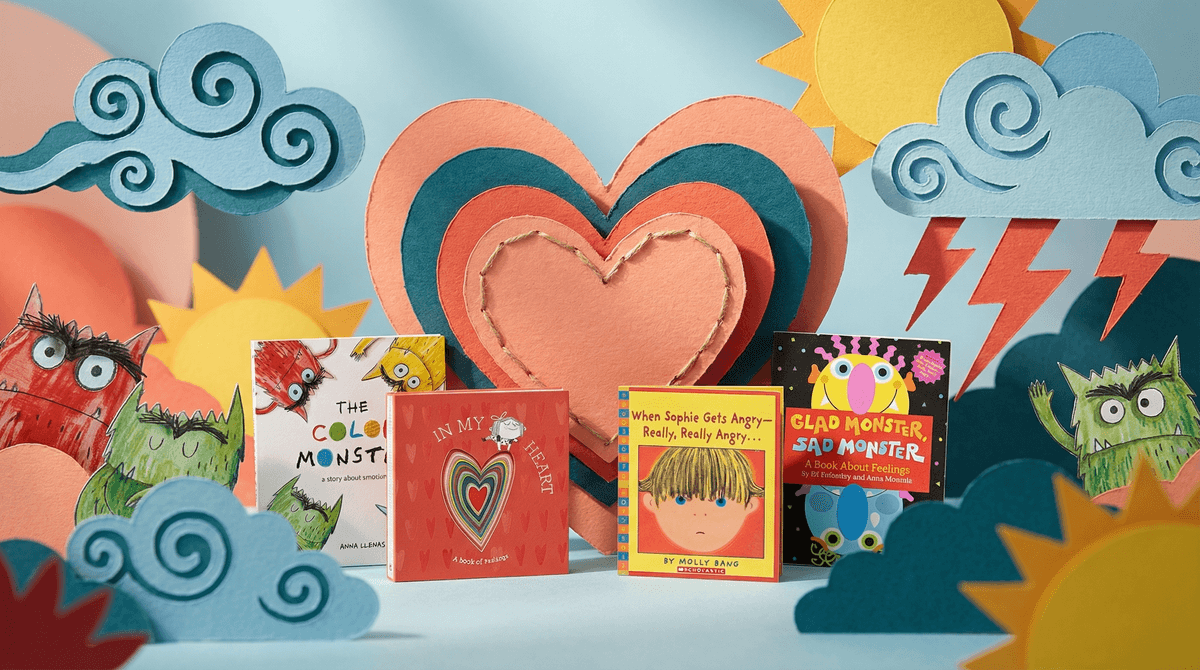
At this age, you're teaching the fundamental emotions: happy, sad, mad, scared. Books like The Feelings Book by Todd Parr use bright colors and simple scenarios. The Color Monster is brilliant because it gives each emotion a color, which helps concrete thinkers grasp abstract concepts.
In My Heart: A Book of Feelings by Jo Witek is particularly good because it describes how emotions feel physically—like happiness making your heart want to jump or anger making it hot. This helps toddlers connect their body sensations to emotional words.
Ages 5-8: Getting More Nuanced
Now you can introduce more complex emotions: disappointment, frustration, jealousy, embarrassment. When Sophie Gets Angry—Really, Really Angry is a classic that shows healthy anger management (Sophie goes outside, climbs a tree, calms down—revolutionary stuff).
The Invisible String helps with separation anxiety and the feeling of missing someone. Glad Monster, Sad Monster comes with masks so kids can literally try on different emotions, which is weirdly effective.
Ages 8-12: Real-World Complexity
Older elementary kids are dealing with legitimate emotional complexity: social hierarchies, academic pressure, body changes, friendship drama. They need books that don't talk down to them.
Wonder by R.J. Palacio is phenomenal for empathy-building and understanding how the same situation can feel completely different to different people. Inside Out and Back Again tackles displacement and cultural identity with genuine emotional depth.
The Diary of a Wimpy Kid series, while not explicitly about emotions, is actually brilliant for helping kids see how Greg's emotional reactions (often self-centered and immature) create his problems. It's emotional education through negative example, which older kids find hilarious and relatable.
Not all "feelings books" are created equal. Some are preachy. Some are so simplistic they're useless past age 3. The best ones:
- Show emotions as normal, not problems to "fix"
- Include both comfortable and uncomfortable feelings
- Demonstrate healthy coping strategies
- Feature diverse characters and situations
- Don't always have a tidy resolution (because life doesn't either)
Read them BEFORE the meltdown. These books work best as preventative tools, not crisis management. Read them at bedtime when everyone's calm, so your kid has the vocabulary ready when they need it. Trying to introduce "The Feelings Book" mid-tantrum is... not effective.
Talk about YOUR emotions too. When you're reading these books, share your own feelings. "I felt really frustrated today when the grocery store was out of the thing I needed" or "I was proud of myself for staying calm when I was annoyed." Kids need to see that adults have emotions too and manage them (usually) without losing it.
Connect them to screen content. When you're watching Bluey together (which, by the way, is exceptional at modeling emotional intelligence), pause and talk about what the characters might be feeling. Use the vocabulary from the books you've read. This helps transfer the skills from page to real life.
Emotional books for kids aren't going to magically eliminate tantrums or sibling fights. But they genuinely help. They give kids the tools to understand what's happening inside them, which is the first step to managing it.
And honestly? In a world where kids are navigating Roblox scams, YouTube comment sections, and the social politics of elementary school, emotional literacy isn't a nice-to-have. It's essential infrastructure.
Start with a few books at your kid's level. Read them regularly. Talk about feelings as they come up in daily life. It won't solve everything, but it's one of those parenting investments that actually pays off.
Not sure where to start? Check out age-appropriate book recommendations or learn more about building emotional intelligence in kids .
.
And if you're dealing with a kid who "hates reading," that's a whole other thing—but there are strategies for reluctant readers that actually work.