

TL;DR
If you want your kids to stop "rotting their brains" with endless YouTube shorts and start building actual skills, these five games are the heavy hitters. They don't feel like school, there are no pop quizzes, and the learning is baked into the fun.
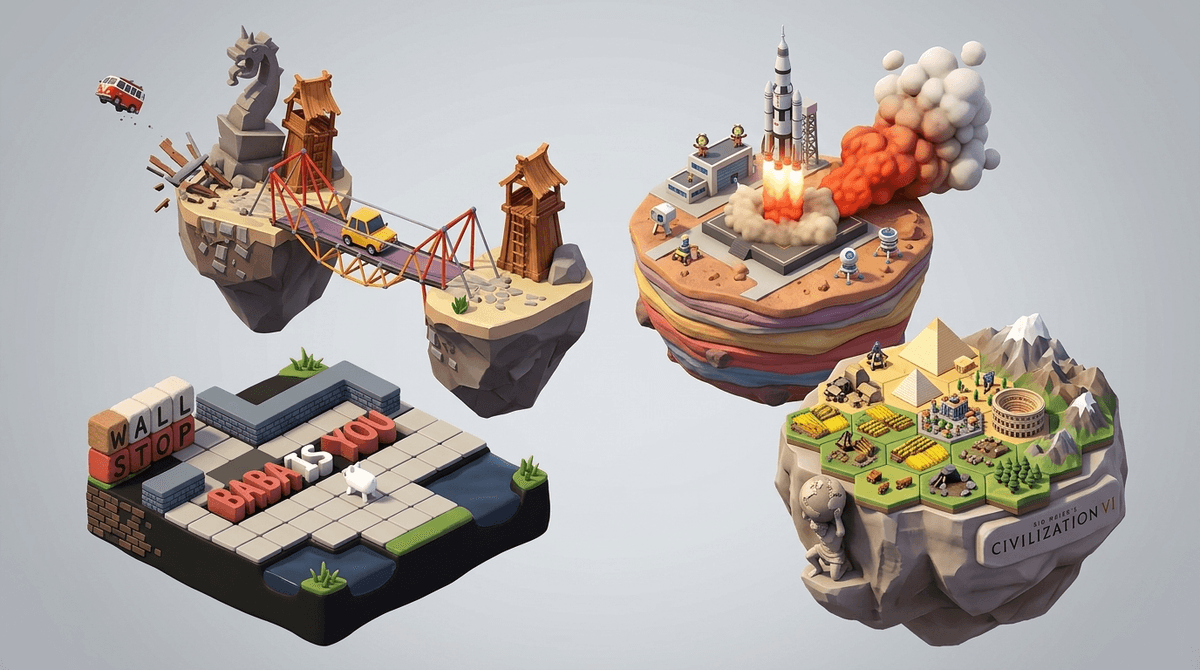
- Engineering & Physics: Poly Bridge 3 — Build bridges that don't collapse (mostly).
- Logic & Coding: Baba Is You — A puzzle game where you literally rewrite the rules of the world.
- History & Strategy: Civilization VI — Manage an empire from the Stone Age to the Space Age.
- Space Science: Kerbal Space Program — Literal rocket science that makes NASA engineers look twice.
- Creative Logic: Minecraft — Specifically the "Redstone" components which teach electrical engineering basics.
We’ve all been there. You buy the "Educational Math Quest" game with the high reviews, and your kid plays it for exactly four minutes before realizing it’s just a glorified worksheet with a dragon skin. They smell the "learning" a mile away, and suddenly they’re back on YouTube watching some weird Skibidi Toilet remix or calling everything "Ohio" in a way that makes you feel a hundred years old.
The problem is that most "educational" software is designed by people who forgot what it’s like to actually play a game. Truly great games—the ones that stick—don't teach by lecturing. They teach through mechanics. If a kid wants to build a giant automated iron farm in Minecraft, they have to understand logic gates. If they want to land a rover on a moon in Kerbal Space Program, they have to understand orbital mechanics.
This is "Stealth Learning." No eye-rolls required.
Kids are naturally wired to solve problems. The issue with school-style games is that the "game" part is usually a reward for the "work" part. (e.g., "Solve five math problems to jump over the pit!")
In stealth learning games, the work is the game. To win, you have to master the system. This builds a type of "systems thinking" that is way more valuable in 2026 than memorizing the dates of the Peloponnesian War.
Learn more about the benefits of systems thinking for kids
Ages 10+ This is the gold standard. Your kid isn't just "learning history"; they are deciding whether to build the Pyramids or focus on seafaring technology. They’ll learn about "Production," "Culture," and "Science" as competing resources. They’ll also accidentally learn who Gilgamesh and Eleanor of Aquitaine were.
- The Learning: Geopolitics, resource management, and historical milestones.
- Parent Hack: It’s turn-based, so it’s easy to walk away from when dinner is ready.
Ages 10+ If your kid prefers real-time action over turn-based thinking, this is it. It features incredibly high-quality documentary-style videos between missions that explain how trebuchets were actually built or how medieval chainmail was made.
- The Learning: Medieval history and military strategy.
Ages 8+ Yes, the game we played in the computer lab is back, but the modern version is actually respectful to history. It includes Native American perspectives and realistic trade mechanics. It’s still brutal—your kids will still die of dysentery—but they’ll understand the sheer grit required for westward expansion.
Ages 8+ This game is a physics engine disguised as a bridge-builder. You have a budget and materials (wood, steel, cable), and you have to get a car across a river. When the bridge snaps, the game shows you exactly where the stress was too high. Your kid will start talking about "triangulation" and "load-bearing joints" within an hour.
- The Learning: Structural engineering and physics.
Ages 11+ This is arguably the most "educational" game ever made that is also a legitimate cult classic. You build rockets for little green aliens. If your center of gravity is off, the rocket flips. If you don't have enough fuel for the return trip, your Kerbals are stranded on the moon forever.
- The Learning: Physics, aerodynamics, and orbital mechanics.
- Warning: It has a steep learning curve. Get tips on helping your kid get started with Kerbal Space Program
Ages 10+ This is for the kids who love Minecraft but want more complexity. You are on an alien planet building a massive automated factory. It requires intense planning, math (e.g., "I produce 60 iron ore per minute, but my furnace only processes 30, so I need two furnaces"), and logistics.
- The Learning: Efficiency, ratios, and industrial engineering.
Ages 7 to Adult This is a mind-bending puzzle game where the rules are blocks on the screen. If the blocks say "Wall Is Stop," you can't walk through walls. But if you push the blocks so they say "Wall Is You," you become the wall. It is the purest expression of "if/then" logic and programming syntax without actually writing code.
- The Learning: Logic, syntax, and creative problem-solving.
Ages 10+ You play an office worker who has to move boxes based on specific instructions. It’s actually a stealth tutorial for Assembly language (the low-level code computers use). It starts simple and gets incredibly challenging.
- The Learning: Computer science logic and optimization.
Ages 8-16 While technically a "website" and a creative tool, Scratch feels like a game to kids because they can make their own Platformers and share them. It’s the ultimate "low floor, high ceiling" tool.
- The Learning: Block-based coding and game design.
When we look at the data, we see that about 70% of middle schoolers are spending their time in "social" games like Roblox or Fortnite. There is nothing wrong with that—socializing is a skill too—but these "Stealth Learning" games offer a different kind of engagement. They are usually single-player or co-op, which means less exposure to the "toxic" chat environments parents often worry about.
A Note on Roblox: Parents often ask if Roblox is "educational." The answer is: only if they are making games. Playing "Adopt Me" is mostly just digital roleplay (and a drain on your bank account via Robux). However, using Roblox Studio to actually build a game is a legitimate introduction to Lua programming and entrepreneurship.
Check out our guide on moving your kid from playing Roblox to making games
If you want these games to "stick," you can't just drop them on your kid's iPad and walk away. Stealth learning works best when there's a "co-pilot."
- Ask "How does that work?": Instead of asking "What are you learning?", ask "How did you get that rocket to stay in the air?" or "Why did that bridge fall down?"
- Expect Frustration: These games are harder than Subway Surfers. Frustration is where the learning happens. Resist the urge to solve the puzzle for them.
- Validate the "Work": If they spend three hours building a complex machine in Minecraft, recognize that as a project, not just "screen time."
Not every minute of gaming needs to be "productive." It’s okay for kids to just decompress with Mario Kart 8. But if you’re looking to swap out some of the "brain rot" for something that builds a future-proof skill set, these stealth learning titles are your best bet.
They won't even realize they're doing math until they're halfway through building a Mars rover. And by then, it’s too late—they’re already hooked.