

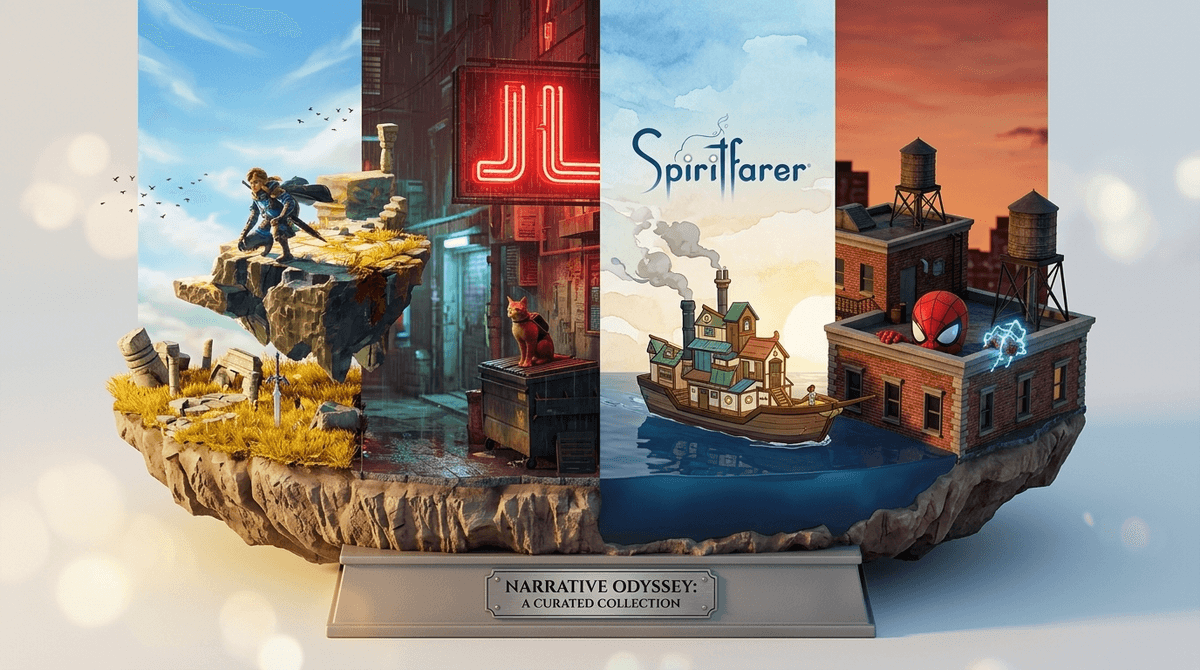
TL;DR: The Best Narrative Games for Tweens
If you’re looking to break the Fortnite or Roblox loop, these five games offer deep stories, meaningful choices, and a definitive "ending" that won't leave your kid begging for "just one more round" at 9:00 PM:
-
The Legend of Zelda: Tears of the Kingdom — The gold standard for creativity and epic scale.
-
Undertale — A masterclass in empathy where your choices actually change the world.
-
Stray — An immersive mystery seen through the eyes of a cat.
-
Spiritfarer — A beautiful, emotional exploration of kindness and saying goodbye.
-
Outer Wilds — The ultimate space mystery that rewards curiosity over combat.
I spent twenty minutes yesterday listening to a 5th grader explain why a specific lunchbox was "so Ohio" only to realize they just meant it was slightly weird. Between the slang and the constant lure of Skibidi Toilet memes, it can feel like our kids' digital lives are becoming a blur of "brain rot" and infinite loops.
Most of the games our 10-12 year olds play are designed to be "forever games." Minecraft, Roblox, and [Brawl Stars](https://screenwiseapp.com/media/brawl-stars-app are built on a loop of competition and collection. They’re digital playgrounds, which is fine, but they aren't exactly stories.
Narrative-driven games are different. They are the "novels" of the gaming world. They have a beginning, a middle, and an end. They ask kids to step into someone else’s shoes, make difficult ethical choices, and think critically about the world around them. If you want to move your tween from passive consumption to active engagement, these are the titles to put on their console.
At age 10 to 12, kids are hitting a massive developmental milestone. They are moving away from the black-and-white thinking of childhood and starting to navigate the "gray areas" of social dynamics and personal ethics.
Narrative games provide a safe laboratory for this. When a game like Undertale asks them, "Do you fight this monster or try to understand why it's attacking you?" it's doing more than providing entertainment. It’s challenging their empathy.
Unlike YouTube Shorts or TikTok, which are designed to keep kids scrolling until their eyes glaze over, narrative games require a "flow state." They demand attention and reward patience.
Learn more about the difference between passive and active screen time
While Breath of the Wild was about exploration, Tears of the Kingdom is about ingenuity. The story is epic—Link must find Princess Zelda across a fractured kingdom—but the real "narrative" is the one your kid builds through problem-solving. It’s essentially a high-stakes physics engine wrapped in a beautiful fantasy story. It encourages kids to think like engineers while participating in a classic hero's journey.
If you only pick one game from this list, make it this one. Undertale looks like a retro game from the 90s, but it is one of the most sophisticated stories ever told in the medium. The hook? You don’t have to kill anyone. You can talk, joke, or pet your way through every encounter. The game remembers how you treat people. If your kid plays it like a typical "destroy everything" game, the story will react with a somber, haunting tone. It’s the ultimate lesson in consequences.
In Stray, you play as a cat lost in a walled city populated by robots. There’s no dialogue from the protagonist—just meows and scratches—which forces kids to pay attention to environmental storytelling. It’s a great "entry-level" narrative game. It’s atmospheric, slightly mysterious, and deals with themes of environmental collapse and the meaning of humanity in a way that is accessible but not "kiddie." Check out our guide on whether Stray is too scary for younger kids
This is a "cozy game" with a heavy heart. You play as Stella, a ferrymaster to the deceased. Your job is to build a boat, care for spirits, and eventually help them move on. It is a profound exploration of grief and kindness. For a 12-year-old starting to grapple with big life questions, Spiritfarer offers a beautiful, non-threatening way to talk about loss and the importance of caring for others.
Note: This is not The Outer Worlds. Outer Wilds is a space exploration mystery where the sun goes supernova every 22 minutes, and you are stuck in a time loop. To "beat" the game, you have to read ancient texts, observe planetary patterns, and piece together a massive cosmic puzzle. It is the ultimate "curiosity" game. There are no quest markers telling you where to go; your kid has to actually think to progress.
For the kid who loves the Marvel Cinematic Universe, this is a narrative powerhouse. It deals with the struggle of balancing personal responsibilities with the "greater good." The relationship between Peter Parker and Miles Morales is a fantastic depiction of mentorship and friendship. It’s high-action, yes, but the story beats are as strong as any movie in the theater.
When we talk about "narrative" games, we are often talking about games that deal with more complex themes than Mario Kart 8 Deluxe.
- Violence: Most of these games feature some combat, but it’s rarely the point. In Undertale, violence is a choice. In Stray, it’s mostly about escaping.
- Complexity: Some of these, like Outer Wilds, can be genuinely difficult. They require reading and logic. If your kid has a low frustration tolerance, you might want to start with Tchia, which is more laid back.
- Emotional Weight: Spiritfarer can be a tear-jerker. If your family has recently dealt with loss, this could be a therapeutic experience, or it might be a bit much. It’s worth a quick conversation.
See content warnings for these games
The best way to support a narrative gaming habit is to treat it like a book club. Because these games have stories, you can actually ask meaningful questions about them:
- "Why did you decide to spare that character?"
- "What do you think happened to the people who lived in that city?"
- "If you were in that situation, would you have made the same choice?"
This turns gaming from a "zoning out" activity into a "zoning in" activity. You're showing them that you value the story they're experiencing, not just the time they're spending on the screen.
We don't need to ban Roblox or Fortnite, but we can offer better alternatives. Narrative-driven games are the "vegetables" that taste like dessert. They provide the dopamine hit of gaming while nourishing a kid's ability to focus, empathize, and solve complex problems.
If your kid is stuck in an infinite loop of "brain rot" content, try introducing one of these stories. You might find that they’re just as hungry for a good ending as we are.
- Check the console: See if you have a Nintendo Switch, PlayStation 5, or Xbox. Most of these games are available across platforms.
- Watch a trailer together: Head to YouTube and search for the trailer for Stray or Tears of the Kingdom to see if the vibe fits your kid.
- Set a "Story Night": Dedicate one night a week to a narrative game where the goal isn't to "win" but to see what happens next in the plot.