

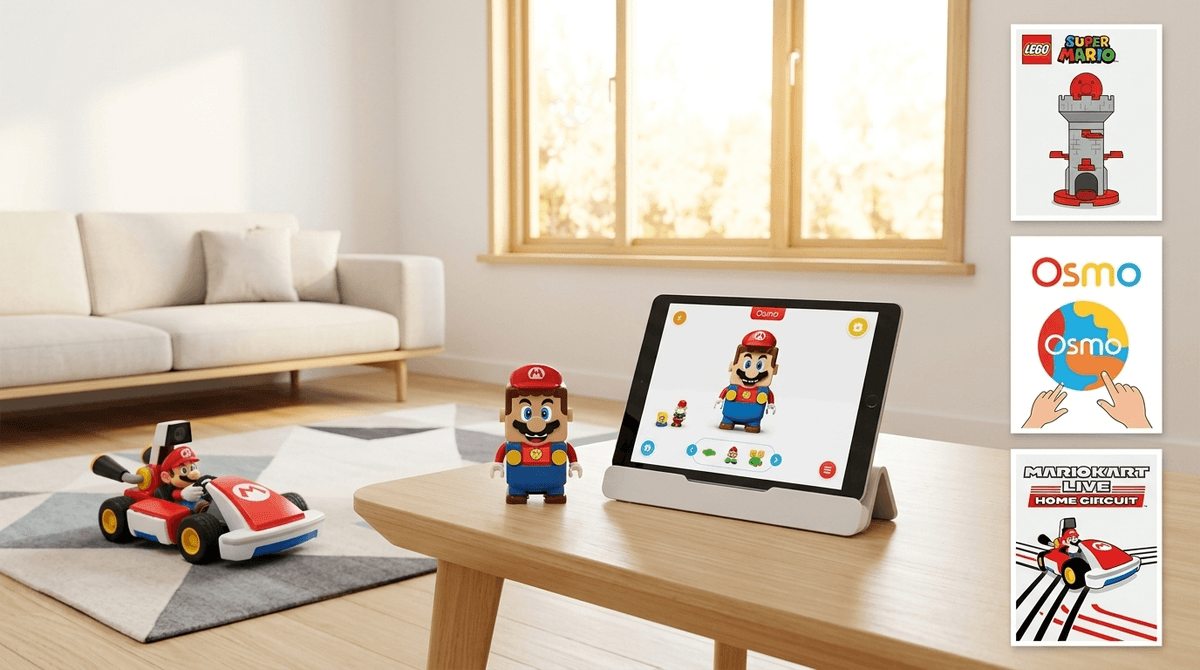
TL;DR: Stop fighting the "screen vs. dirt" war. The best play happens in the "phygital" middle ground where digital tools supercharge physical creativity. Top recommendations: LEGO Super Mario for tactile platforming, Osmo for hands-on learning, and Stop Motion Studio to turn those random plastic figurines into actual cinema.
The other day at pickup, I heard a second-grader describe a particularly messy art project as "so Ohio," and it hit me: the wall between "online life" and "real life" hasn't just thinned—it’s gone. To our kids, a digital experience is just as "real" as a physical one.
We’ve spent a decade treating screen time like a sugary snack—something to be strictly rationed and balanced with "healthy" activities like blocks or tag. But the reality of 2025 is the Phygital Frontier. This is the space where the iPad isn't a passive window into "brain rot" like Skibidi Toilet, but a tool that makes the physical world more interesting.
If we want to raise tech-healthy humans, we have to stop treating the tablet like the enemy of the toy box and start treating it like the ultimate accessory.
Phygital (physical + digital) play is any activity where the digital and physical worlds loop together. It’s Pokémon GO making a walk to the park an adventure. It’s using a YouTube tutorial to learn how to fold a complex origami crane. It’s Minecraft inspiring a kid to go into the backyard and build a "dirt hut" in real life.
The goal isn't just to "limit screens." It’s to ensure that when the screen is on, it’s feeding the imagination, not just numbing it.

When kids engage in hands-on play, they develop fine motor skills and spatial awareness. When they engage in digital play, they develop systems thinking and digital literacy. When they do both? They become creators rather than just consumers.
The "brain rot" we all worry about—that glazed-over look kids get after two hours of mindless scrolling—happens when the digital experience is a dead end. Phygital play is a loop. The digital input triggers a physical output, and vice versa.
Ages 6-12 This is the gold standard of phygital. You build a physical course out of bricks, and the Mario figure has a sensor that "reads" the colors and special barcodes on the bricks. He reacts to lava (red bricks), gets coins, and battles bosses.
- The Screenwise Take: It’s brilliant because the "game" only works if you actually build something with your hands. It turns "building a set" into "designing a level."
- No-BS Review: The expansion sets get pricey fast, and the app is mostly just for instructions and tracking scores. But for keeping a "video game kid" engaged with physical blocks? It’s unmatched.
Ages 4-10 Osmo uses a little red mirror that clips over the iPad camera, allowing the tablet to "see" the table in front of it. Kids move physical tiles, drawing pads, or coding blocks, and the app responds.
- The Screenwise Take: Osmo Genius Starter Kit is the best way to make a tablet feel like a board game.
- Why Kids Love It: It feels like magic. They draw a picture on paper, and it "jumps" into the screen to become part of a story.
Ages 7+ Take all those Star Wars figures and LOL Surprise dolls gathering dust and give them a job. This app lets kids film their own movies frame-by-frame.
- The Screenwise Take: This is the ultimate "active" screen time. It requires patience, storytelling, and set design.
- Pro-Tip: Buy a cheap $10 tripod for the phone or iPad. It saves a lot of frustration.
Ages 8+ You drive a real RC car around your living room using your Nintendo Switch. The car has a camera, so your coffee table becomes a race track on the screen.
- No-BS Review: It is incredibly cool for exactly three days. Then you realize you need a lot of floor space and your cat is terrified of it. It’s a high-price "wow" item, but the "phygital" integration is impressive.
Ages 8-14 Sphero is a robotic ball you control via an app. But the "Edu" side lets kids actually code its movements, colors, and reactions.
- The Screenwise Take: It’s coding with immediate physical consequences. If your code is wrong, the robot hits the wall. That’s a better teacher than any "if/then" worksheet.
Is Roblox teaching entrepreneurship or just draining your bank account? The answer is: Yes.
If your kid is just spending Robux on "Pet Simulator 99" skins, it’s a digital arcade. But if they are using Roblox Studio to build their own games, they are learning 3D modeling, Lua scripting, and user experience design.
To make Roblox "phygital," challenge them to sketch their game levels on paper before they build them. Ask them to write a "business plan" for their game. If they want Robux, make them "earn" it by finishing a physical project.
Preschool & Kindergarten (Ages 3-6)
Focus on Augmented Reality (AR) that encourages movement.
- Try: PBS Kids Games has great AR features that put characters in your room.
- Boundary: Keep it tactile. If they aren't touching something physical (blocks, crayons, dirt) while using the tech, keep the sessions under 20 minutes.
Elementary (Ages 7-11)
This is the "Maker" phase. Use tech as the instruction manual.
Middle School (Ages 12-14)
Focus on Utility and Skill-Building.
- Try: Procreate for digital illustration or GarageBand for music production.
- Boundary: At this age, "phygital" looks like using Discord to coordinate a real-life meetup or using AllTrails to plan a hike. The tech should facilitate the real world, not replace it.
Instead of saying "Get off that iPad and go play," try:
You're validating their digital interests while gently steering them toward the physical world. It shows you’re "fluent" in their world without being a "cool mom/dad" who lets them rot.
Digital wellness isn't about a stopwatch. It's about integration.
When we bridge the gap between the screen and the floor, the "battle" over screen time usually dissipates. The tablet stops being a forbidden fruit and starts being a tool—like a hammer or a paintbrush.
Start small. This weekend, download Stop Motion Studio, grab a handful of clay or some action figures, and see what happens. You might find that the "phygital" middle ground is actually where the most fun is had.