

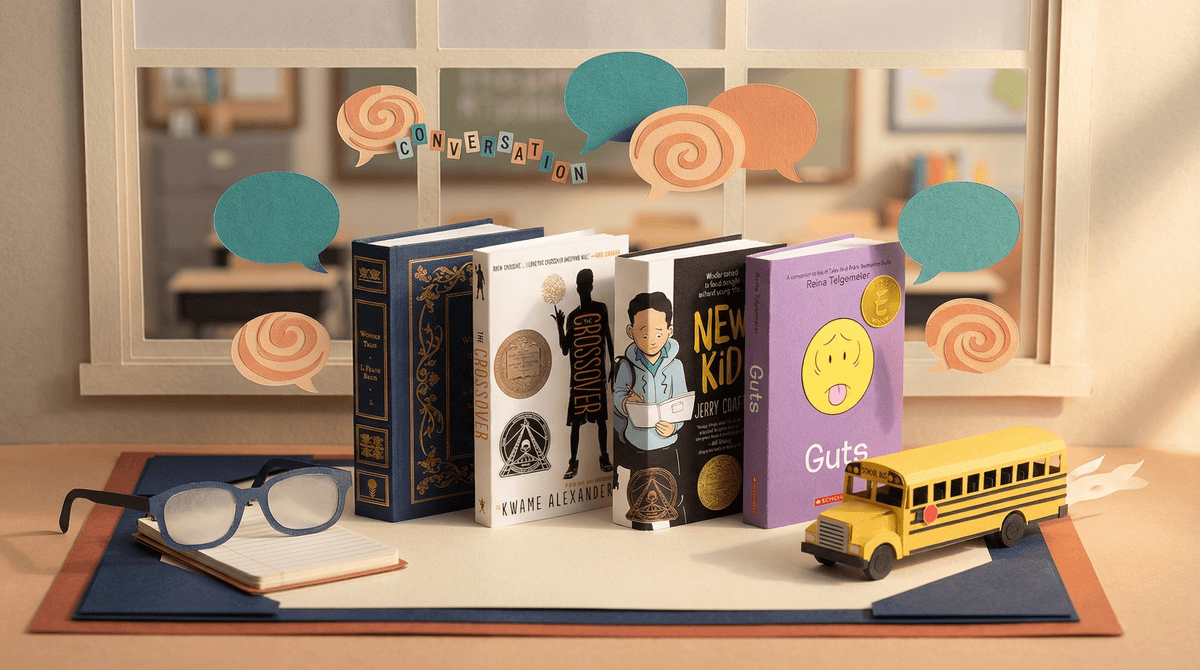
Look, I'm not talking about "summer reading lists" or whatever dusty classics the school is assigning. I'm talking about books that actually help kids process what it feels like to walk back into those hallways—the social anxiety, the identity questions, the "where do I fit in?" spiral that hits somewhere between the bus stop and homeroom.
Back-to-school books are the ones that spark real conversations about friendship drama, body changes, feeling different, and figuring out who you are when you're not just "someone's kid." They're books that meet kids where they actually are, not where curriculum committees think they should be.
Here's the thing: kids are walking into schools with more social complexity than ever before. They're navigating group chats, social media drama (even if they're "not supposed" to be on it yet), performative friendships, and identity questions that used to wait until high school but now hit in elementary school.
And yet, we're still handing them books about... what, a kid who moves to a new town and makes one friend and everything's fine? Come on.
The right book can be a mirror ("oh thank god, someone else feels this way") or a window ("wait, that's what it's like for them?"). Either way, it gives you an opening to talk about the stuff that actually matters—not just "how was school today?" (answer: "fine") but "hey, that part where the character felt left out at lunch... does that ever happen to you?"
Ages 6-8: Early Elementary
The Invisible Boy by Trudy Ludwig
This one's about a kid who gets overlooked until someone finally sees him. It's perfect for talking about inclusion and what it means to notice the quiet kids. The illustrations literally show the main character in grayscale until he's included—kids get it immediately.
Those Shoes by Maribeth Boelts
About wanting the "right" shoes when your family can't afford them. This book doesn't sugarcoat economic differences, and it opens up conversations about consumerism and kindness that are shockingly relevant in the age of Stanley cup obsession.
Ages 8-11: Upper Elementary
Wonder by R.J. Palacio
Yes, it's everywhere. Yes, your school probably already did a unit on it. But if your kid somehow missed it, this book about a boy with facial differences starting school is still the gold standard for empathy conversations. The multiple perspectives are what make it work—kids see how everyone's dealing with their own stuff.
New Kid by Jerry Craft
A graphic novel about a Black kid navigating a predominantly white private school. It's funny, it's honest about microaggressions and code-switching, and it doesn't tie everything up in a neat bow. This is the book for talking about what it means to be "the only one" in a space.
The Crossover by Kwame Alexander
Written in verse, so even reluctant readers tend to fly through it. It's about twin brothers, basketball, family dynamics, and growing apart from the people you've always been close to. Perfect for kids navigating changing friendships.
Ages 11-14: Middle School
Speak by Laurie Halse Anderson
This one's heavy—it's about a girl who stops speaking after a traumatic event at a party. But it's also the most honest book about isolation, trauma, and finding your voice again. Not for every kid, but for the right kid at the right time, it's life-changing. Read it yourself first.
Ghost by Jason Reynolds
About a kid who's fast, angry, and running from his past. It's part of a series, and Reynolds writes with so much heart about kids who don't fit the "good kid" mold but are trying anyway. Great for conversations about second chances and what it means to be on a team.
The Hate U Give by Angie Thomas
A teen witnesses a police shooting of her unarmed friend. This book doesn't shy away from racism, police violence, or code-switching between different worlds. It's for older middle schoolers and high schoolers, and it will absolutely spark difficult conversations—which is exactly why it matters.
Heartstopper series by Alice Oseman
Graphic novels about a gay romance between two British teens. They're sweet, affirming, and deal with coming out, mental health, and friendship. If you've got a kid questioning their identity or just want them to see healthy LGBTQ+ relationships normalized, this is it.
Not every book will land. Some kids want to see themselves reflected; others want total escapism. Both are fine. The goal isn't to force deep conversations—it's to make space for them.
Graphic novels count. If your kid only wants to read Dog Man or Amulet, that's still reading. But if you want to nudge them toward something with more emotional depth, try Guts by Raina Telgemeier (about anxiety) or Roller Girl (about growing apart from a best friend).
You don't have to read every book with them. But you should know what they're reading. Skim reviews on Common Sense Media if you're not sure about content. And if a book deals with tough topics—trauma, racism, sexuality—read it yourself first so you're not blindsided when your kid has questions.
Some books are conversation starters, not conversation enders. If your kid reads Wonder and suddenly wants to talk about what makes someone a good friend, lean in. If they read Speak and get quiet, give them space but check in later.
Back-to-school season is already overwhelming—new teachers, new schedules, new social hierarchies. Books won't solve everything, but the right one can help a kid feel less alone, spark a conversation you didn't know how to start, or just give them a break from doomscrolling TikTok.
Start with one. Pick a book that matches where your kid is—socially, emotionally, developmentally. Read it together, or separately and then talk about it. And if they hate it, try another one. The goal isn't to turn them into literary critics. It's to give them tools to navigate the messy, complicated, sometimes beautiful experience of growing up.
- Browse age-appropriate book recommendations in the Screenwise media library filtered by age and themes
- Talk to your kid about what they're curious about—friendship? Identity? Tough stuff? Let that guide your picks
- Check out alternatives to screen time if you're trying to build more reading time into the routine
- Need more personalized recommendations? Get book recommendations for your kid about your specific kid's interests and reading level