Our reviews and ratings are 100% unbiased. Screenwise is a Bookshop.org affiliate and an Amazon Associate, so if you buy a book through one of our links, we may earn a commission. Bookshop.org purchases also support independent bookstores.
Screenwise Verdict
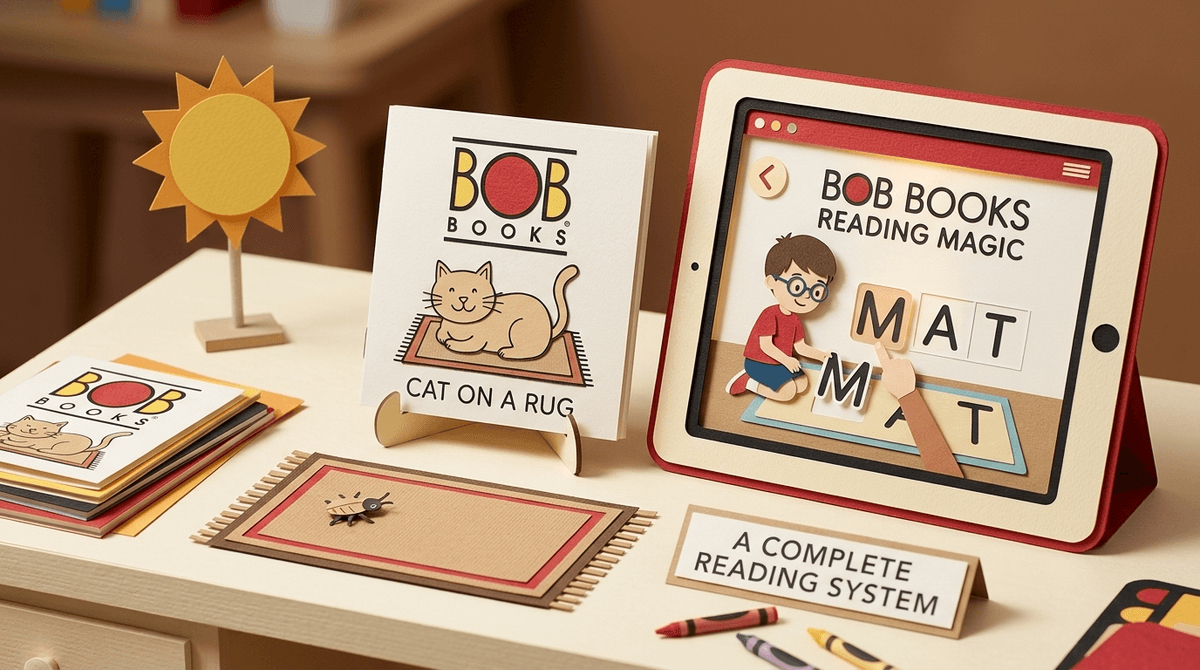
Bob Books are the unsexy workhorses of early literacy. They're not going to win awards for storytelling or spark your kid's imagination—'Mat sat on Sam' is not exactly Roald Dahl. But here's the thing: they work.
For forty years, these little books have been the phonics equivalent of training wheels, giving kids the structure and success they need to crack the reading code. The progression is smart, the approach is research-backed, and the confidence boost for struggling readers is genuine and important.
The verdict: Essential tools for teaching reading, but pair them with actual literature. Think of Bob Books as scales for a piano student—you need them to build the skill, but you also need real music to fall in love with playing. Use these to teach decoding, then immediately follow up with books that have plots, characters, and stories worth caring about.
Age Fit
Perfect for ages 4-6 who are just starting to decode letters and sounds, especially pre-K through early first grade. Kids who are already reading fluently will find them too simple, but struggling second graders might still benefit from the confidence boost.
WISE Breakdown
Wholesome
92
Simple, gentle stories with friendly illustrations that build confidence without stress. The tone is encouraging and supportive, designed to make early readers feel successful. Stories feature relatable scenarios (Sam sat, Mat ran) without conflict or negative emotions. The measured, gradual approach respects developmental stages.
Imaginative
58
These are functional phonics tools, not imaginative literature. The stories are intentionally bare-bones to focus on decoding skills—two to three letter words, very simple sentences. Illustrations are described as 'silly' and 'fun' but deliberately don't distract from the words. There's minimal plot, character development, or creative storytelling. They serve their purpose brilliantly, but imagination isn't the point.
Safe
98
About as safe as media gets. Simple words, neutral content, no concerning themes. The entire design is built around building confidence in struggling readers, so there's nothing that could trigger anxiety or distress. Parent reviews consistently praise the non-threatening approach.
Enriching
88
Extraordinarily effective at their specific mission: teaching kids to decode text using phonics-based Science of Reading principles. Forty years of success, millions of copies sold, and countless kids proudly saying 'I read the whole book!' The gradual introduction of sounds, decodable text, and immediate success build both literacy skills and reading confidence. However, enrichment is narrow—this is skill-building, not broadening vocabulary, cultural knowledge, or emotional intelligence.
Parent Info
✓
Why It Might Be Great
Proven track record over 40+ years helping kids decode their first words and feel genuinely proud
Built on Science of Reading research with systematic phonics progression that actually works
The confidence boost is real—kids who struggle with reading finally get to say 'I read the whole book!' and mean it
Gradual difficulty increase respects how reading skills actually develop, starting with just four sounds
Parents and teachers consistently report success with reluctant or struggling readers
⚠
What to Watch For
These are teaching tools, not bedtime stories—the plots are essentially nonexistent ('Sam sat. Mat sat.')
Kids who are already reading may find them boring; they're specifically for decoding practice
You'll need to supplement with richer literature for vocabulary, imagination, and storytelling
Some kids blow through them in days, others need weeks—pace varies wildly
Conversation Starters
"Which words were easiest for you to sound out? Which ones were tricky?"
"Want to read this one to [sibling/pet/stuffed animal] and be the teacher?"
"How does it feel when you can read a whole book by yourself?"
"Should we make up a different ending to this story together?"