

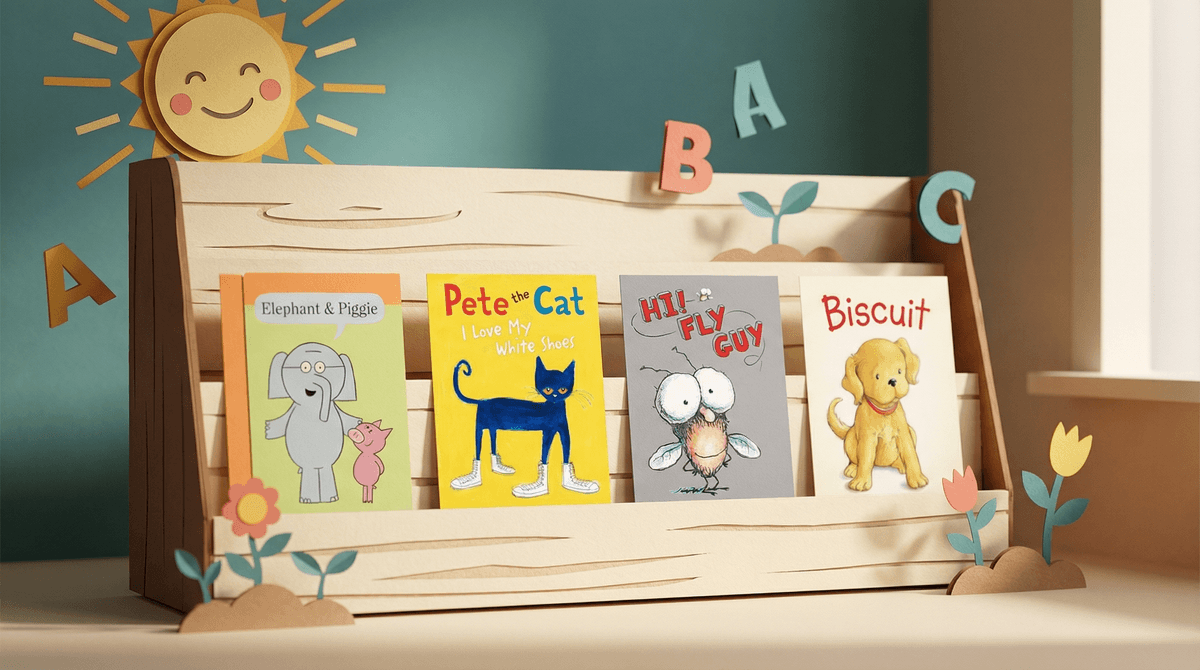
Look, I'm going to be honest: getting a 5 or 6-year-old to sit still with a book can feel like trying to nail jello to a wall. But here's the secret weapon that actually works—book series designed specifically for early readers.
These aren't the chapter books your third-grader is reading. We're talking about books with repetitive language patterns, predictable storylines, and characters that show up again and again so kids feel like they're visiting old friends. Think 20-40 pages max, large text, lots of pictures, and stories simple enough that after a few read-throughs together, your kindergartner can start "reading" them independently (even if they're half-memorizing, half-decoding—that totally counts).
The magic of a series is that once a kid connects with the characters or format, they want the next book. And another. And suddenly your reluctant reader is asking to go to the library. It's basically the same psychology that makes them watch 47 episodes of Bluey, except now it's books.
Random picture books are great for bedtime, but for building actual reading skills? Series are the MVP. Here's why:
Familiarity breeds confidence. When kids know the characters, the format, and the general vibe, they can focus their brain power on decoding words instead of figuring out what the heck is happening in the story.
Built-in motivation. Finishing a book feels good. Wanting the next one? That's the reading habit forming in real-time.
Scaffolded difficulty. Good series for this age often get slightly more complex as they go, so kids are leveling up their skills without realizing it.
Repetition without boredom. Kids this age love repetition (it's why they'll watch the same episode 800 times), and series deliver that comfort while still offering something new.
Elephant & Piggie by Mo Willems
Ages 4-7 | 25 books in the series
These are legitimately funny. Like, you-will-actually-laugh-out-loud funny. The dialogue is simple, the emotions are big, and the friendship between anxious Elephant and impulsive Piggie is genuinely sweet. Each book is around 60 pages but reads in 5 minutes because it's mostly speech bubbles. Perfect for kids just starting to read independently.
Parent tip: These work great as "plays" where you and your kid read different character parts.
Biscuit by Alyssa Satin Capucilli
Ages 3-6 | 30+ books
The OG puppy series. Biscuit is a small yellow dog who gets into small yellow dog adventures. The vocabulary is super controlled and repetitive ("Woof, woof!" appears approximately 10,000 times), which is actually perfect for emergent readers. Are they sophisticated? No. Will your kid be able to read them independently after a few tries? Yes.
Real talk: These are a little boring for adults, but they're confidence builders for kids who need wins.
Pete the Cat by James Dean
Ages 4-8 | 40+ books
Pete is the chill cat who rolls with whatever happens, teaching resilience through groovy adventures. The "I Love Pete the Cat" reader series is specifically designed for kindergartners, with controlled vocabulary and simple sentences. Some books include songs, which helps with memory and engagement.
Watch out for: The original picture books are different from the "I Can Read" leveled readers—make sure you're getting the right ones for independent reading.
Fly Guy by Tedd Arnold
Ages 4-8 | 15 books
A boy and his pet fly. Yes, really. These are weirdly compelling and slightly gross in a way that appeals to kindergartners. The humor is accessible, the plots are silly, and the vocabulary is challenging enough to be interesting without being frustrating.
Why kids love it: It's about a fly. Kids this age think that's hilarious.
Henry and Mudge by Cynthia Rylant
Ages 5-8 | 28 books
A boy and his huge dog having gentle, slice-of-life adventures. These are slightly longer and more complex than the others on this list—great for late kindergarten or kids who are ready to level up. The language is beautiful without being complicated, and the stories have actual emotional depth.
Bonus: These hold up on re-reads way better than some other early reader series.
Bob Books
Ages 4-6 | Multiple sets
Okay, these aren't going to win literary awards, but they're phonics workhorses. Each set introduces specific letter sounds and sight words in a super systematic way. The stories are... let's say "functional." But for kids learning to decode, they're incredibly effective.
When to use them: These are tools, not entertainment. Use them for practice, then reward with the fun stuff.
Reading level matters—but so does interest. A book labeled "Kindergarten level" that bores your kid is useless. If your 5-year-old is obsessed with dinosaurs, a slightly harder dinosaur book will work better than an "appropriate" book about sharing.
Check the format. Early reader series usually fall into levels:
- Pre-reader/Emergent: Mostly pictures, 1-2 sentences per page
- Level 1: Simple sentences, lots of repetition, familiar words
- Level 2: Longer sentences, more complex plots (usually late K/early 1st grade)
Look for "I Can Read," "Step into Reading," or "Ready to Read" labels. These are the major leveled reader series that publishers use, and they're pretty consistent about difficulty.
Try before you buy. Libraries are your friend. Check out 5-6 books from a series and see what sticks before investing.
Here's something worth thinking about: the same kid who "can't focus" on a book will happily watch 90 minutes of Paw Patrol. That's not a moral failing—it's brain chemistry. Screens are designed to be maximally engaging with zero effort required.
Books require more cognitive work, which is exactly why they're valuable. But that also means you might need to make reading more appealing than the alternative. Some ideas:
I'm not saying books are "better" than screens in some moral sense, but they do build different skills—patience, imagination, sustained attention, decoding. Skills that are harder to develop if everything is delivered via algorithm.
"My kid only wants me to read to them." That's normal. Try "echo reading" where you read a page, then they read the same page. Or alternate pages. Gradually shift more to them.
"They memorize the book instead of reading it." That's actually a stage of reading development. It's how they learn book language and story structure. Let it happen. Eventually they'll start actually decoding.
"They only want the same book over and over." Repetition is how learning happens at this age. Let them re-read favorites 47 times. Sneak in new books from the same series alongside the beloved one.
"We started a series and they lost interest." Not every series will click. Try a different one. There's no moral obligation to finish a series just because you started it.
The best book series for your kindergartner is the one they'll actually read. Not the one with the best reviews, not the one their teacher recommends, not the one you loved as a kid—the one that makes your specific kid want to turn pages.
Try a bunch. See what sticks. Don't stress about reading level if they're engaged. And remember: the goal isn't to create a tiny literary critic. It's to build the habit of reading and the confidence that "I can do this."
Also? If they want to read the same Elephant & Piggie book 900 times, that's not a failure—that's a reader in training.
This week: Hit the library and check out 3-4 books each from two different series. See which one your kid gravitates toward.
This month: Once you find a series that works, get the next 3-5 books so you have them ready when they finish one. Momentum matters.
All year: Mix independent reading time with read-aloud time. They're different skills, and both matter. And if you need a break from reading the same book for the 47th time, audiobooks count too.