

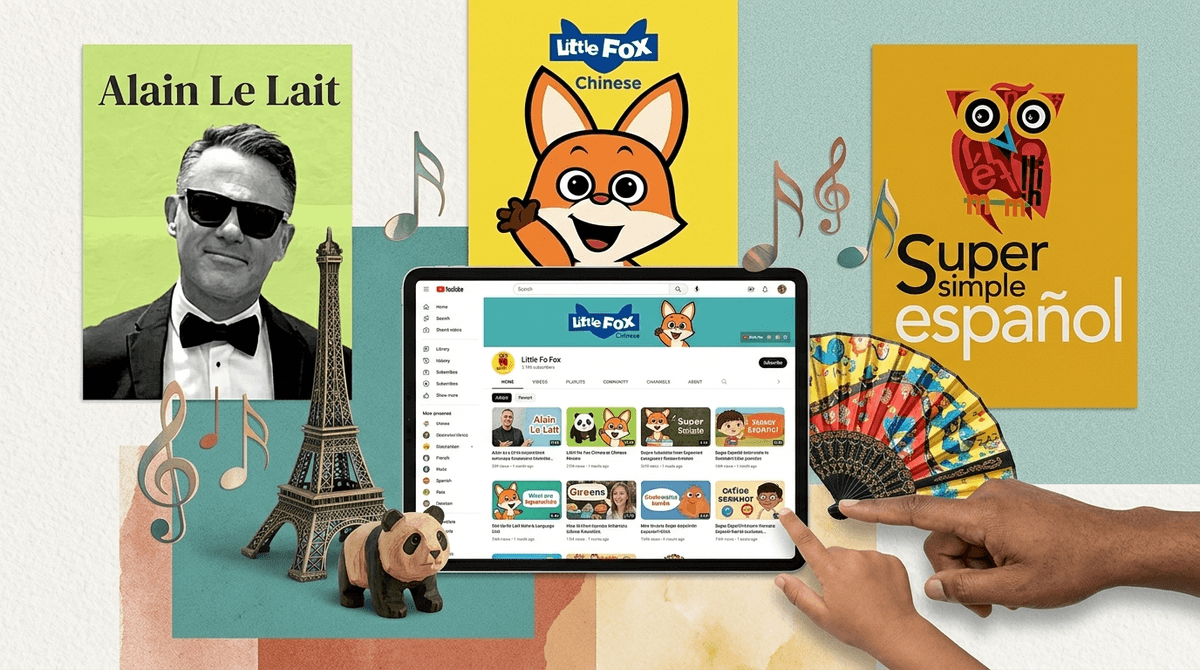
TL;DR: Yes, YouTube can move the needle on fluency, but only if you move past the "passive background noise" phase. If you want the best results without the brain rot, start with Super Simple Español for the little ones, Basho & Friends for catchy music-based learning, and Little Fox Chinese for structured storytelling.
Find YouTube channels based on your kid's age and target language
We’ve all been there. You’re trying to get dinner on the table, the toddler is vibrating at a frequency that suggests an imminent meltdown, and the 7-year-old is asking for the tenth time why they can't play Roblox. You hand over the iPad, but to soothe your internal "too much screen time" alarm, you navigate to a channel that’s entirely in Spanish.
"It’s educational," you tell yourself. "They’re practically in a dual-immersion program now."
But is that actually true? Or is watching Cocomelon in French just... watching Cocomelon with a different soundtrack?
The reality is that YouTube is a double-edged sword for language learning. It offers incredible, free access to native speakers and high-quality pedagogy, but it also offers a direct pipeline to "educational junk"—content that looks like it’s teaching something but is actually just high-speed, flashing-light "brain rot" that leaves kids overstimulated and not actually knowing how to say "Where is the library?"
Here is how to navigate the "Language Loophole" effectively.
Language acquisition requires two main things: comprehensible input and engagement.
Comprehensible input is just a fancy way of saying "stuff your kid can almost understand based on the context." If a kid watches a video of someone saying "pomme" while holding an apple, they get it. If they watch a complex political debate in French, they’re just hearing noise.
YouTube is the king of comprehensible input because it combines visuals with audio. For kids who think anything older than a week is "prehistoric" and use "Ohio" to describe literally anything cringey, the fast-paced, visual nature of YouTube keeps them engaged long enough for some of that vocabulary to actually stick.
Spanish: The Gold Standard
Spanish content on YouTube is vast, but quality varies wildly. You want to avoid the channels that are just dubbed versions of American toy-unboxing videos.
Ages 2-6 This is the gold standard for early learners. The pacing is slow (a rare gift on YouTube), the pronunciation is crystal clear, and the songs are genuinely catchy. It’s perfect for building a foundational vocabulary of colors, animals, and daily routines. Check out our guide on why Super Simple Songs is a parent favorite
Ages 5-10 If your kid thinks nursery rhymes are "for babies," Basho is the answer. It uses catchy, modern music (think hip-hop and pop vibes) to teach Spanish. It feels much more "cool" and much less like a classroom. It’s great for older elementary kids who still need the basics but want a more mature aesthetic.
Mandarin Chinese: Beyond the Basics
Mandarin is notoriously difficult for English speakers because of the tones, but visual storytelling makes it much more accessible.
Ages 4-12 Little Fox is essentially a leveled reading program but in video form. They have "stories" categorized by difficulty level. This is huge because it allows your kid to progress. They start with single words and move into complex narratives. It’s one of the few channels that feels like a legitimate curriculum.
Ages 3-8 Miss Panda (Amanda Hsiung-Blodgett) is an actual educator, and it shows. Her content is very interactive, encouraging kids to speak back to the screen. If you want your kid to actually produce sounds rather than just sit there like a statue, this is the one.
French: Chic and Educational
Ages 3-9 You might recognize the "Boum Boum" song. Alain Le Lait creates quirky, slightly surreal animated songs that kids find hilarious. The repetition is excellent for memorization without being annoying.
Ages 2-5 This is the French equivalent of the big-budget nursery rhyme channels. It’s very colorful and very fast. Use this sparingly if your kid is prone to overstimulation, but it’s great for pure immersion for toddlers.
Here is the "no-BS" truth: Your kid will not become fluent just by watching YouTube.
If they watch Minecraft videos in Spanish, they might learn the word for "diamond" or "creeper," but they aren't going to be able to order dinner in Madrid.
To make the "loophole" work, you have to move from passive consumption to active engagement.
- Repeat the Catchphrases: If a song has a hook, sing it in the car.
- Bridge to Apps: Use YouTube as the "hook" and then use an app like Duolingo or Khan Academy Kids (which has great Spanish content) for the actual practice.
- Turn on Subtitles (Sometimes): For older kids, having the target language subtitles on while they watch can help connect the sounds to the written words. Avoid English subtitles; that just turns it into a reading exercise in English.
- Ages 2-5: Stick to high-quality, slow-paced music channels. Avoid anything with "surprise eggs" or "toy reviews," even if they are in another language. Those are designed to trigger dopamine loops, not language centers.
- Ages 6-10: Look for "Let’s Play" style videos in the target language for games they already like, such as Toca Life World. Because they already know the context of the game, they can pick up the verbs and nouns more easily.
- Ages 11+: This is where you can transition to actual "vloggers" from other countries. Seeing a teenager in Mexico City talk about their day is way more compelling than a textbook.
YouTube’s algorithm doesn't care if your kid is learning Mandarin; it cares if they stay on the platform. Even on YouTube Kids, the "Recommended" sidebar can quickly lead from a lovely French song about snails to a weird, AI-generated video of a superhero in a dental office.
Pro-tips for safety:
- Use Playlists: Don't just let the "Auto-play" run. Create a "Spanish Time" playlist and populate it with vetted videos.
- Check the "About" Section: Ensure the channel is run by actual educators or reputable media companies rather than anonymous content farms.
- Supervised Viewing: For younger kids, language learning should be a "together" activity. If you’re reacting to the video, they are much more likely to value the information.
It is perfectly okay to use YouTube as a tool. We live in a world where digital literacy is just as important as traditional literacy. If your kid is going to have screen time anyway, choosing a high-quality language channel is a massive win.
However, don't let the "educational" label blind you to the quality of the content. Some "language learning" videos are just low-effort animations with Google Translate voiceovers. If the voice sounds robotic or the grammar seems off, trust your gut and switch it off.
YouTube is an incredible supplement, but a terrible primary teacher. Use it to build excitement, to hear native accents, and to make the language feel "real" and not just like a school subject.
Find the channels that resonate with your kid's specific brand of humor—whether that’s the goofy songs of Alain Le Lait or the structured stories of Little Fox Chinese—and let them lean into it.
Just remember: if they start calling their Spanish homework "mid" or saying the vocabulary is "giving Ohio," you know the YouTube influence has officially taken hold.
- Pick one language and find 3-5 videos to put into a dedicated playlist today.
- Watch with them for the first 10 minutes to gauge their interest and the content quality.
- Use our list maker for specific channel recommendations if your kid has a niche interest, like "Spanish channels about space" or "Japanese channels for kids who love cats."