

Let's be honest: if you've got a toddler or preschooler, you've probably used Cocomelon, Paw Patrol, or Ms. Rachel to buy yourself 20 minutes of peace. No judgment here—92% of families in our community use TV or streaming, and these shows are practically inescapable.
But here's the thing: not all screen time is created equal, and the shows dominating toddler screen time right now share some concerning patterns that child development experts are increasingly worried about.
Screenwise Parents
See allThe pacing problem is the big one. Cocomelon averages a scene change every 2-3 seconds. That's faster than most action movies. Paw Patrol isn't much better, with rapid cuts, constant sound effects, and problems that get solved in 11 minutes flat. This hyperstimulation creates what researchers call "attentional inertia"—kids get hooked on the fast pace and struggle to engage with slower, real-world activities afterward.
The language issue is subtler but equally important. While Ms. Rachel does use some educational language, the repetitive, simplified vocabulary across these shows doesn't challenge developing brains the way richer language does. Compare "Ryder needs us!" to "I wonder what we might discover if we look more carefully."
Emotional modeling in these shows tends toward the superficial. Characters experience problems and feelings, sure, but they're resolved so quickly there's no space for kids to sit with complexity, process emotions, or see realistic coping strategies.
The irony? These shows work really well—at least in the short term. They're designed to capture and hold attention through that rapid pacing, bright colors, and repetitive music. Kids zone out. Parents get a break. Everyone's happy.
Until you try to turn it off and your previously chill toddler melts down like you've committed a war crime.
That's the dopamine cycle at work. These shows create a specific type of stimulation that's hard for young brains to regulate. It's not that your kid is "addicted" exactly, but their brain has learned to expect that level of input, and everything else feels boring by comparison.
Here's where it gets practical. You don't have to go full no-screens (though if that works for your family, amazing). But if you're going to use screen time—and most of us are—here are shows with gentler pacing, richer language, and better emotional modeling:
For ages 2-5:
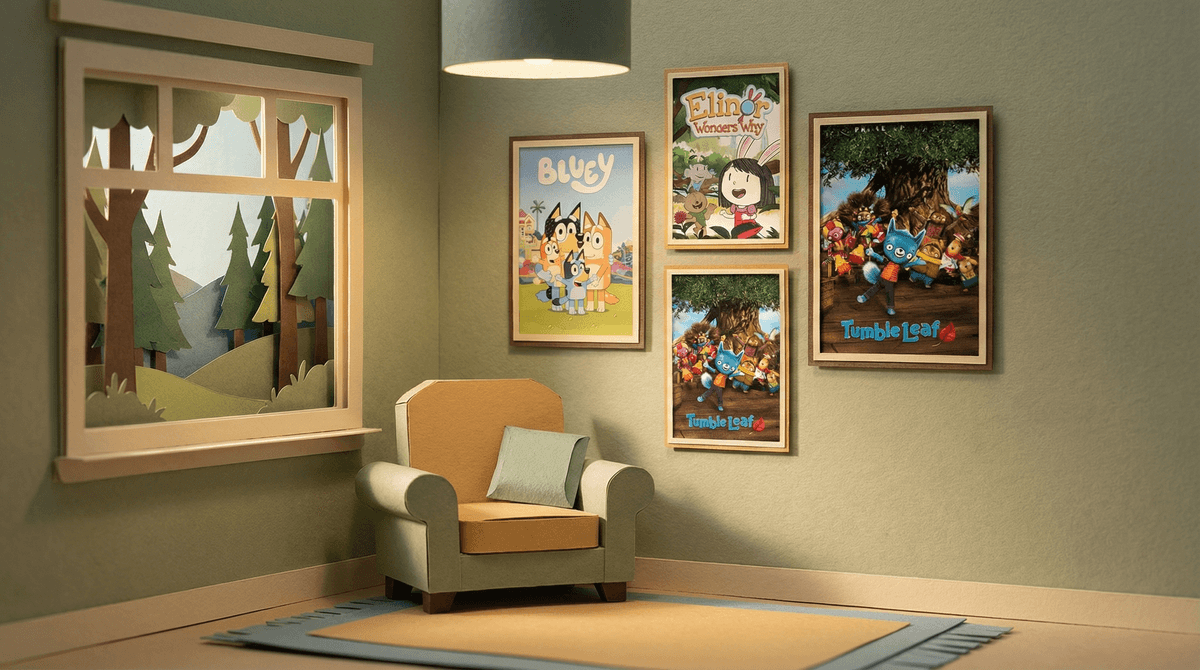
- Bluey (the gold standard—slower pacing, real family dynamics, actual emotional complexity)
- Daniel Tiger's Neighborhood (Mr. Rogers' legacy, genuinely helpful emotional strategies)
- Tumble Leaf (gorgeous stop-motion, encourages observation and patience)
- Elinor Wonders Why (science-focused with thoughtful pacing)
For ages 5-8:
- Wild Kratts (animal science with adventure, but not frenetic)
- Hilda (beautiful animation, real emotional stakes, thoughtful problem-solving)
- Molly of Denali (Indigenous representation, critical thinking, rich vocabulary)
In our community data, 40% of families use the kids' profile on Netflix, while another 40% use the regular profile. If you're in that 40% using kids' profiles, you'll find most of these shows there or on PBS Kids.
If your kid is deep in the Cocomelon zone, going cold turkey might be rough. Here's a gentler transition:
Start with "bridge" shows that are better than Cocomelon but not as slow as Bluey. Daniel Tiger works well here.
Reduce screen time gradually while you transition. The average screen time in our community is 4.2 hours daily, jumping to 5 hours on weekends. If you're above that, consider what's realistic for your family before making changes.
Expect an adjustment period. Your kid might say Bluey is "boring" at first. That's actually a sign the transition matters—their brain is recalibrating to slower pacing.
Watch together when possible. Co-viewing transforms screen time from passive consumption to interactive learning. Talk about what's happening, ask questions, make connections.
Paw Patrol and Cocomelon aren't going to permanently damage your kid if you've already used them. But if you're thinking about your family's screen time strategy—which, as a Screenwise parent, you clearly are—there are better options that respect your child's developing attention span, language abilities, and emotional intelligence.
The goal isn't perfection. It's intention. And sometimes that means choosing Bluey over Paw Patrol, even when your kid protests.
-
Audit your current rotation. What are your kids actually watching? Take a look at your family's viewing patterns
and identify the hyperstimulating shows. -
Pick one new show from the list above and introduce it this week. Don't remove anything yet—just add something better to the mix.
-
Set up co-viewing time for at least one episode this week. Even 10 minutes of engaged watching together beats an hour of solo screen time.
-
Talk to other parents. Only 20% of families in our community use YouTube Kids, which suggests most of us are being thoughtful about content sources. You're not alone in wanting something better for your kids.
Your family's digital wellness is a marathon, not a sprint. Small, intentional changes compound over time.