

TL;DR: Robux is the digital currency that fuels the Roblox ecosystem. It’s how kids buy "skins," "game passes," and social status. While it feels like throwing money into a black hole, it’s actually a prime opportunity to teach digital budgeting. Quick Links: • How to set up Roblox parental controls • Is Roblox safe for kids? • Teaching kids about digital money
If you’ve spent more than five minutes with a child between the ages of 7 and 12 lately, you’ve heard the plea. It usually happens right when you’re mid-email or trying to get dinner on the table. "Mom, can I please just have 400 Robux? It’s only five dollars!"
To us, it’s five dollars for pixels that don’t exist. To them, it’s the difference between being a "Bacon Hair" (the default, uncustomized avatar that screams "I’m a noob") and finally looking like they belong in Brookhaven.
In 2026, over 75% of American children ages 9–12 are active on Roblox. It’s not just a game; it’s the digital mall, the playground, and the after-school hangout all rolled into one. And just like the mall in the 90s, you can’t do much without a little cash in your pocket.
Robux is the proprietary currency of the Roblox platform. You buy it with real-world money (usually starting at $4.99 for 400 Robux), and then your child spends it inside various "experiences" (games) created by other users.
It’s important to understand that Roblox isn't one game. It's a platform hosting millions of games. This means Robux can be spent in two ways:
- Avatar Shop: Buying clothes, hair, wings, or animations that follow your child from game to game.
- In-Game Purchases: Buying a "Game Pass" for a specific game—like a faster car in Welcome to Bloxburg or a legendary pet in Adopt Me!.
It’s easy to dismiss Roblox as "brain rot," especially when they're playing games themed after "Skibidi Toilet" or using "Ohio" as an adjective for everything weird. But the drive for Robux is deeply social.
- Social Signaling: In the physical world, kids want the right sneakers. In Roblox, they want the "Limited" hat. Being a "Bacon Hair" can actually lead to digital bullying or exclusion from certain social groups within games.
- The Creator Economy: Some kids want Robux because they want to "donate" to their favorite creators in games like Pls Donate.
- Utility: In many games, the "free" version is intentionally frustrating. Want to build a two-story house in Bloxburg? You have to pay for the privilege.
When the request comes in, don't just say "no" and don't just hand over your credit card. Use these strategies to turn the "Robux Loop" into a lesson.
1. The "Wait 24 Hours" Rule
Digital purchases are designed to be impulsive. The flashing lights and "Limited Time Offer!" banners are there to trigger FOMO. Tell your kid: "I’ll consider it, but we aren't buying it until tomorrow." Half the time, the "must-have" item is forgotten by morning.
2. Establish a Digital Allowance
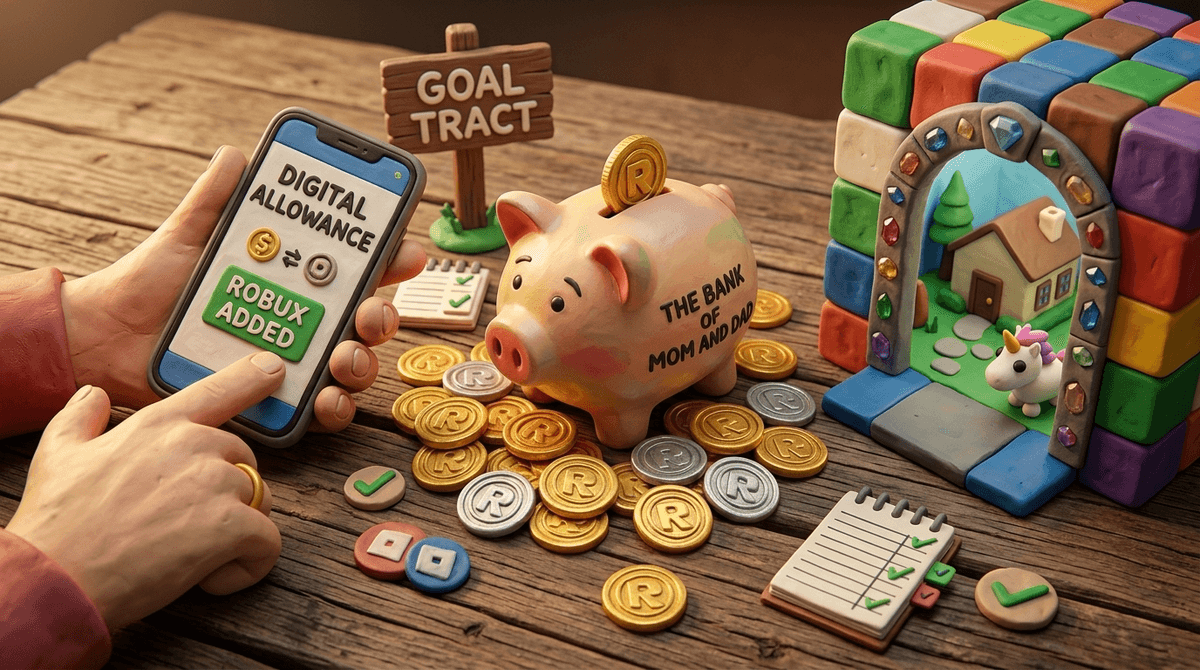
If your child is old enough to navigate Roblox, they are old enough to manage a budget. Whether it’s $5 a month or earned through chores, give them a set amount. When the Robux are gone, they’re gone. This stops the constant "Just five more dollars?" nagging.
3. Audit the Purchase
Ask them to show you what they want to buy. If it’s a "Game Pass" for a game they only played for ten minutes, explain why that’s a bad investment. If it’s a cool shirt they’ll wear every day across all games, that’s a "better" value.
- Ages 5-7: Total oversight. They shouldn't have the password to make purchases. At this age, they don't understand that Robux = Rent Money. If you give them Robux, do it as a rare treat and sit with them while they spend it.
- Ages 8-12: The "Sweet Spot" for learning. This is when they should start managing a small digital allowance. Use this time to talk about scams (see below).
- Ages 13+: If they are still into Roblox, they might be interested in the "DevEx" side—actually making games and earning Robux. This is where Roblox can actually transition from a money pit to a lesson in coding for kids.
This is the "no-BS" part: The internet is full of predators and scammers looking for kids who are desperate for Robux.
There is no such thing as free Robux.
If a YouTube video, a TikTok, or a "friend" in a game tells your kid to go to a website or enter their password for "10,000 Free Robux," they are being scammed. These sites are designed to steal accounts or install malware.
If you feel like Roblox is becoming a toxic cycle of wanting and spending, it might be time to pivot to games that offer more "creative" bang for your buck without the constant microtransactions.
The gold standard. You buy it once, and while there is a "Marketplace" in the Bedrock version, the core game is infinite and doesn't require constant cash infusions to be "cool."
If your kid says they want Robux to "make games," move them over to Scratch. It’s a free coding platform from MIT. No currency, no "skins," just pure logic and creativity.
Often described as "2D Minecraft," Terraria is a deep, complex game with zero in-app purchases. It’s a great way to show kids that a game can be incredibly fun without a virtual storefront.
Roblox loves to market itself as a place where kids learn to be entrepreneurs. And sure, for the 0.01% of kids who learn Luau (the programming language) and build a hit game, that’s true.
But for the other 99.9%, Roblox is a consumerism simulator. The platform is designed by geniuses to keep kids clicking, wanting, and spending. Don't feel guilty for setting hard boundaries. You aren't "stifling their creativity" by refusing to buy a $20 virtual pet that will be forgotten by Tuesday.
Robux isn't the enemy, but unmonitored spending is.
Treat Robux like any other "want" in your child’s life. It has a value, it requires a trade-off, and it shouldn't be granted just because they’re bored. By shifting the conversation from "Can I have...?" to "How are you going to budget for...?" you’re turning a potential conflict into a life skill.
- Check your settings. Ensure your credit card isn't "saved" on their device. Learn how to stop accidental in-app purchases
 .
. - Have the "Bacon Hair" talk. Ask them why they want the Robux. Is it for a specific game feature, or are they feeling social pressure?
- Set a limit. Decide today what your monthly "Digital Entertainment" budget is for the family and stick to it.
Take the Screenwise Survey to see how your family's Roblox habits compare to your community