

The Board Game Ladder: Building a Lifelong Love of Tabletop Play from Toddler to Teen
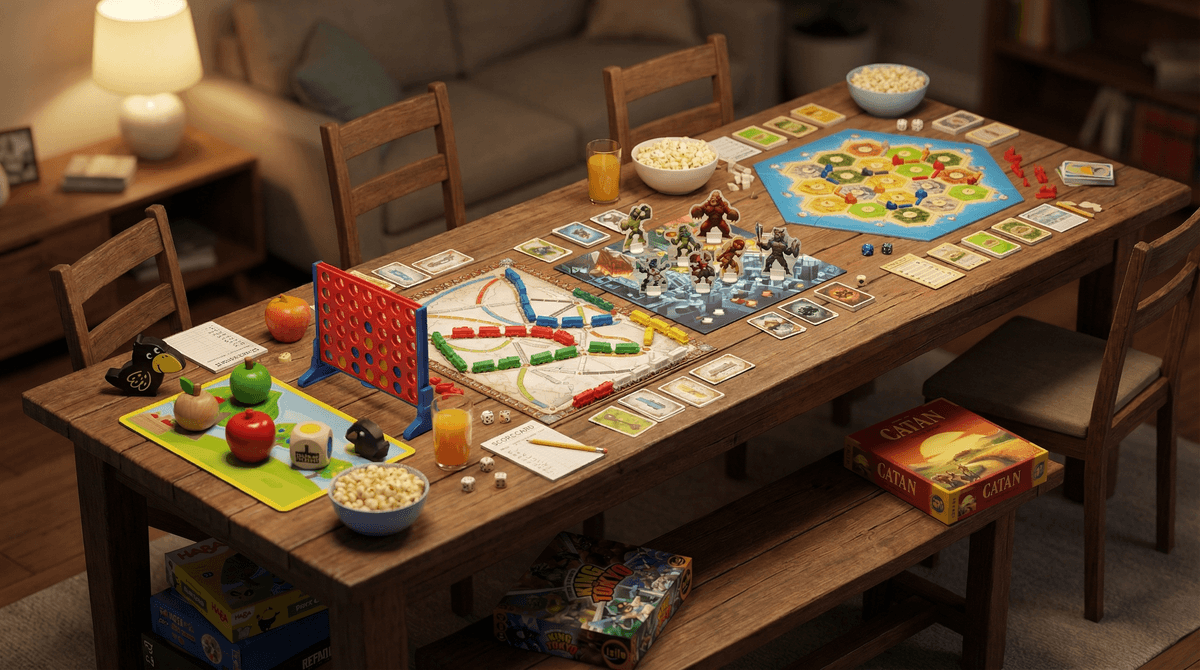
TL;DR: Start with First Orchard at age 2, move through Hoot Owl Hoot! and Ticket to Ride: First Journey in the early years, then graduate to Catan Junior and eventually Settlers of Catan by the teen years. The secret? Match complexity to developmental stage, keep early sessions short, and celebrate the wins.
According to our Screenwise community data, about 55% of families are actively gaming together, and the average family logs around 4.2 hours of screen time daily. Board games offer something genuinely different—face-to-face interaction, strategic thinking, and zero Wi-Fi required. But the progression matters. Throw a 5-year-old into Catan and you've just created a kid who thinks board games are boring and confusing. Start them on the right ladder, though, and by middle school they're the one suggesting game night.
At this stage, you're not teaching strategy—you're teaching that games have rules, turns exist, and losing doesn't mean the world ends. Keep sessions under 20 minutes and focus on tactile, colorful games with zero reading requirements.
This is the platonic ideal of a first board game. Six wooden snails, color-coded dice, and a simple race to the finish. No reading, no counting, just "roll the die, move the matching snail." It teaches color recognition, turn-taking, and—crucially—that nobody "wins" in a way that feels devastating to a toddler, since you're all just watching snails inch forward together.
A cooperative fruit-collecting game where everyone works together to harvest fruit before the raven reaches the orchard. The pieces are chunky wood (safe for little hands), the rules are dead simple, and because it's cooperative, there's no meltdown when someone "loses." This one introduces the concept that sometimes the game wins, which is a surprisingly useful life lesson.
By age 4 or 5, kids can start handling light pattern recognition and spatial reasoning. Connect Four asks them to anticipate where a disc will land and spot vertical, horizontal, or diagonal patterns. It's quick (10-15 minutes), visually satisfying when those discs drop, and you can play it while half-watching them—which, let's be honest, is sometimes all the bandwidth you have at 5 p.m. on a Tuesday.
Preschoolers and early elementary kids are ready for games that introduce basic strategy, simple deduction, and a bit of planning ahead. They can read some sight words, count reliably, and handle a 30-minute session if the game keeps moving.
Another cooperative gem. Players work together to help owls fly back to the nest before the sun rises. It teaches color-matching, simple deduction (which color card helps the most right now?), and teamwork. The cooperative structure keeps the emotional stakes low, which is key when you're still building confidence.
This one's a wildly popular card game (created by a kid, which is a fun fact to share) that teaches pattern-matching and quick decision-making. It's silly, fast-paced, and has enough randomness that a 6-year-old can legitimately beat an adult. That randomness is actually good at this age—it keeps kids engaged even when they don't fully grasp optimal strategy yet.
The classic deductive reasoning game. "Does your person have glasses? Brown hair? A mustache?" It's teaching kids to ask yes/no questions, narrow possibilities, and think logically—all while flipping down little plastic faces. Bonus: it's teaching them that asking good questions is more powerful than guessing randomly, which is a skill that transfers to, well, everything.
By early elementary, kids can handle resource management, route planning, and games that reward thinking two or three moves ahead. They can read independently, do basic addition and subtraction in their heads, and sit for 45 minutes if the game holds their attention.
This is the streamlined, kid-friendly version of the modern classic Ticket to Ride. Players collect train cards and claim routes on a map, racing to connect cities. It introduces route planning, spatial reasoning, and the concept of "blocking" opponents without being cutthroat about it. The map is gorgeous, the pieces are satisfying to place, and it scales beautifully—adults won't be bored playing this one.
A dice-rolling, monster-battling game that teaches risk assessment and probability. Do you re-roll for more energy cubes, or lock in your attack dice? It's got just enough chaos to keep younger kids competitive, but enough decision-making that older kids and parents stay engaged. Plus, the theme (giant monsters fighting for control of Tokyo) is inherently fun.
A tile-placement game where you're building a medieval landscape one tile at a time. It's teaching spatial reasoning, planning, and flexible thinking (your perfect road just got blocked—now what?). The rules are simple enough for a 7-year-old, but the strategy deepens as kids get older. This is one you can keep playing for years.
Tweens are ready for games with deeper mechanics, longer play times (60+ minutes), and genuine strategic depth. They can handle losing gracefully (mostly), think several turns ahead, and enjoy the satisfaction of executing a long-term plan.
This is the gateway to the full Settlers of Catan experience, but simplified for younger players. You're still collecting resources, trading, and building—but the pirate theme and streamlined rules make it more accessible. It's teaching resource management, negotiation (trading is half the game), and strategic placement. If your kid takes to this one, they're ready for the full Catan experience within a year or two.
A tile-placement strategy game with an environmental theme. You're rebuilding ecosystems, managing resources, and thinking about sustainability—all while playing a genuinely fun game. It's a great conversation starter about climate and conservation, and the mechanics are engaging enough that it doesn't feel preachy.
Quick-play kingdom-building that scales beautifully for mixed-age groups. You're drafting tiles to build a 5x5 kingdom, trying to match terrain types for points. It teaches spatial reasoning, risk/reward decision-making (do you grab the high-value tile now, or wait for a better position?), and plays in 15-20 minutes, so you can easily do a few rounds in one sitting.
Teens can handle everything adults can. At this point, you're not dumbing anything down—you're playing real strategy games that reward critical thinking, negotiation, and long-term planning.
Settlers of Catan (Full Version)
The classic. You're settling an island, collecting resources (wood, brick, wheat, sheep, ore), trading with other players, and racing to 10 victory points. It's teaching negotiation, probability (those dice rolls matter), resource management, and strategic flexibility. Every game plays differently depending on the board layout and what other players are doing. This is the game that turns casual players into board game enthusiasts.
Ticket to Ride (Standard Edition)
The full version of the earlier "First Journey" game. More routes, more complexity, more strategic depth. You're still claiming train routes, but now you're managing longer connections, blocking opponents more deliberately, and racing against the clock as the train pieces run out. It's elegant, beautiful, and endlessly replayable.
A word-association party game that's perfect for teens and adults. One player gives one-word clues to help teammates guess multiple words on the board, while avoiding the opponent's words (and the dreaded "assassin" word that ends the game). It's teaching lateral thinking, vocabulary, and communication under pressure. Plus it scales to large groups, so it's great for family gatherings.
Start with co-op games. Seriously. Cooperative games like First Orchard and Hoot Owl Hoot! remove the sting of losing and teach kids that games can be fun even when you don't "win." Once they've got the confidence and emotional regulation, you can introduce competitive games.
Keep early sessions short. A 3-year-old has a 15-minute attention span, max. If you push it to 30 minutes, you're just teaching them that board games are boring. End on a high note, even if you don't finish the game. As they get older, their tolerance for longer sessions will naturally grow.
Demo the first round. Don't just read the rules aloud—play a practice round where you narrate your thinking out loud. "I'm going to move this snail because I rolled yellow. Now it's your turn—what color did you roll?" Breaking rules into story chunks and modeling the gameplay makes everything click faster.
Celebrate the small wins. Did they remember to take their turn without being prompted? Did they count their points correctly? Did they handle losing without a meltdown? That's progress. A sticker chart or simple "you're getting so good at this!" goes a long way.
Rotate the library. Don't just play the same game every week. Mix in word games like Bananagrams, spatial puzzles like Carcassonne, math-focused games like Ticket to Ride, and social deduction games like Codenames. A varied "gaming diet" builds well-rounded skills—fine motor, visual-spatial, critical thinking, math, language, and social-emotional development.
Watch for choking hazards and reading requirements. Toddler games should have big, chunky pieces with no small parts. Games for early readers should minimize text or use icons and pictures. Don't hand a 5-year-old a game that requires reading full sentences—it'll just frustrate everyone.
Building a love of board games is a long game (pun intended). You're not trying to create a tournament-level strategist by age 8—you're creating positive associations, building skills incrementally, and carving out screen-free time that actually feels fun, not like a punishment.
Start simple with Snail's Pace Race or First Orchard, move through cooperative and light-strategy games in the elementary years, and by the time they hit middle school, you've got a kid who genuinely wants to play Catan on a Friday night. And honestly? That's a parenting win worth celebrating.
If you want more ideas, check out our guides on cooperative games for kids, strategy games for tweens, or how to teach kids to lose gracefully. And if you're wondering whether your family's game habits are typical, take the Screenwise survey to see how you stack up against other families in your community.