

The Video Game Landscape: Recommendations for Intentional Parents
A framework for understanding the difference between healthy, enriching video games and open-ended gaming platforms like Minecraft, Roblox, and Fortnite. Discover developmentally positive alternatives by age.
A framework for helping families make sense of the new era of online gaming, and discover healthy, enriching alternatives that promote growth, creativity, and joy.
"Personalized tips: Use the Personalized Guide widget in the app to tailor suggestions to your child.
Community benchmarks: See how Minecraft and Roblox usage changes by grade in our benchmark charts.
The video game industry is larger than film and music combined — and far more diverse.
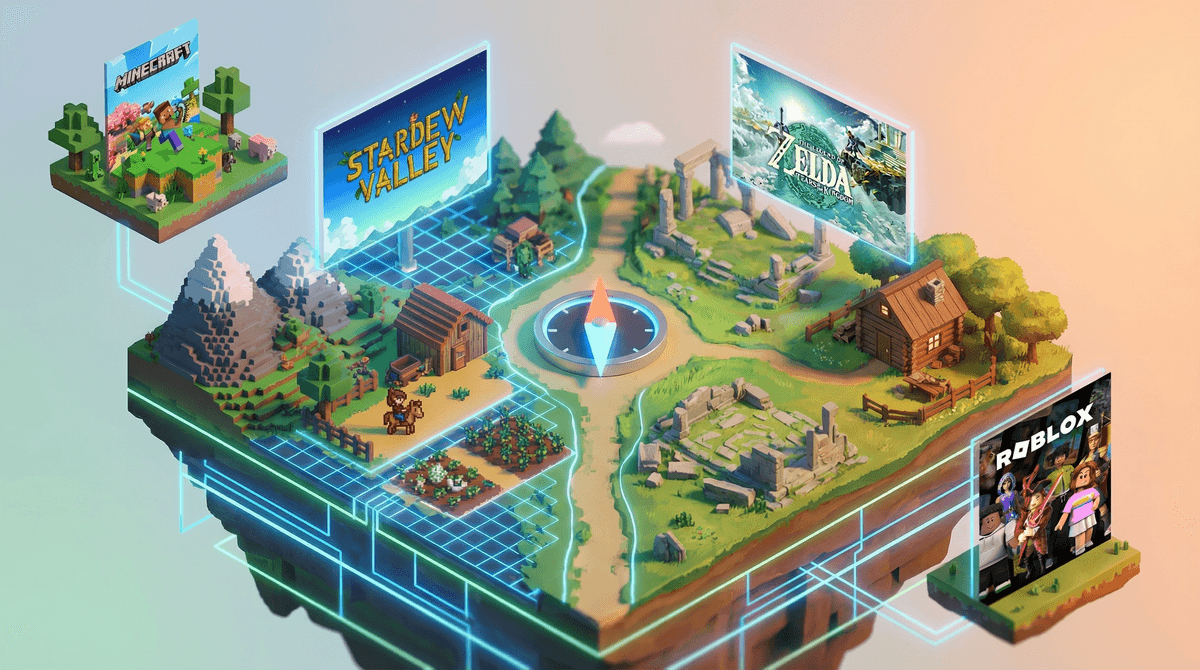
For many families, “video games” has become shorthand for Minecraft or Roblox, which are not traditional games. They’re platforms — places where users make and share experiences, often with social-media-like incentives.
Types of Games
Not all games are created equal. Here’s a framework for the rich diversity of video games:
Adventure & Story Games
Narrative-driven, often emotional and purposeful journeys.
Examples: Zelda: Tears of the Kingdom, Ori and the Will of the Wisps, Journey, Celeste
What kids gain: Empathy, persistence, emotional literacy
Puzzle & Logic Games
Require reasoning, pattern recognition, and creativity.
Examples: Portal 2, Monument Valley, Baba Is You, The Witness
What kids gain: Cognitive flexibility, problem-solving
Strategy & Building Games
Involve systems thinking and long-term planning.
Examples: Civilization VI, Stardew Valley, Mini Metro
What kids gain: Planning, resource management, patience
Co-op & Social Games
Built for collaboration, not just competition.
Examples: Overcooked 2, LEGO Star Wars, Unravel Two, Moving Out
What kids gain: Teamwork, communication, cooperation
Sports & Racing Games
Skill-based, fair competition and hand-eye coordination.
Examples: Mario Kart 8 Deluxe, Rocket League, FIFA, Switch Sports
What kids gain: Sportsmanship, coordination, reaction time
Educational & Creative Games
Teach real skills through engaging mechanics.
Examples: Kerbal Space Program, Toca Builders, Universe Sandbox
What kids gain: Curiosity, experimentation, STEM learning
Card & Turn-Based Games
Require strategy, foresight, and reflection.
Examples: Slay the Spire, Hearthstone, Marvel Snap
What kids gain: Patience, logical reasoning, planning
These are social platforms disguised as games — more like YouTube than Mario.
They blend creation tools, social media, and commerce — which is why kids love them and parents get nervous.
Platform Overview
Minecraft
- What it really is: Digital sandbox for creativity and exploration
- Benefits: Spatial reasoning, imagination
- Challenges: Unmoderated servers, online strangers
Roblox
- What it really is: A massive user-generated game marketplace
- Benefits: Early coding skills, design thinking
- Challenges: Unsafe chats, advertising, manipulative economies
Fortnite (Creative Mode)
- What it really is: Half-shooter, half-creative world
- Benefits: Team play, creative building
- Challenges: Violence exposure, constant updates, strong screen-time pull
"Important to know: These worlds don’t end — they evolve. They operate like social networks, rewarding time-on-platform over completion.
Use these five dimensions to evaluate any game your child wants to play:
🎯 Goal Clarity
Parent question: Does it have a clear goal or creative mission?
Healthy zone: Games with structure and completion
🧑🤝🧑 Social Design
Parent question: Is social play safe and intentional?
Healthy zone: Local co-op or invite-only multiplayer
💰 Business Model
Parent question: Does it make money ethically?
Healthy zone: One-time purchase or subscription
🧠 Cognitive Value
Parent question: Does it teach, stretch, or inspire?
Healthy zone: Strategy, puzzles, creativity
❤️ Emotional Tone
Parent question: How does my child feel afterward?
Healthy zone: Energized, proud, or inspired
These games are selected for their clear goals, ethical design, and developmental benefits. Each offers something Minecraft and Roblox can’t: structure, completion, and intentional learning.
Ages 5–8: Foundation & Playful Learning
- Toca Builders / Toca Nature — Sandbox creativity for young kids
Encourages design, exploration, cause/effect - LEGO Star Wars / LEGO Harry Potter — Cooperative story games
Builds teamwork and humor in shared play - Kirby and the Forgotten Land — Gentle action platformer
Timing and coordination without stress - Mario Kart 8 Deluxe — Colorful racing game
Fair competition and self-regulation - Monument Valley 1 & 2 — Visual logic puzzle
Spatial reasoning and patience - Unravel Two — Cooperative adventure
Fosters empathy and teamwork
Ages 8–11: Exploration & Systems Thinking
- Terraria — 2D building and exploration
Creative problem-solving in structured worlds - Stardew Valley — Farming, relationships, time management
Routine, planning, reward for effort - Celeste — Challenging climbing adventure
Resilience, persistence, positive self-talk - Portal 2 — Physics-based puzzles
Reasoning, logic, collaboration (great co-op) - Overcooked 2 — Fast-paced cooking teamwork
Communication under pressure - Spiritfarer — Story-driven management about goodbyes
Emotional intelligence and compassion - Mini Metro — Transit planning puzzle
Design and pattern thinking
Ages 12–15: Creativity, Challenge, and Reflection
- The Witness — Open-world visual puzzles
Observation, abstract reasoning - Slay the Spire — Card strategy roguelike
Planning and adaptive decisions - Civilization VI — World-building strategy
Cause/effect, leadership, patience - Rocket League — Soccer with cars
Skill mastery, teamwork, resilience - Ori and the Will of the Wisps — Beautiful action platformer
Focus + emotional storytelling awareness - Journey — Wordless online adventure
Mindfulness and empathy - Kerbal Space Program — Space engineering sim
Real-world physics intuition and STEM interest
Ages 16+: Strategic Mastery & Creative Autonomy
- Into the Breach — Tactical turn-based strategy
Deep logic and anticipation - Hades — Myth-inspired roguelike action
Persistence and growth mindset - Cities: Skylines — Urban planning simulation
Systems design, civic thinking - Human Resource Machine — Visual coding puzzles
Logic, sequencing, computational thinking - Hearthstone / Marvel Snap — Digital card strategy
Foresight, probability, flexible thinking
Minecraft, Roblox, and Fortnite aren’t inherently bad — but they operate more like social media platforms than traditional games, designed to keep kids engaged indefinitely.
Traditional video games offer something different: clear goals, completion, and developmental benefits. They teach skills, tell stories, and provide the satisfaction of finishing something meaningful.
As parents, our job isn’t to ban platforms entirely — it’s to help kids develop digital literacy, understand what they’re engaging with, and discover the incredible variety of experiences games can offer.
"Next Steps
- Pick one game from your child’s age range to try together this week
- Use the Healthy Game Framework to evaluate games your child already plays
- Talk about the difference between platforms and games
- Set clear boundaries around open-ended platforms while encouraging diverse gaming
Want more guidance? Check out our complete parent guides for Minecraft, Roblox, and Fortnite.