

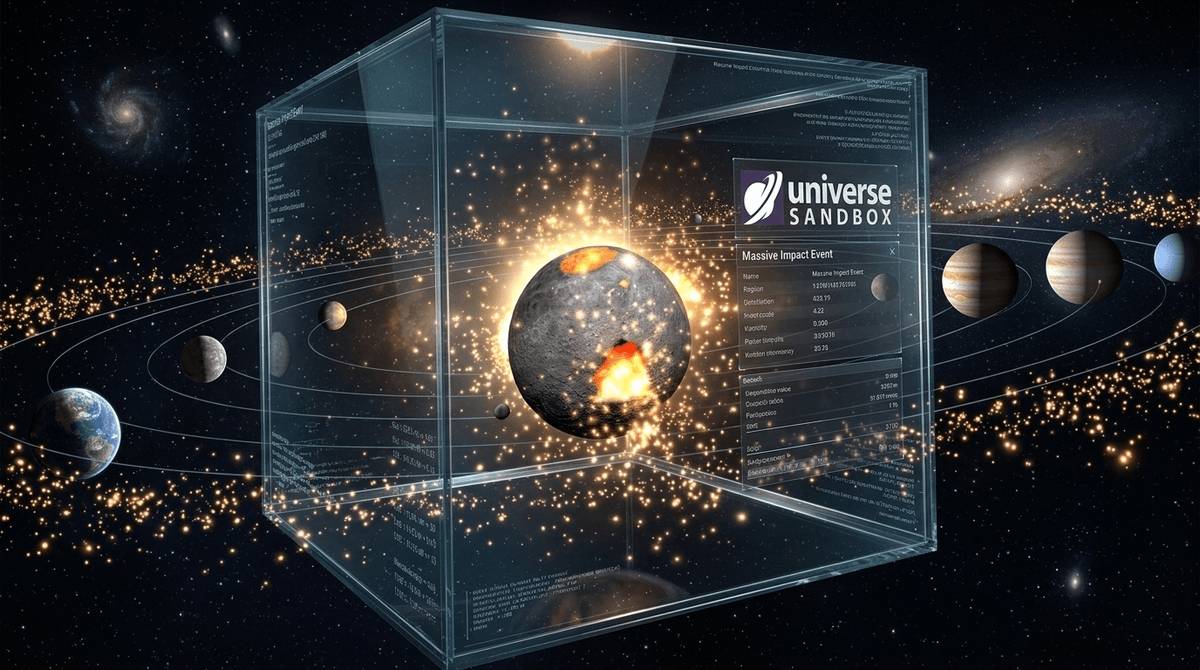
TL;DR: Universe Sandbox is a "god-mode" space simulator that lets kids manipulate gravity, climate, and celestial collisions with terrifyingly accurate physics. It’s one of the rare games where "senseless destruction" actually teaches astrophysics, orbital mechanics, and climate science. No microtransactions, no "brain rot," just pure scientific curiosity.
If your kid is into space, check out these related picks:
- Kerbal Space Program (For the aspiring rocket scientist)
- [Stellarium](https://screenwiseapp.com/media/stellarium-app (For the backyard stargazer)
- NASA Kids' Club (For younger explorers)
- What If? by Randall Munroe (For the kid who asks "but what if we hit the moon with a hairdryer?")
If you’ve spent any time watching your kid play Minecraft or Roblox, you’re used to seeing them build things. Universe Sandbox is a little different. It’s a physics-based space simulator where the entire known universe is a playground.
There are no levels to beat, no bosses to fight, and no "Ohio" memes to decode (unless they decide to put a black hole in the middle of a virtual Cincinnati). Instead, it’s a high-powered tool that uses real-time N-body gravity simulations. In plain English: if you put a second Sun next to our Sun, the game calculates exactly how that would mess up Earth’s orbit, freeze our oceans, or turn the solar system into a cosmic pinball machine.
It’s available on PC, Mac, and VR, and it’s essentially the digital version of that one kid in science class who always asked, "What happens if I throw this into a volcano?" but with a much higher budget and zero physical danger.
Most "educational" games feel like a math worksheet with a thin coat of glitter. Kids smell that a mile away. Universe Sandbox succeeds because it leads with the "cool factor" of destruction.
- The Power Trip: There is something inherently satisfying about having the power to shrink the Sun, turn Jupiter into a star, or collide two galaxies just to see the "fireworks."
- Visual Splendor: The graphics are genuinely stunning. Watching a planet break apart into molten fragments is mesmerizing. It’s the ultimate "low-stress" gaming experience because you can’t really "fail."
- The "What If" Factor: It taps into that specific brand of curiosity kids have. "What if the Moon was made of iron?" "What if Earth had rings like Saturn?" The game gives them the data to answer those questions instantly.
- Creative Chaos: It’s a sandbox in the truest sense. They can create their own solar systems from scratch, name the planets after their pets, and then see if life can actually survive on "Planet Fluffy."
Learn more about the benefits of sandbox games for cognitive development
While your kid thinks they’re just making stuff explode, they are actually absorbing some pretty heavy-duty scientific concepts:
The game doesn't cheat. If a planet gets too close to a star, it hits the "Roche limit" and gets torn apart by tidal forces. Kids start to understand how gravity isn't just a force that keeps us on the ground; it's a constant cosmic tug-of-war that dictates how everything in the universe moves.
This is where the game gets surprisingly deep. You can change the CO2 levels in Earth's atmosphere and watch the temperature rise in real-time. You can see how a planet's "albedo" (reflectivity) affects its climate. It’s a much more visceral way to understand the greenhouse effect than reading a textbook.
It is notoriously hard for the human brain to grasp how big space is. Universe Sandbox lets kids zoom from a single person-sized asteroid all the way out to the Milky Way. It provides a sense of perspective that is both humbling and educational.
Recommended Age: 10+
Technically, a 7-year-old could click around and make planets collide, but the interface is quite complex. It looks a bit like professional 3D modeling software or a NASA dashboard.
- Ages 7-9: They will likely need you to sit with them to navigate the menus. They’ll enjoy the "Total Destruction" aspect but might miss the scientific nuance.
- Ages 10-13: This is the sweet spot. They’re old enough to understand the "What If" scenarios and can start using the more advanced tools to build stable solar systems.
- Ages 14+: High schoolers can use this for actual physics homework or to visualize concepts they’re learning in Earth Science or Astronomy.
Here is the best news you’ll hear all week: Universe Sandbox is incredibly safe.
- No Multiplayer: There is no built-in chat, no "creepy strangers," and no bullying. It is a solitary, contemplative experience.
- No Microtransactions: You buy the game once, and you own it. There are no "Star Bucks" or "Cosmic Gems" to buy. Your bank account is safe.
- Content: The "violence" is strictly astronomical. You are destroying inanimate planets, not people or animals. There is no blood, no gore, and no questionable themes.
Check out our guide on the safest games for middle schoolers
1. It Can Be a Resource Hog
Because the game is calculating real-time physics for thousands of objects, it can be hard on your computer. If your kid is playing on an old "hand-me-down" laptop, it might lag or overheat if they try to explode too many things at once. If you hear the computer fans sounding like a jet engine, it’s time to tell them to delete a few galaxies.
2. The Learning Curve is Real
Don't be surprised if your kid spends the first hour frustrated because they keep accidentally flinging the Earth into deep space. That’s actually part of the learning process. Orbital mechanics are hard!
3. It’s Not a "Game" in the Traditional Sense
If your kid is looking for a story, characters, or "winning," they might get bored quickly. This is a tool for tinkerers. It’s for the kid who likes LEGO or Scratch.
Instead of asking "Are you winning?", try these conversation starters to bridge the gap between "screen time" and "learning time":
- "Can you show me what happens if you replace our Sun with a Red Giant?"
- "I heard you can terraform Mars in that game. What did you have to change to make it habitable?"
- "Show me the biggest explosion you’ve made today. What caused it?"
- "If we lived on a planet with two suns, like Tatooine, what would our orbit look like?"
Universe Sandbox is the "anti-brain rot." It’s a sophisticated, beautiful, and deeply educational piece of software that respects a kid’s intelligence. It encourages them to ask "Why?" and "What if?" and then gives them the tools to find the answer through experimentation.
In a world of Skinner-box mobile games designed to keep kids clicking for rewards, Universe Sandbox is a breath of fresh, albeit oxygen-depleted, cosmic air.
- Check the specs: Make sure your computer can handle it before buying.
- Watch a tutorial together: Look up "Universe Sandbox beginner guide" on YouTube to get a feel for the controls.
- Set a "Mission": Challenge your kid to create a stable solar system with three planets that all support life. It’s harder than it looks!