

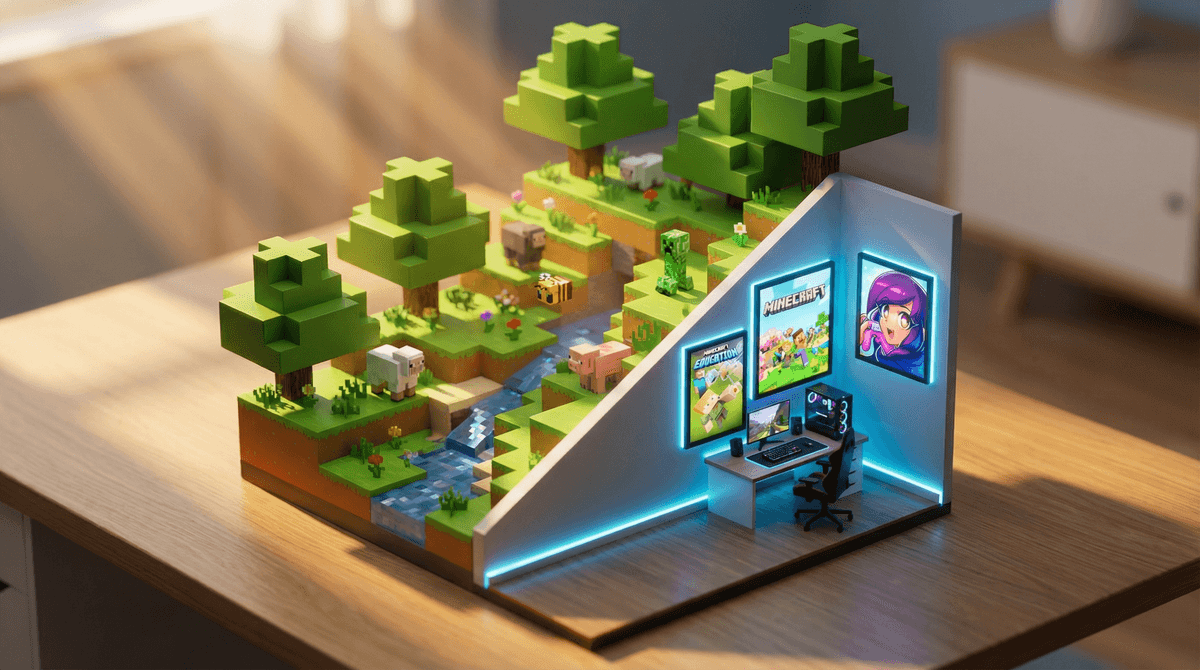
Minecraft is a sandbox video game where players explore, build, and survive in a blocky, pixelated world made entirely of cubes. Think of it as digital LEGOs meets survival adventure meets creative studio. Released in 2011, it's now one of the most popular games ever made, with over 300 million copies sold worldwide.
The game has several modes: Creative Mode (unlimited resources, fly around, build whatever you want), Survival Mode (gather resources, craft tools, fight monsters, don't die), Adventure Mode (play custom maps made by others), and Hardcore Mode (survival but if you die once, game over). Most kids start with Creative or Survival.
Here's what makes it different from traditional video games: there's no real "winning." No final boss, no credits roll, no end screen congratulating you. It's an open-ended experience where players set their own goals—whether that's building a replica of their school, creating a working calculator using redstone circuits, or just surviving 100 days without getting blown up by a creeper .
.
It's genuinely creative. Kids aren't just consuming content—they're creating worlds. I've seen 9-year-olds build functioning roller coasters, recreate their favorite movie scenes, and design elaborate cities with working transportation systems. The creative potential is legitimately impressive.
It meets them where they are. A 6-year-old can play in peaceful Creative mode building houses for imaginary pets. A 13-year-old can learn basic coding through redstone mechanics or command blocks. The game scales with skill level in a way few others do.
The social aspect is huge. Kids play together on servers, collaborate on builds, show each other their creations, and bond over shared experiences. "Remember when we finally defeated the Ender Dragon?" becomes genuine friendship currency at school. According to recent data, about 55% of kids ages 8-12 have played Minecraft, making it a common cultural touchstone.
It scratches multiple itches. Want to explore caves? Fight zombies? Build a farm? Design a mansion? Learn about circuits? It's all there. The variety means kids rarely get bored—they just shift to a different aspect of the game.
It's rated E10+ (Everyone 10+), but honestly, younger kids play it constantly—especially in Creative mode where there's no combat. The "violence" is extremely cartoonish (hitting blocky animals, fighting pixelated zombies), and you can adjust difficulty or play in Peaceful mode where hostile mobs don't spawn.
The online multiplayer needs supervision. Kids can play on public servers with strangers, private realms with friends, or local multiplayer. Public servers are where things get dicey—chat functions, potential for inappropriate content, and stranger danger all apply. Many parents stick with Minecraft Realms (a subscription service for private servers) or local play until kids are older.
YouTube is part of the ecosystem. Kids don't just play Minecraft—they watch other people play it. Dream, Aphmau, and dozens of other creators have massive followings. Some of this content is fine; some includes language or themes you might not love. Worth checking what they're watching.
Mods and add-ons expand the game. These are modifications created by the community that change gameplay—new creatures, new building blocks, new mechanics. They can be amazing educational tools (some teach chemistry or history), but downloading them requires some tech literacy and caution about malware. Minecraft Education Edition offers vetted, curriculum-aligned content if you're interested in the learning angle.
Time disappears in this game. "Just five more minutes" is a lie. Kids will play for hours if you let them because there's always one more thing to build, one more cave to explore. Clear time limits are your friend here.
Ages 6-8: Creative mode on a family device where you can see what they're doing. No online multiplayer with strangers. This age group loves building houses and collecting animals. Expect them to ask you to look at their creations approximately every 90 seconds.
Ages 9-11: Can handle Survival mode and might be ready for private servers with real-life friends. This is prime Minecraft age—probably 60-70% of their classmates play. Good time to teach about digital citizenship and appropriate online behavior.
Ages 12+: Can likely navigate public servers with established ground rules. They might be interested in more complex aspects like redstone engineering, command blocks, or creating their own mods. Some kids this age start YouTube channels or Twitch streams about their gameplay—whole different conversation.
Minecraft isn't brain rot. It's not going to turn your kid into a zombie (despite the zombies in the game). Is it educational? Eh, kind of—it teaches spatial reasoning, resource management, basic engineering concepts, and collaboration. But let's be real: kids aren't playing it for the learning outcomes. They're playing because it's fun, creative, and social.
The key is setting boundaries that work for your family. Time limits, online safety rules, and keeping devices in common areas are all reasonable approaches. But if your kid wants to spend Saturday afternoon building a replica of the Eiffel Tower out of blocks? There are definitely worse ways to spend screen time.
Think of Minecraft less like traditional video games and more like a digital construction set that happens to have zombies. It's a tool for creativity, problem-solving, and yes, entertainment. Like any tool, it's about how it's used.
Want to really understand what your kid is doing in there? Ask them to give you a tour of their world. Kids absolutely light up when showing off their creations. You'll learn what they're actually doing (probably not just "playing Minecraft" but building a specific thing with specific goals), and you'll get insight into how they think and problem-solve.
Set up a Realm or private server if they want to play with friends. The $8/month subscription for Minecraft Realms is worth it for peace of mind about who they're interacting with.
Use Screenwise to see how your family's Minecraft time compares to others in your community and get personalized recommendations based on your kid's age and your family's values. Because "everyone plays Minecraft" is true, but how much, in what mode, and with whom varies wildly—and that context matters for making decisions that feel right for your family.
And if you want to go deeper on related topics, check out our guide on "Minecraft and Roblox are Platforms not Video Games" to understand why these games are fundamentally different from Fortnite or Mario Kart.