

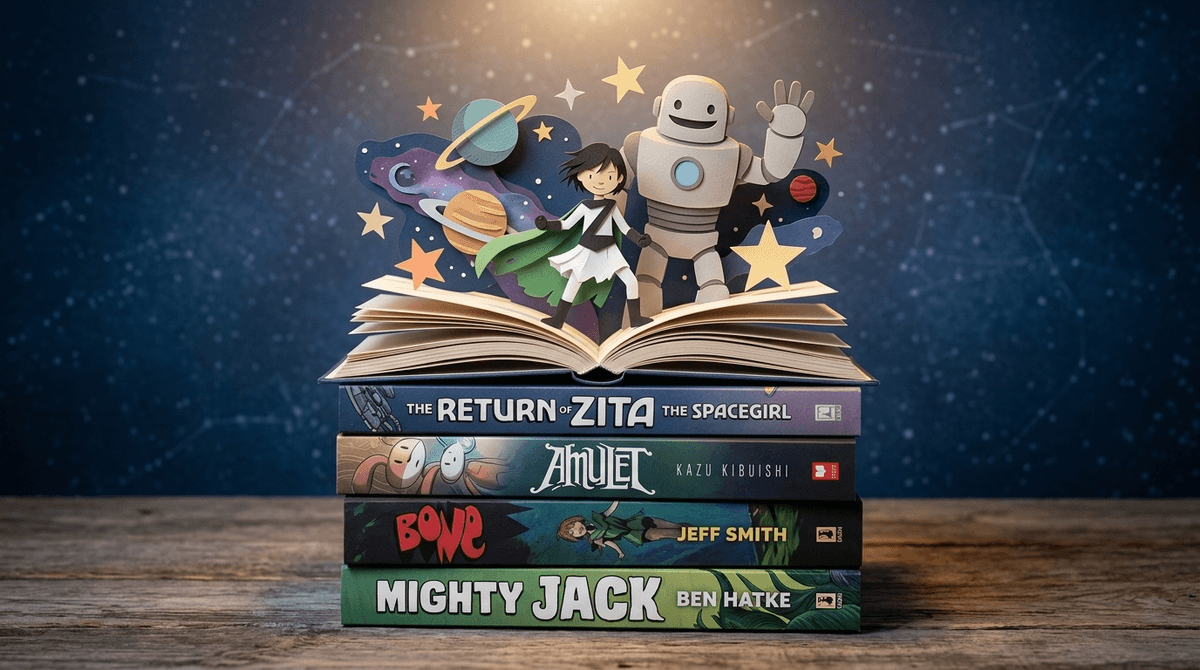
TL;DR: The Return of Zita the Spacegirl is the stunning conclusion to Ben Hatke’s trilogy. It’s a masterclass in middle-grade graphic novels that tackles heavy themes like imprisonment, the burden of fame, and what happens when your "hero" status feels like a lie. If your kid has been coasting on Skibidi Toilet memes and you want to redirect that visual energy toward something with actual soul, this is your golden ticket.
Quick Links:
- Book 1: Zita the Spacegirl
- Book 2: Legends of Zita the Spacegirl
- The Finale: The Return of Zita the Spacegirl
- Follow-up: Mighty Jack by Ben Hatke
If you’ve missed the first two installments, here’s the vibe: Zita is a normal girl who accidentally jumped through a portal to save her friend and ended up becoming a galactic legend. But in The Return of Zita the Spacegirl, the party is over.
Zita is stuck in a dungeon on a literal prison planet. She’s stripped of her gadgets, her friends are scattered, and she’s facing the consequences of her own impulsive heroism. This isn’t a "monster of the week" story. It’s a redemption arc. Zita has to figure out who she is when she’s not the "Spacegirl" everyone expects her to be.
Ben Hatke’s art style is whimsical—think Studio Ghibli meets Star Wars—but the emotional stakes are grounded. It’s the kind of book that makes a 9-year-old stop scrolling YouTube Shorts because they actually care if the giant robot survives.
We talk a lot about "brain rot" in digital wellness—those low-effort, high-dopamine loops that kids get stuck in on TikTok or Roblox. Graphic novels like Zita are the perfect "gateway drug" back to deep literacy.
Here is why this specific book is a heavy hitter for intentional parents:
- Accountability over Ego: Zita has to face people she’s let down. In an era where kids are obsessed with "clout" and "main character energy," seeing a hero admit they were wrong is a vital counter-narrative.
- Complex Friendships: The relationship between Zita and Piper (the charming but untrustworthy rogue) is messy. It teaches kids that people aren't just "good" or "bad"—they are complicated, and trust is earned, lost, and sometimes rebuilt.
- Visual Literacy: Hatke uses "silent" panels brilliantly. Your kid has to read the characters' faces and body language to understand the plot. That’s a massive upgrade from the literal, loud, and over-explained content they usually consume online.
Find other graphic novels that build emotional intelligence
If your kid devours the Zita trilogy, don't let the momentum die. Here are the logical next steps to keep them off the iPad and in a story:
Set in the same "Hatke-verse," this is a modern, slightly darker retelling of Jack and the Beanstalk. It deals with a sister who has autism and a mother working multiple jobs. It eventually crossovers with Zita, which is basically the MCU for kids who like quality storytelling.
If Zita is the "gateway," Amulet is the obsession. It’s a bit more intense and high-stakes, perfect for the 10-12 age range. It features a strong female lead navigating a steampunk fantasy world.
This is for the kid who loves the world-building of Minecraft or Zelda: Tears of the Kingdom. The art is breathtaking, and the story explores anxiety in a way that’s incredibly relatable for today’s kids.
The GOAT of kids' graphic novels. It starts as a comedy and turns into an epic Lord of the Rings style saga. If they liked the "ragtag group of misfits" vibe in Zita, they will love Bone.
Recommended Ages: 7–12
- 7-8 Year Olds: They will love the action and the weird aliens. Some of the prison scenes might feel a little "heavy," but there’s nothing truly nightmare-inducing. It’s a great "read-together" book.
- 9-10 Year Olds: This is the sweet spot. They’ll catch the nuances of the friendships and the "fake it till you make it" themes Zita struggles with.
- 11-12 Year Olds: They might fly through it in 20 minutes, but the themes of identity and sacrifice will stick. It’s a great bridge to more complex YA novels.
Safety Considerations
There is zero profanity and no sexual content. There is "cartoon violence"—lasers, robots exploding, and characters being put in peril—but it’s handled with a sense of weight rather than being gratuitous. The most "intense" part is the emotional isolation Zita feels at the beginning of the book.
Check out our guide on managing "scary" content in media
There’s a specific plot point in The Return of Zita the Spacegirl that is worth a dinner table conversation. In the second book, an imposter takes Zita’s place and becomes a "social media star" version of her. In this third book, Zita has to deal with the fact that the idea of her is more popular than the real her.
For kids growing up in the age of YouTube and Instagram, this is a huge lesson. We spend so much time talking to our kids about their "digital footprint" and their "online persona." Zita is a literal representation of that struggle.
How to Talk About It:
- "Zita felt like a fraud because everyone thought she was a perfect hero, but she knew she had made mistakes. Do you ever feel like you have to act differently when people are watching (or when you're online)?"
- "Piper is a character who makes a lot of bad choices but wants to be better. Do you think someone can be a 'good person' even if they do 'bad things'?"
- "Why do you think Zita decided to go back and help, even when she could have just stayed safe?"
The Return of Zita the Spacegirl is a rare bird: a series finale that actually sticks the landing. It doesn't pander, it doesn't pull punches on the emotional costs of adventure, and it looks beautiful doing it.
If your kid is stuck in a loop of "Ohio" memes and MrBeast challenges, hand them this trilogy. It’s the kind of story that reminds them—and us—that being a hero isn't about the cape or the gadgets; it's about showing up for your friends when things get ugly.
Next Steps:
- Grab the first book, Zita the Spacegirl, from the library.
- If they like it, look into how to encourage graphic novel reading.
- Take the Screenwise survey to see how your family’s media consumption stacks up against the community.
Learn more about the impact of visual storytelling on child development