

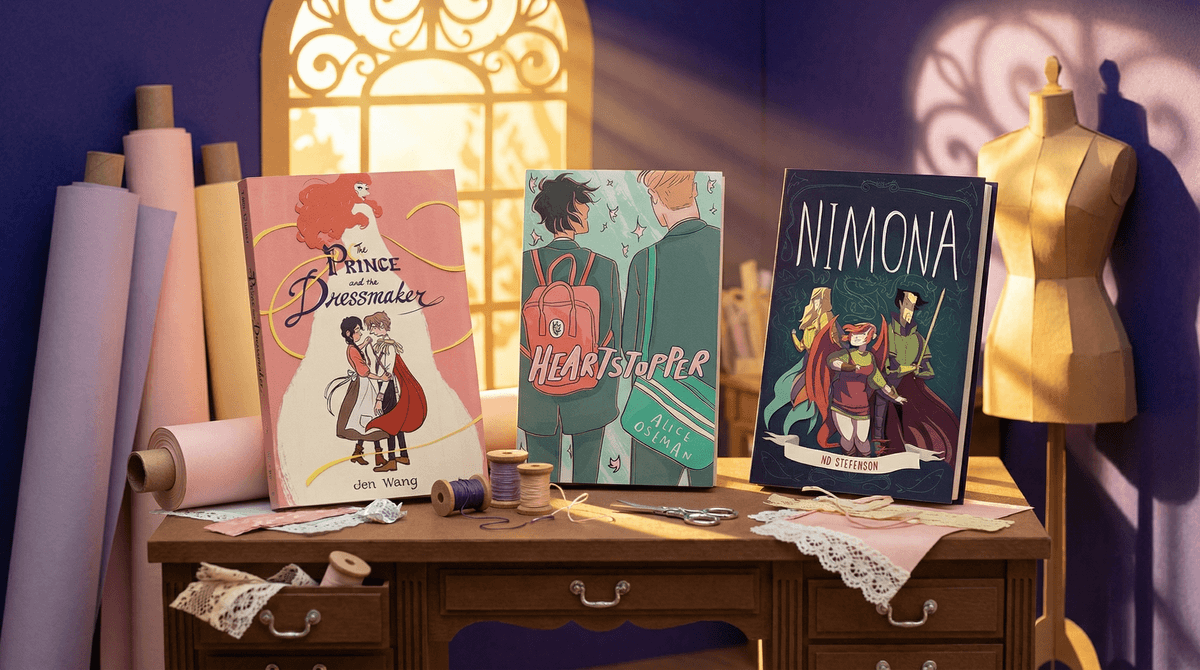
The Prince and the Dressmaker is a graphic novel by Jen Wang that's been quietly making its way through middle school libraries and bedroom bookshelves since 2018. It tells the story of Prince Sebastian, heir to the throne in an alternate-history Paris, who has a secret: he loves wearing dresses. His dressmaker Frances designs stunning gowns for him, and together they navigate the tension between Sebastian's public royal duties and his private identity as "Lady Crystallia."
The book won multiple awards including an Eisner Award nomination, and it's become a touchstone for conversations about gender expression, identity, and authenticity. You might have seen it on your kid's summer reading list, spotted it at the library, or heard about it from another parent who wasn't quite sure what to make of it.
Here's the thing: this book is landing in kids' hands whether we're prepared for the conversation or not. So let's get prepared.
The art is gorgeous. Jen Wang's illustrations are lush and expressive, with detailed dress designs that feel like fashion sketches come to life. Kids who love Heartstopper or Nimona will recognize the same vibrant, emotionally resonant art style.
But beyond the aesthetics, the story resonates because it's fundamentally about being yourself when the world expects you to be someone else. That's middle school in a nutshell, right? Whether your kid is dealing with friend drama, family expectations, or just trying to figure out who they are, Sebastian's journey hits home.
The friendship between Sebastian and Frances is also genuinely touching—it's about loyalty, creative collaboration, and the complications that come when secrets affect people you care about. Kids who love design, fashion, or creative pursuits often connect with Frances's entrepreneurial spirit and artistic vision.
Ages 10-14 is the sweet spot for this book, though some mature 8-9 year olds might be ready, and plenty of teens still love it.
The content is remarkably gentle. There's no violence, no sexual content, no profanity. The "edgiest" element is simply that a prince wears dresses and enjoys it. There's a kiss at the end (no spoilers about who), but it's completely age-appropriate.
That said, the themes require some emotional maturity:
- Understanding the difference between gender expression and gender identity
- Grappling with societal expectations vs. personal authenticity
- Processing the pain of hiding parts of yourself from people you love
- Understanding class differences and power dynamics
If your kid has read Drama by Raina Telgemeier or Guts by Raina Telgemeier, they're probably ready for The Prince and the Dressmaker. It's actually less complex emotionally than something like The Crossover by Kwame Alexander or Ghost by Jason Reynolds.
Let's address the elephant in the room: this book depicts gender non-conformity as positive and valid. Prince Sebastian isn't portrayed as confused or going through a phase—he genuinely loves wearing dresses, and the book treats this as something to be celebrated, not corrected.
The book doesn't explicitly label Sebastian's identity. He's not described as transgender, non-binary, or gender-fluid, though readers interpret him differently. He's a boy who loves wearing dresses. The story is more about self-expression and authenticity than about specific identity labels.
For families with traditional views on gender, this might feel challenging. That's okay—you get to decide what's right for your family. But here's what's worth knowing: kids are encountering these ideas everywhere, from Steven Universe to The Owl House to conversations with classmates. A book like this, which you can read together and discuss, might actually be the most controlled way to engage with these concepts.
Some parents worry that exposure to gender non-conforming characters will "confuse" their kids. Research consistently shows this isn't how it works—kids don't develop their gender identity based on what they read in books. But they do develop their capacity for empathy and their understanding of human diversity through stories. You might want to dig deeper into research on media influence and identity development .
.
If your kid brings this book home, consider it an invitation to conversation, not a crisis to manage.
Some starter questions:
- "What did you think about Sebastian's secret? Why do you think he kept it hidden?"
- "How did you feel about Frances's decision to keep his secret?"
- "What do you think the book is saying about being yourself?"
- "Have you ever felt like you had to hide something about yourself to fit in?"
You don't have to have all the answers. It's totally fine to say, "That's an interesting question. What do you think?" or "I'm still figuring out what I think about that."
If your kid asks whether it's "okay" for boys to wear dresses, you can share your family's values while still acknowledging that different families think differently: "In our family, we believe [X]. Other families might think [Y]. What matters most to me is that people are kind to each other, even when they're different."
The book also opens up great conversations about courage, authenticity, and the cost of secrets—themes that transcend the gender stuff entirely.
The Prince and the Dressmaker is a beautifully illustrated story about self-expression, friendship, and the courage it takes to be yourself. It's age-appropriate for middle-grade readers and handles its themes with nuance and heart.
Whether this book is right for your family depends on your values and where your kid is developmentally. But if they're already reading it—or asking to—consider reading it yourself first, then reading it together. The conversations that come from shared reading are often more valuable than the book itself.
And if you decide it's not the right fit for your family right now? That's okay too. There's no parenting trophy for having the most progressive bookshelf. There is value in knowing what your kids are reading and being someone they can talk to about it.
- Read it yourself first if your kid has expressed interest—it's a quick read, maybe 90 minutes
- Check out other Jen Wang books like Stargazing, which deals with friendship and mental health
- Explore similar titles like Melissa by Alex Gino (about a transgender girl) or When Aidan Became a Brother (about a transgender boy) if you want more books in this space
- Talk to your school librarian about how they approach these books and what conversations they're seeing
- Learn more about how to talk to kids about gender expression vs. gender identity
You've got this. And remember—the fact that you're here, reading this, trying to understand what your kid is reading? That's good parenting.