

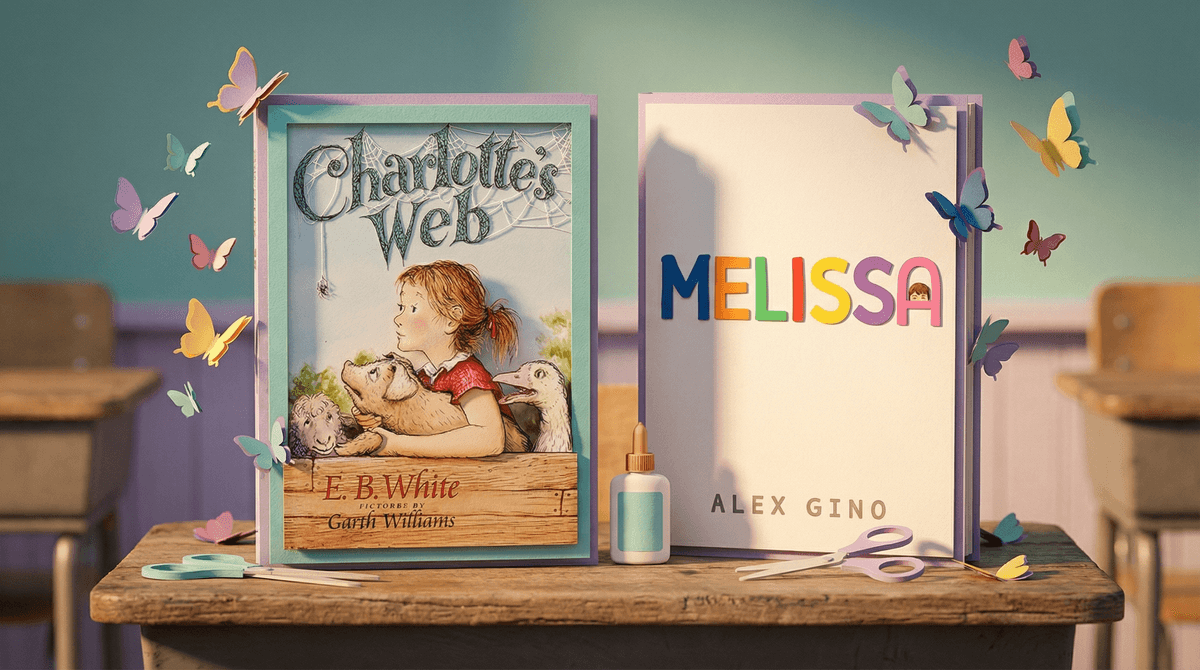
Melissa by Alex Gino (originally published as "George" in 2015, retitled in 2022) is a middle-grade novel about a fourth-grader who the world sees as a boy named George, but who knows in her heart that she's a girl named Melissa. When her class puts on a production of Charlotte's Web, Melissa desperately wants to play Charlotte—but her teacher says that's a "girl's role." With the help of her best friend Kelly, Melissa finds the courage to show everyone who she really is.
This book was groundbreaking when it came out—one of the first middle-grade novels with a transgender protagonist written for a mainstream audience. It's won multiple awards, been translated into over 20 languages, and yes, it's also been challenged or banned in some school districts, which is often how parents first hear about it.
Whether or not your child knows anyone who is transgender (though statistically, they probably do or will), this book offers something valuable: a story about the courage it takes to be yourself when the world has other expectations.
For kids who are transgender or questioning their gender identity, seeing themselves reflected in a book can be genuinely life-changing. For kids who aren't, it's a window into someone else's experience—which is basically what all good literature does.
The book handles its subject matter with remarkable gentleness. There's no violence, no trauma beyond the everyday difficulties of being misunderstood. Melissa faces challenges—a dismissive teacher, a brother who struggles to understand, classmates who might not get it—but the overall tone is hopeful. The message isn't "being different is hard" (though it can be). It's "you deserve to be seen for who you are."
Reading Level & Content: The book is written at a 4th-5th grade reading level and is typically recommended for ages 8-12. The content is age-appropriate for this range—there's nothing graphic or inappropriate. The most "mature" element is simply the concept of gender identity itself.
How Gender Identity Is Explained: Gino doesn't get into complex theory or medicalization. Melissa simply knows she's a girl, the same way any kid knows their own gender. She loves fashion magazines, dreams of being seen as herself, and feels uncomfortable when people use the wrong name and pronouns. It's presented as an internal knowing, not something that needs extensive justification.
The Name Change: The book was originally titled "George" (the name everyone calls Melissa before she comes out) but was retitled "Melissa" in 2022 at the author's request, to honor the protagonist's true identity. If you're seeing different titles in different places, that's why—they're the same book.
Religion & Values: The book doesn't address religion directly. If your family's faith tradition has specific teachings about gender, you might want to think through how you'll navigate that conversation if your child reads this book.
The Author: Alex Gino is nonbinary and uses they/them pronouns. They've been open about writing from personal experience of not fitting into expected gender categories. For some families, knowing the author's perspective adds important context.
Ages 8-10: This is the target age range. Kids this age can absolutely understand the core concept—Melissa knows she's a girl even though others see her as a boy. They may have questions about how someone "knows" their gender, which is actually a great opportunity to talk about how we all have an internal sense of who we are. Keep explanations simple and concrete.
Ages 11-13: Older middle schoolers will pick up on more nuanced themes—the isolation of keeping a secret, the risk of losing friendships, the complexity of Melissa's relationship with her brother. They may also have more sophisticated questions about transgender identity, medical transition, or social issues. Be prepared to have deeper conversations.
Younger than 8: Probably too early unless your child is an advanced reader and you're actively looking for books on this topic. The emotional complexity might be hard to grasp.
If your child is reading this for school or picks it up on their own, here are some conversation starters:
"What did you think of Melissa's story?" Start open-ended. Let them tell you what stood out to them. Sometimes kids focus on the friendship with Kelly, or the school play drama, rather than the gender identity piece.
"Have you heard the term transgender before?" Gauge what they already know. Kids are often more informed than we expect—or they've heard terms without really understanding them.
"How do you think Melissa felt when people used the wrong name?" This helps kids develop empathy without requiring them to understand every aspect of gender identity.
"What would you do if you were Kelly?" The best friend's role is significant—she's supportive but also learning. This can lead to good conversations about being a good friend to people who are different from us.
"Is this book trying to make my child transgender?" No. That's not how gender identity works, and that's not what this book does. Reading about a transgender character doesn't make someone transgender any more than reading Harry Potter makes them a wizard.
"My child is too young to think about gender identity." Actually, most kids have a solid sense of their own gender by age 3-4. This book isn't introducing a concept that's too advanced—it's just introducing a character whose gender identity doesn't match what people assumed.
"What if this leads to difficult questions?" It might! That's not necessarily a bad thing. Difficult questions are opportunities to share your family's values and help your child think critically. You can acknowledge that different families and communities have different beliefs about gender while still teaching respect for all people.
"Will other kids make fun of my child for reading this?" In most communities, this book is pretty widely accepted in the middle-grade space—it's won major awards and is in many school libraries. But yes, in some communities, it might raise eyebrows. You know your community best.
Melissa is a gentle, age-appropriate story about identity, courage, and friendship. Whether it's right for your family depends on your values, your child's maturity, and your readiness to have conversations about gender identity.
What makes this book powerful isn't that it's pushing an agenda—it's that it treats a transgender child as fully human, deserving of respect and understanding. For many kids, that's an important message. For some families, it might conflict with deeply held beliefs.
The good news? You get to decide what's right for your family. If you're unsure, read it yourself first. Talk to your child's teacher about the context if it's assigned at school. And remember that saying "not yet" or "let's read this together" is always an option.
If you're considering this book: Read it yourself first (it's short—you can finish it in an evening). Think through what questions might come up and how you'd want to answer them based on your family's values.
If your child is already reading it: Ask them about it! Most kids appreciate when parents show genuine interest in what they're reading, and it opens the door for them to come to you with questions.
If you want alternatives: Looking for books that explore identity and self-acceptance without the gender identity element? Try Wonder by R.J. Palacio, The Crossover by Kwame Alexander, or Merci Suárez Changes Gears by Meg Medina.
If you want to learn more: Explore how other parents are navigating conversations about gender identity with their kids, or check out what age-appropriate resources exist for families with different perspectives on this topic.