

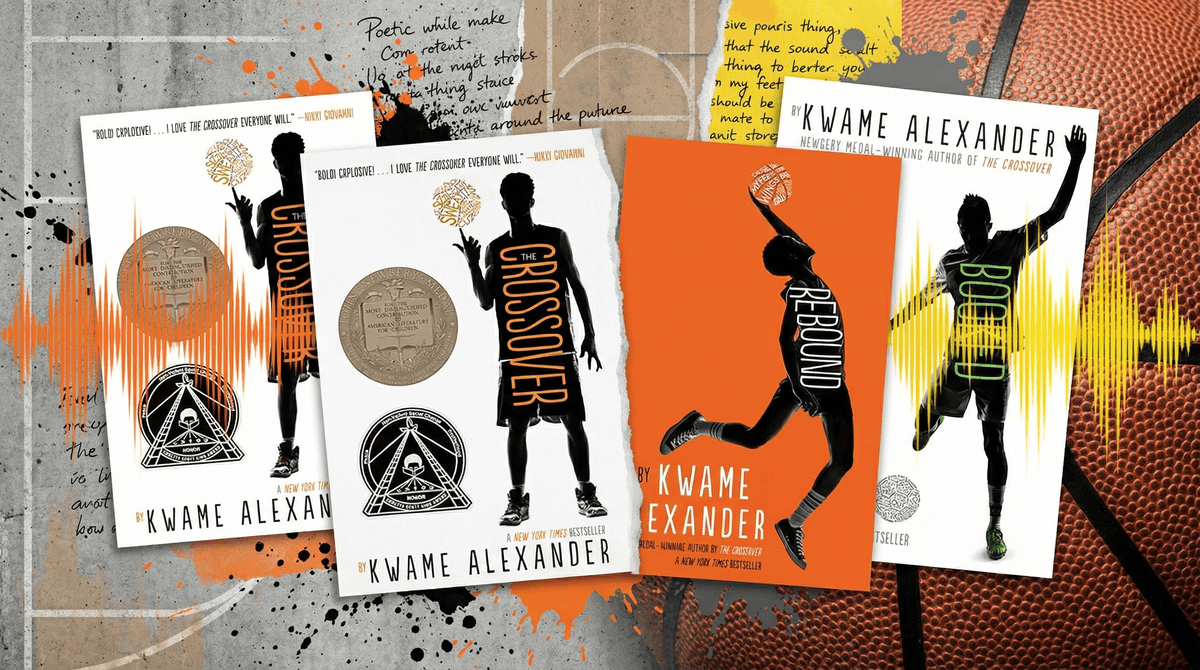
The Crossover by Kwame Alexander is a 2014 young adult novel written entirely in verse that follows 12-year-old Josh "Filthy McNasty" Bell and his twin brother Jordan "JB" as they navigate middle school, basketball, family dynamics, and first love. The book won the Newbery Medal and has become a staple in middle school classrooms and home bookshelves across the country.
Here's what makes it different: it reads like a mixtape. Short, punchy poems that feel like free verse rap lyrics mixed with traditional poetry. Some pages have just a few words. Others are packed with wordplay, basketball terminology, and the rhythm of dribbling a ball down the court. It's the kind of book that kids who say they "don't like reading" end up devouring in a weekend.
The story centers on the Bell family—Josh and Jordan, their former professional basketball player dad, and their principal mom—as they deal with typical middle school drama (girls, friendship, identity) alongside a serious family health crisis. It's funny, heartbreaking, and real in ways that land hard with the middle school age group.
It doesn't feel like reading. That's the magic trick here. The verse format means pages fly by. Kids get the satisfaction of finishing pages quickly, which builds momentum. For reluctant readers or kids who feel intimidated by thick chapter books, The Crossover is a gateway drug to reading for pleasure.
The basketball scenes are electric—even kids who don't play can feel the energy. And for kids who do play basketball (or any sport), seeing their world reflected on the page with such precision and respect is huge. The vocabulary is authentic without being exclusionary.
But here's the deeper hook: Josh's voice is so specific and honest about what it feels like to be 12. The jealousy when your twin brother gets a girlfriend. The confusion when your parents argue. The terror when someone you love is sick. The way identity feels both solid (I'm a basketball player, I'm a brother) and completely fluid (who am I without my twin, without my dad's approval?).
Alexander doesn't talk down to kids. He writes about first crushes, family tension, and mortality with the same weight, trusting young readers to handle complex emotions.
Best for ages 10-14, though some advanced 9-year-olds and plenty of high schoolers have loved it too.
Content considerations:
- Health crisis: A major character has a serious heart condition and the story doesn't shy away from the medical reality and emotional impact. This is handled sensitively but honestly—definitely something to be aware of if your family is dealing with health issues.
- Mild language: Nothing worse than "crap" or "sucks," but there's typical middle school attitude and sass.
- Romance: Age-appropriate first crush territory. Hand-holding, butterflies, jealousy—nothing physical beyond that.
- Family conflict: Parents argue (realistically), siblings fight, and there's tension around a parent not following medical advice. These conflicts feel authentic rather than traumatic.
The book deals with grief and loss, which is probably the biggest emotional consideration. The ending is powerful and sad, though not graphic. Some kids will need to process it; others will find it cathartic. Worth thinking about your child's current emotional landscape before handing it over if they're particularly sensitive or dealing with family health issues.
You might be wondering why a book guide is on Screenwise. Here's the thing: The Crossover is an antidote to scroll culture. It proves that reading doesn't have to mean slogging through dense paragraphs. The format is almost TikTok-like in its pace and punch, but with depth that short-form video can't touch.
The book also offers something screens often don't: space to feel complex emotions without immediately moving on. Josh's grief, confusion, and growth unfold across pages that kids can sit with, reread, and absorb. There's no algorithm pushing them to the next thing.
For families trying to build reading habits in a digital world, The Crossover is gold. It's short enough (237 pages with lots of white space) that it doesn't feel like a massive commitment. It's engaging enough that kids often finish it in one or two sittings. And it frequently becomes the book that makes kids realize they actually do like reading—they just needed to find the right entry point.
Conversation starters it enables:
- Identity and individuality (especially relevant if you have twins or siblings close in age)
- How we handle fear and worry about people we love
- What it means to be part of a team vs. standing out individually
- How family traditions and legacies shape us
- The difference between hearing advice and actually listening to it
It's probably already in their classroom. The Crossover is one of the most commonly taught middle school books right now, so there's a decent chance your 6th-8th grader will encounter it at school. If they're reading it for class, ask if you can read along. The book takes maybe 2-3 hours to read, and having shared vocabulary about Josh and JB's world can open up conversations that feel less forced than "how was school today?"
The audiobook is fantastic. Narrated by JD Jackson, it brings the rhythm and musicality of the verse to life. Great for family car rides or for auditory learners. Some kids prefer to read along while listening—the combination can be powerful for building reading fluency and confidence.
There's a graphic novel adaptation illustrated by Dawud Anyabwile that came out in 2019. It's beautiful and maintains the verse format while adding visual storytelling. Some kids prefer it; others love both versions. Neither is "better"—they're different experiences of the same story.
It's part of a series. Rebound is a prequel about Josh and Jordan's dad, and Booked is a companion novel about soccer. If your kid loves The Crossover, there's more Kwame Alexander to explore. He also has books for younger readers like The Undefeated.
The Crossover is one of those rare books that works on multiple levels. It's accessible enough for reluctant readers, sophisticated enough for advanced readers, and emotionally resonant enough that adults often find themselves tearing up while reading it alongside their kids.
In a media landscape where everything competes for attention in 15-second increments, this book proves that young people absolutely will engage with slower, deeper storytelling—when it's done with respect for their intelligence and emotional capacity.
It's not a "screen-free alternative." It's just a really good book that happens to offer something different than what screens typically provide: a complete emotional arc, space for reflection, and proof that words on a page can hit as hard as any video.
If your kid is on the fence about reading it: Start by reading the first few poems aloud together. The rhythm is infectious, and hearing it can hook kids who might be intimidated by the format.
If they've already read it: Ask them which poem hit hardest and why. The beauty of verse is that different readers connect with different moments. Their answer will tell you a lot about what they're processing.
If you're looking for similar reads: Try Ghost by Jason Reynolds, Brown Girl Dreaming by Jacqueline Woodson, or Long Way Down by Jason Reynolds—all novels in verse that punch above their page count.
And if your kid finishes The Crossover and immediately wants to talk about it? That's the goal. That's what good stories do. They make us want to share the experience, to process it with someone else, to figure out what we think and feel. In a world of endless content, that kind of engagement is worth protecting.