

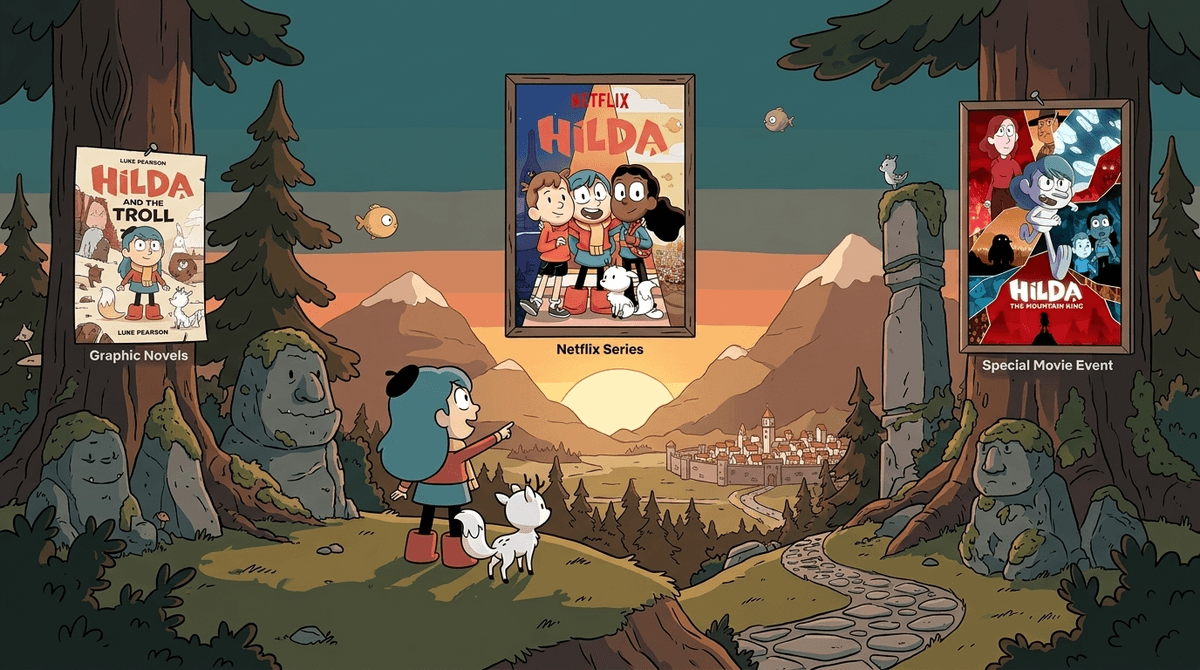
TL;DR: Hilda is essentially the "prestige TV" of kids' animation and graphic novels. It is the perfect antidote to "brain rot" content, offering a "cozy fantasy" world that rewards curiosity rather than just overstimulating the senses. The original graphic novels are stunning and great for reluctant readers, while the Netflix series expands the lore without losing the soul of the characters. It’s safe, smart, and genuinely beautiful.
Quick Links:
- The Books: Hilda graphic novels by Luke Pearson
- The Series: Hilda (Netflix)
- The Feature Film: Hilda and the Mountain King
- The App: Hilda Creatures
If you haven’t encountered the blue-haired explorer yet, imagine if Studio Ghibli moved to Scandinavia and decided to write a story about a girl who treats giant trolls and invisible elves like slightly annoying neighbors.
Created by Luke Pearson, Hilda lives in a world where the supernatural is just... natural. She starts in the wilderness with her mom and her deer-fox, Twig, but eventually moves to the walled city of Trolberg. Unlike a lot of kids’ media where the goal is to "defeat the monster," Hilda’s goal is usually to understand the monster, negotiate with it, or help it find its lost socks.
It’s part of a genre we call cozy fantasy for kids. It’s not high-octane "Ohio" energy; it’s thoughtful, atmospheric, and deeply empathetic.
Kids are currently inundated with fast-paced, loud, and often nonsensical content (looking at you, Skibidi Toilet). Hilda stands out because it treats kids like they have an attention span and an emotional vocabulary.
- Independence: Hilda wanders. She explores. She makes mistakes and has to fix them. In an era of "helicopter parenting," kids find the freedom Hilda has—clambering over mountains and chatting with wood spirits—incredibly aspirational.
- The "Spooky-But-Safe" Vibe: It has ghosts, trolls, and "Nightmares," but it’s never traumatizing. It’s that perfect level of "creepy" that feels like a rite of passage for a 7-year-old.
- Low-Stakes High-Stakes: The world isn't usually ending. Usually, the "big problem" is that a giant stepped on a house because he didn't see it, or the elves are filing too much paperwork. It’s funny and relatable in a weirdly bureaucratic way.
This isn't a case where one is "better" than the other; they just offer different experiences.
The books are where it all started. If your kid is into Dog Man or Wings of Fire, these are a massive step up in terms of artistic quality.
- The Art: It’s mid-century modern meets indie comic. The color palettes are limited and gorgeous—lots of oranges, teals, and muted reds.
- The Pacing: Because they are graphic novels, kids can linger on the details. There’s a lot of "environmental storytelling" where the art tells you more than the words.
- Reluctant Readers: These are the gold standard for kids who "don't like to read." They are fast-paced but require kids to interpret visual cues and complex dialogue.
Netflix didn't just "adapt" the books; they expanded the universe.
- The Voice Acting: Bella Ramsey (from The Last of Us and Game of Thrones) voices Hilda, and she brings a perfect mix of pluck and vulnerability.
- Character Development: The show spends way more time on Hilda’s friends, David and Frida. Frida, in particular, gets a great arc involving magic and high expectations that many "gifted and talented" kids will feel in their souls.
- The Music: The soundtrack is incredible. It’s synth-heavy and atmospheric, featuring artists like Grimes for the opening theme. It feels "cool" in a way that doesn't try too hard.
This is a 80-minute feature that bridges the gap between Season 2 and Season 3. It’s the most "epic" the series gets. If your kid has watched the show, this is non-negotiable viewing. It handles themes of identity and "the other" better than most Oscar-winning dramas.
If your family has already binged all three seasons and read every book, here is where to go next:
- For the "Spooky-Cozy" itch: Over the Garden Wall. It’s a bit darker than Hilda, but shares that "magical woods" atmosphere. Best for ages 8+.
- For the "Nature-Adventure" itch: The Wild Robot by Peter Brown. This book (and now movie) hits the same emotional notes about survival and kindness.
- For the "Mystery-Comedy" itch: Gravity Falls. It’s faster and more "cartoonish," but the lore is just as deep.
- For the "Reluctant Reader" itch: Lightfall by Tim Probert. This is the closest thing to the Hilda graphic novels in terms of sheer beauty and world-building.
Check out our full list of graphic novels that aren't 'brain rot'
Ages 5-7: They will love Twig (the deer-fox) and the funny creatures. Some of the "troll" stuff might be a bit intense if they are sensitive to shadows or loud noises, but Hilda’s bravery is contagious. Ages 8-10: This is the "sweet spot." They’ll catch the nuances of the friendship drama and the environmental themes. Ages 11+: Don’t be surprised if your middle-schooler still watches this. It has a "comfort watch" quality, similar to Adventure Time, that appeals to older kids (and adults).
Safety Note: There is zero "bad" language and no sexual content. The "violence" is fantasy-based (dodging giant feet, using a wooden sword against a spirit), but it’s rarely about hurting things and almost always about solving a puzzle.
One of the best things about Hilda is Hilda’s mom, Johanna. In most kids' shows, parents are either:
- Dead (The Disney Special)
- Bumbling idiots who need the kids to save them
- Non-existent
Johanna is a real person. She worries, she gets frustrated when Hilda lies to her, and she tries to set boundaries while still respecting Hilda’s need to explore. The relationship between Hilda and her mum is the emotional anchor of the series. It’s a great jumping-off point for conversations about trust and independence.
Learn more about how to talk to your kids about independence vs safety
If you’re watching or reading together, try these conversation starters:
- "Why do you think the people in Trolberg are so afraid of the trolls, even though the trolls were there first?" (Great for talking about prejudice/history).
- "Hilda really wanted to stay in the woods, but her mom wanted to move to the city. How do they compromise?"
- "Frida is a bit of a perfectionist. Do you ever feel like you have to be perfect at everything?"
Hilda is a rare 10/10. Whether you start with the graphic novels or the Netflix show, you’re giving your kid content that is actually "nutritious" for their brain. It encourages them to look at the world with wonder rather than just scrolling for the next dopamine hit.
In a world of "Ohio" memes and loud YouTube influencers, be the parent who introduces them to the quiet, brave, blue-haired girl and her deer-fox. You won't regret it.
- Check your local library for the Hilda graphic novels. They are oversized and beautiful—worth seeing in print.
- Watch the first episode of the show on Netflix with your kid. If they aren't hooked by the "Midnight Giant," I’d be surprised.
- Explore more "Cozy" media. If they love the vibe, look into Stardew Valley or Animal Crossing for their next gaming session.