

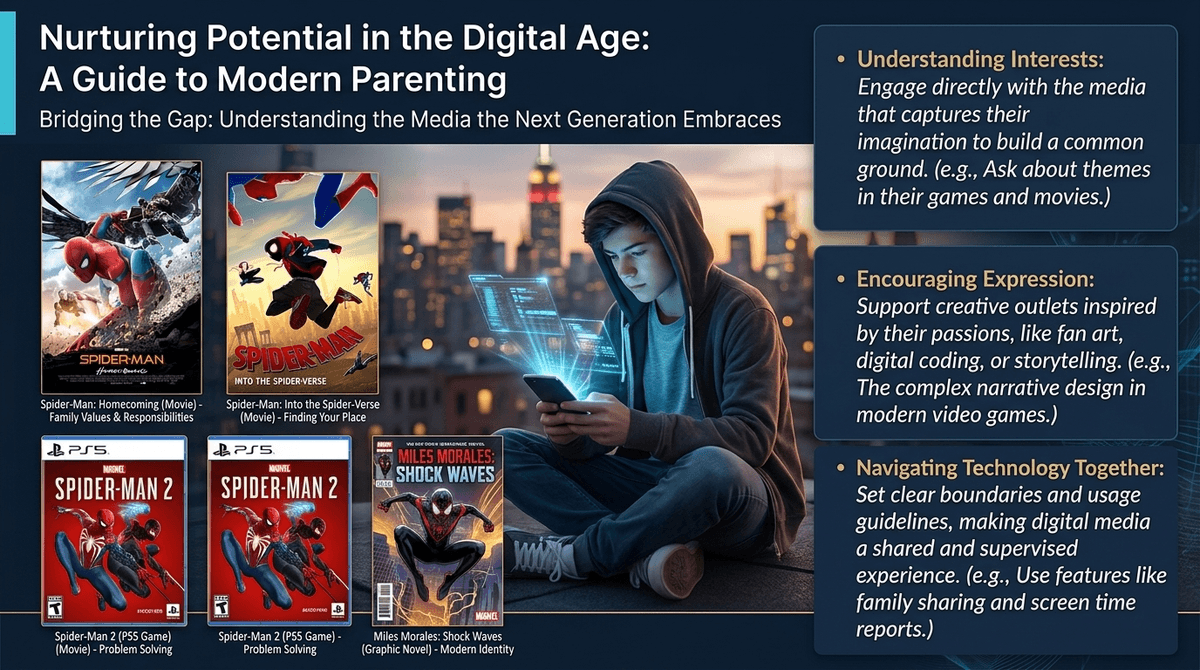
TL;DR: Spider-Man: Homecoming is the most "digital-native" superhero movie ever made. It’s a fantastic watch for ages 10+ that perfectly mirrors the struggle of a teenager wanting full access to the "pro" features of life (and tech) before they’ve mastered the basics.
Quick Links for the Spidey-Obsessed:
- The Follow-up: Spider-Man: Far From Home (Dealing with deepfakes and AR)
- The Gold Standard: Spider-Man: Into the Spider-Verse (A visual masterpiece about identity)
- The Best Game: Marvel's Spider-Man (PS5) (Open-world responsibility)
- For the Readers: Spider-Man: Miles Morales by Jason Reynolds
If you grew up with Tobey Maguire or Andrew Garfield, clear your head. Spider-Man: Homecoming gives us a Peter Parker who is actually 15, actually in high school, and—most importantly—actually obsessed with his phone.
In this version, Peter is mentored (sort of) by Tony Stark. After the events of Captain America: Civil War, Peter is sent back to Queens with a high-tech suit that is basically a $10 billion smartphone with legs. The movie follows Peter as he tries to prove he’s ready for the "big leagues" (The Avengers) while failing his Spanish quizzes and accidentally blowing up a deli.
We talk a lot about "digital wellness" and "screen time," but Spider-Man: Homecoming gives us a literal, physical metaphor for exactly what we’re all going through with our kids: The Training Wheels Protocol.
In the film, Tony Stark locks the most dangerous and advanced features of Peter’s suit behind a software wall. Peter, being a tech-savvy Gen Z kid, immediately recruits his best friend Ned to "jailbreak" the suit so he can access everything.
This is the central tension of modern parenting. We give our kids a device—a Chromebook for school or a first iPhone—and we put on the "training wheels." We use Screen Time or Google Family Link. And what do the kids do? They head to YouTube or TikTok to find workarounds.
One of the coolest (and most relevant) parts of the movie is "Karen," the AI built into Peter’s suit. She’s like a much more competent version of Siri or ChatGPT.
Peter relies on Karen for everything: aiming his webs, identifying people through walls, and even getting dating advice. It raises a question we’re seeing in classrooms right now: Is the tech helping Peter become a better hero, or is it doing the work for him?
When Peter finally loses the suit and has to fight the Vulture in a homemade hoodie, he realizes that "if you’re nothing without the suit, then you shouldn’t have it." That is a hard truth to drop on a kid who feels like they can't survive a car ride without Roblox or YouTube.
Absolutely not. Unlike some of the mindless colorful noise on YouTube Kids, Spider-Man: Homecoming is a legitimate coming-of-age story.
- Violence: It’s Marvel violence. Lots of things explode, but there’s very little blood. The stakes feel real, but not traumatizing.
- Language: There’s some mild "high school" swearing (the "S" word shows up once or twice), but it’s remarkably clean compared to something like Guardians of the Galaxy.
- Themes: It handles rejection, social anxiety, and the desire to grow up too fast.
Recommended Age: 10 and up. If they’ve seen The Avengers, they are more than ready for this.
If your kid finishes the movie and suddenly wants to be a "guy in the chair" (the tech support friend) or a web-slinger, here is how to direct that energy into high-quality media:
This is the pinnacle of superhero gaming. It’s not just about hitting bad guys; it’s about Peter and Miles Morales trying to balance their real lives with their digital/hero lives. It’s a great way to talk about time management and gaming.
If Homecoming is about the tech, Spider-Verse is about the art. It is arguably the best animated film of the last decade. It’s a great jumping-off point for kids interested in digital art or animation.
If your kid loves the idea of Ned "hacking" the suit, don't let them actually try to jailbreak your home router. Get them on Scratch. They can learn the logic of "Training Wheels Protocols" by building their own games.
For the kids who prefer visual storytelling but need a break from screens, this graphic novel is fantastic and hits those same "young hero in the city" vibes.
The movie opens with a "film by Peter Parker"—a series of shaky-cam phone clips he took during his trip to Berlin. It’s pure YouTube/TikTok energy.
Peter’s desperate need for validation from Tony Stark (his "likes" and "follows") is a major plot point. He spends the whole movie waiting for a text back. This is a perfect opening to talk about "ghosting," digital anxiety, and the "Always On" culture.
Peter feels like he isn't a hero unless he's recording it or telling someone about it. Sound familiar?
Check out our guide on helping kids deal with digital validation
After the movie, skip the "Did you like it?" question and try these:
- "Do you think Tony Stark was right to lock the suit features?" (This is a trap, but a good one. It leads directly to a conversation about your own house rules for Discord or Snapchat).
- "If you had a 'Karen' AI in your ear all day, would you use it to do your homework?" (A great way to gauge their thoughts on AI and ethics).
- "Why was Peter so much better at being a hero when he was just wearing his old sweatpants?" (Focuses on internal skills vs. external tools).
Spider-Man: Homecoming isn't just a "superhero movie"—it's a mirror. It shows us a kid who is brilliant, capable, and well-intentioned, but also impulsive and over-reliant on his gear.
As intentional parents, our job is to be the Tony Stark in this scenario (hopefully with less billionaire sass). We provide the tech, we set the Training Wheels Protocol, and we wait for them to prove they can handle the "Instant Kill Mode" of the real world without actually using it.
It’s a fun, fast-paced, and genuinely smart movie that treats the "digital life" of a teenager as a central part of their identity, not just a side-plot. Highly recommended for a family movie night.
- Set the boundaries: Check out our guide on smartphone contracts for teens.
- Explore the tech: If they liked the AI aspect, look into educational AI tools for kids.
- Stay updated: See if the next Spider-Man movie is safe for kids