

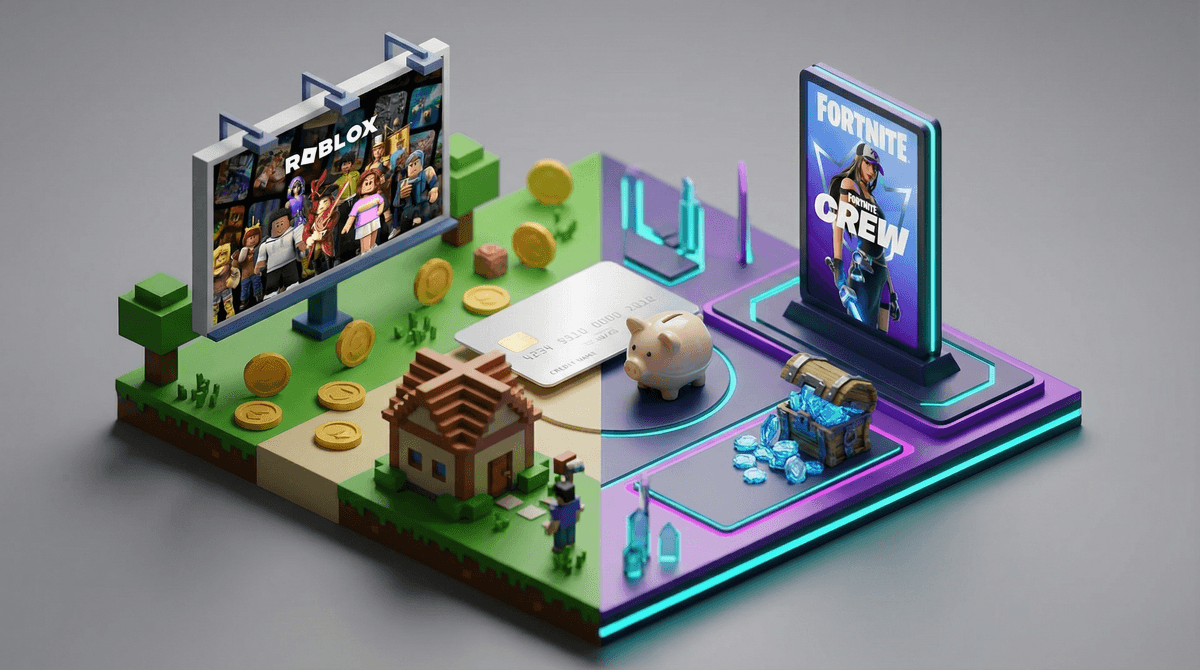
Let's cut through the noise: Robux and V-Bucks are virtual currencies that cost real money. Robux is the currency for Roblox, V-Bucks for Fortnite. Your kid can't earn them through regular gameplay in meaningful amounts—they need to buy them. And yes, they will ask. Repeatedly.
Here's the breakdown:
- Robux: Used in Roblox to buy avatar items, game passes, and access to premium experiences. Roughly 80 Robux = $1 USD (though pricing tiers make this fuzzy)
- V-Bucks: Used in Fortnite exclusively for cosmetics—skins, emotes, pickaxes, gliders. 1,000 V-Bucks ≈ $8 USD
Neither currency gives gameplay advantages in the traditional "pay to win" sense, but that doesn't mean the pressure to spend isn't real.
The psychology here is chef's kiss from a game design perspective, and absolutely maddening from a parenting one.
For Roblox/Robux:
Your kid isn't just playing one game—they're navigating a social universe where their avatar IS their identity. That default bacon-hair look? It screams "new player" or "can't afford Robux." Kids face genuine social pressure to customize their avatars. Plus, many popular Roblox games have VIP passes or special abilities that cost Robux. Learn more about how Roblox's economy actually works .
.
For Fortnite/V-Bucks: It's all about the drip. Fortnite's Battle Pass system creates FOMO on steroids—limited-time skins, seasonal content, crossover events with Marvel or Star Wars. Your kid's friends are running around as Spider-Man, and they're stuck in the default skin. The social currency is real, even if the actual currency is virtual.
Both games use artificial scarcity (limited-time offers), social comparison (everyone can see what you're wearing), and variable pricing (bundle deals that make you spend more to "save" money). It's not accidental. These systems are designed by people with psychology degrees.
Let's do some math that'll make you wince:
Roblox:
- Basic avatar outfit: 200-500 Robux ($2.50-$6)
- Popular game pass: 300-1,000 Robux ($3.75-$12)
- Monthly Roblox Premium (which includes monthly Robux): $4.99-$19.99/month
Fortnite:
- Single skin: 800-2,000 V-Bucks ($6-$16)
- Battle Pass (seasonal, ~3 months): 950 V-Bucks ($8)
- Emote or pickaxe: 200-800 V-Bucks ($2-$6)
A kid asking for "just one skin" every couple weeks is looking at $10-20/month. Add in a Battle Pass, some impulse purchases, and suddenly you're at $30-50/month. Per kid. And if you have multiple kids who play? Yeah.
The sneaky part: both platforms use obfuscated pricing. You can't buy exactly 800 V-Bucks—you have to buy 1,000, leaving 200 sitting there, tempting another purchase to "use them up." Roblox does the same thing. It's the same psychology as casino chips—when it doesn't feel like real money, it's easier to spend.
Ages 8-10: These kids are just starting to understand money concepts. They see friends with cool stuff and want it, but don't grasp the cumulative costs. This is actually a great teaching opportunity about budgeting and delayed gratification. Consider:
- A small monthly allowance ($5-10) they can choose to spend on Robux/V-Bucks or save
- Require them to wait 24 hours before any purchase (impulse control practice)
- No access to payment methods—you approve everything
Ages 11-13: Middle schoolers feel the social pressure most acutely. They're also old enough to understand earning and budgeting. Try:
- Connecting in-game currency to real-world chores or responsibilities
- Setting a monthly cap and letting them manage it
- Teaching them to evaluate "worth"—is this skin really worth 3 hours of yard work?
Ages 14+: Teens can handle more autonomy but still need guardrails:
- Consider letting them earn money for in-game purchases through actual work
- Discuss opportunity cost—that $20 could be V-Bucks or movie tickets with friends
- Set hard limits on access to payment methods (remove saved cards, require approval for purchases over $X)
The "Free-to-Play" Trap: Both Fortnite and Roblox are technically free. Your kid can play without spending a dime. But the experience is designed to make free players feel like second-class citizens. That's the business model. It's not evil, but it is intentional, and pretending otherwise is naive.
The Social Dynamics: Your kid isn't being shallow or materialistic when they beg for Robux. They're navigating real social hierarchies where digital items signal belonging. Dismissing this as "just a game" misses the point—for kids, this IS their social space. That said, you're still the parent, and "everyone has it" has never been a good reason to say yes to anything.
The Teaching Moment: This is genuinely one of the best opportunities to teach financial literacy in a low-stakes environment. Messing up a Robux budget won't ruin their credit score. Let them make small mistakes now while the consequences are minor.
The Earning Potential (Roblox Only):
Here's something interesting: kids can actually create games in Roblox and earn Robux from other players. Some teens make real money through the Developer Exchange program. If your kid is interested in game design, Roblox's creation tools could be educational. Just know that the vast majority of young creators earn little to nothing—it's not a get-rich-quick scheme.
Option 1: The Monthly Budget Give them a set amount monthly ($10-20 is common). They manage it, they live with their choices. When it's gone, it's gone. This teaches budgeting and prioritization.
Option 2: The Earning System Tie in-game currency to real-world responsibilities. Not regular chores (those are part of being in a family), but extra tasks. This teaches work ethic and value.
Option 3: Special Occasions Only In-game currency becomes a birthday/holiday gift option. This limits spending but might increase the nagging between occasions.
Option 4: The Hard No Some families don't do in-game purchases, period. Your kid can play free or not at all. This is a valid choice, though be prepared for significant social pressure and complaints.
The Hybrid Approach (Most Popular): Many families combine these—a small monthly budget plus the ability to earn extra, with special occasion bonuses. The key is consistency. Whatever you choose, stick to it. Caving "just this once" teaches them that persistence pays off.
- Remove saved payment methods from gaming accounts and devices
- Require password/approval for all purchases (both platforms allow this)
- Check purchase history monthly—both as a teaching tool and to catch unauthorized spending
- Set up spending alerts through your credit card if available
- Have regular money conversations—not just when they're asking for something
For detailed platform-specific settings, check out our guides on Roblox parental controls and Fortnite parental controls.
Robux and V-Bucks aren't going anywhere. These games have hundreds of millions of players, and the free-to-play model works precisely because it converts a small percentage of players into spenders. Your kid will be exposed to this pressure whether you engage with it or not.
The question isn't whether these currencies are "good" or "bad"—they're tools, and like any tool, they can be used well or poorly. The real opportunity is using your kid's desperate desire for a Fortnite skin as a crash course in financial literacy, delayed gratification, and value assessment.
Will they still beg? Yes. Will they claim you're the only parent who "doesn't understand"? Absolutely. Will they survive without the latest Roblox accessory? They will.
Set your boundaries, stick to them, and use this as the teaching moment it is. Because trust me, the stakes only get higher from here—better they learn about impulse spending with V-Bucks than with a credit card at 18.
- Have a family meeting about in-game spending—get everyone's input on a system
- Set up parental controls on both platforms TODAY (not tomorrow, today)
- Decide on your family's approach and communicate it clearly
- Explore alternatives to Roblox or alternatives to Fortnite if you want to see what else is out there
- Consider using Screenwise to track and understand your family's actual gaming patterns—sometimes the data surprises us
And remember: you're not a bad parent for saying no, and you're not a bad parent for saying yes with limits. You're just trying to navigate digital parenting in 2026, and that's hard enough without judgment.