

Raising Bilingual Kids in a Screen-Dominated World
Look, I'm going to be real with you: screens are probably going to be part of your bilingual journey whether you like it or not. The question isn't whether to use them, but how to use them without accidentally raising a kid who can say "subscribe and smash that like button" in two languages but can't hold a conversation with their grandmother.
Raising bilingual kids has always been hard. You're fighting against the dominant language of school, friends, and basically everything cool. But now? Now you're also competing with an algorithm that's really good at serving up English content because, let's be honest, that's where most of the content is.
The good news: there's more multilingual content available than ever before. The bad news: it's buried under approximately 47 million hours of English-language Minecraft tutorials and Roblox gameplay videos.
Here's the thing that the "no screens ever" crowd won't tell you: screens can be genuinely useful tools for language exposure, especially if you're raising kids in a place where your target language isn't widely spoken.
If you're trying to raise Spanish speakers in suburban Minnesota, or Mandarin speakers in rural Oregon, screens might be one of your only consistent sources of native-speaker content. Abuela can't FaceTime 24/7, and you can't manufacture a whole friend group of kids who speak your target language.
The research actually backs this up. Studies show that kids can learn vocabulary and grammar patterns from quality screen content in their target language—but (and this is a big but) only when it's combined with real human interaction. The screen can't be the teacher; it has to be the teaching assistant.
Here's what actually happens in most homes: You set your kid up with YouTube Kids in Spanish. They watch one video. The algorithm sees they speak English (because they do), and within three videos, they're back to English content. Why? Because there's more of it, it gets more engagement, and the algorithm is optimized for watch time, not your family's language goals.
Same thing happens on Netflix. You can set the interface to another language, but the recommendations? Still skewed heavily toward English content because that's what most users watch.
This is where you have to get intentional. You can't just throw a device at your kid and hope they absorb Korean. You need a strategy.
Ages 2-5: The Foundation Years
This is your golden window. Little kids don't care if Peppa Pig speaks English or Mandarin—they just want to watch a pig jump in muddy puddles.
What works:
- Set device language to your target language and don't change it
- Curate specific playlists instead of letting autoplay run wild
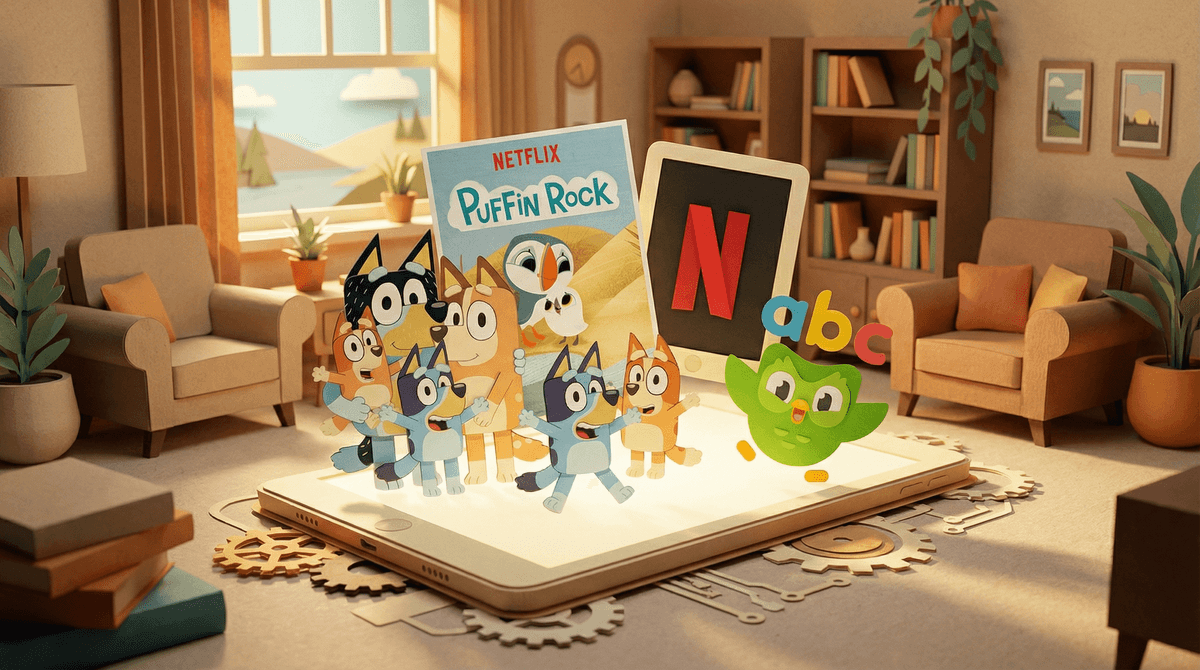
- Use apps like Duolingo ABC (available in multiple languages) for early literacy
- Shows like Bluey have excellent dubs in Spanish, French, and other languages—and they're actually good
- Puffin Rock on Netflix has solid language options and is genuinely charming
The key: Watch with them. Pause and talk about what's happening. The screen provides input; you provide interaction.
Ages 6-10: The Drift Begins
This is when kids start having opinions about what they watch, and those opinions are heavily influenced by what their friends are watching—which is probably in English.
What works:
- Find YouTubers who create content in your target language about topics your kid already loves. There are Minecraft YouTubers in basically every language at this point
- Genshin Impact and other games with full language options—let them play in your target language
- Duolingo can actually be motivating for this age if you don't make it feel like homework
- Look for dubbed versions of shows they already want to watch—Avatar: The Last Airbender has excellent dubs in multiple languages
The key: Give them agency. Let them pick what to watch, but from a curated set of options in your target language. Frame it as "this is our Spanish screen time" versus "this is your free choice time."
Ages 11+: The Resistance Is Real
Tweens and teens are going to resist. They want to watch what their friends watch, read what their friends read, and participate in the cultural moments happening in English.
What works:
- Stop fighting about entertainment media. Let them watch their English stuff
- Instead, use screens for connection: FaceTime with family members who speak your target language, group chats with cousins, etc.
- Find content creators who are genuinely cool in your target language—not educational content, but actual entertainment
- Gaming can be huge here: playing Fortnite or Roblox with voice chat in your target language with friends or family
- Music and TikTok—yeah, TikTok—can actually help. The algorithm will serve content in multiple languages if you engage with it
The key: Make the target language feel like a superpower, not a chore. It's about identity and connection, not just vocabulary.
Let me save you some time and frustration:
- Educational apps that feel like school: Kids can smell homework from a mile away
- Low-quality dubbed content: If the lip sync is terrible and the voice acting is wooden, they won't watch it
- Forcing them to watch baby shows in the target language when they're past that age: A 10-year-old is not going to watch preschool content just because it's in Spanish
- Pretending screens alone will do the job: They won't. You still need real conversation
Here's the uncomfortable truth: if your kid can't use the language to talk about things they actually care about, they won't maintain it.
Screens can help with input—vocabulary, pronunciation, cultural context. But they can't replace output. Your kid needs to actually speak the language, and they need to speak it about things that matter to them.
So if they're watching Pokémon in Japanese, you need to be ready to talk about Pokémon in Japanese. If they're playing Minecraft in French, you need to engage with their creations in French.
This is where a lot of parents hit a wall. You might not know the vocabulary for "Ender Dragon" or "netherite" in your target language. That's okay. Look it up together. Make it a thing you figure out as a team.
Screens aren't the enemy of bilingualism, but they're not the solution either. They're a tool, and like any tool, they work best when used intentionally.
The winning formula:
- Curate content in your target language that's actually engaging (not just educational)
- Watch/play/engage together when possible
- Use screens to facilitate real human connection (video calls, gaming with family, group chats)
- Create space for conversation about what they're consuming
- Accept that they'll consume English content too, and that's fine—bilingualism isn't about purity, it's about competence
And remember: if your kid grows up able to code-switch between languages, understand cultural nuances, and connect with family across borders—even if they learned some of that vocabulary from a YouTuber playing Among Us—that's a win.
- Audit your current apps and streaming services: learn how to change language settings
 on your most-used platforms
 - Make a list of your kid's current interests and find content creators in your target language who cover those topics
- Set up one "target language only" device or profile if possible—this removes the constant negotiation
- Schedule regular video calls with family members who speak your target language (and yes, screen time for connection absolutely counts as quality time)
You've got this. It's messy, it's imperfect, and your kid will probably still answer you in English half the time. But that's parenting in 2026—we're all just doing our best with the tools we have.