

TL;DR: Prodigies Music is the gold standard for turning "screen time" into "skill time" for kids aged 2–10. It uses a color-coded system and catchy video lessons to teach pitch, rhythm, and music theory. Think of it as Guitar Hero meets a high-end Montessori music conservatory. It’s effective, but it does require an investment in physical bells and a subscription.
Quick Links:
- Prodigies Music App
- Simply Piano (Best for older kids 8+)
- Duolingo Music (Great free alternative for basics)
- YouTube Kids (Where you can find their free "sample" lessons)
We’ve all been there: you want your kid to be the next Mozart (or at least have a hobby that doesn’t involve watching someone else unbox toys on YouTube), but the thought of forcing a four-year-old to sit through 30 minutes of scales makes you want to hide in the pantry.
The traditional "practice room battle" is a rite of passage most of us would gladly skip. Enter Prodigies Music. If you’ve seen the colorful desk bells all over your Instagram feed or heard a parent at school mention "Mr. Rob," you’re looking at the heavyweight champion of early childhood music tech.
At its core, Prodigies Music is a video-based curriculum accessible via their website or app. It’s led primarily by "Mr. Rob," a guy who has the infectious energy of a Bluey episode but with a Master’s degree in music education.
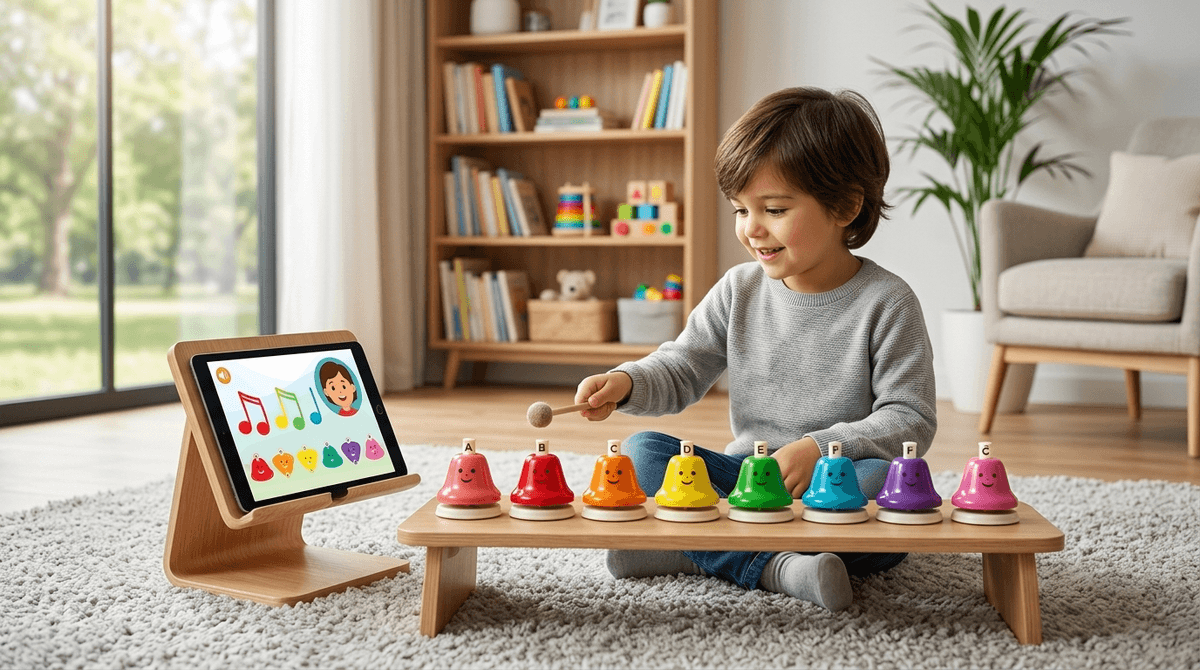
The "secret sauce" is the Chroma-Notes system. Every note in the scale is assigned a specific color (C is red, D is orange, etc.). This matches the industry-standard Boomwhackers and their proprietary desk bells. Instead of struggling to read black-and-white sheet music—which is basically a foreign language to a toddler—kids just follow the colors on the screen.
It’s gamified, it’s fast-paced, and it’s designed to be played with an instrument in hand, not just watched passively.
Kids love it because it feels like a win. In a world where they are constantly being told they’re too small to do things, they can hit a red bell and be "right" every single time.
But from a "Screenwise" perspective, the reason this matters is the Critical Period for Auditory Development. Research shows that between ages 0 and 5, a child’s brain is uniquely wired to develop "Perfect Pitch" (the ability to identify a note just by hearing it). Most traditional music lessons start at age 7 or 8, which is actually after this window has started to close.
Prodigies Music targets that 2–6 age range specifically to build "pitch memory." It’s basically teaching them music as a native language rather than a secondary subject they have to study in middle school.
While we talk about it as an "app," Prodigies Music is really a hybrid experience. You can’t just hand your kid an iPad and expect results. You need the gear.
These are the iconic, colorful bells you see in the videos. They are durable (toddler-proof) and tuned perfectly. The app is designed around hitting these bells in sync with the animations on the screen.
Once they master the bells, the platform has a massive library for the ukulele. It’s the same color-coded system, making the transition from "hitting a bell" to "strumming a string" surprisingly seamless.
They also offer a piano track. If you already have a keyboard at home, you can buy color-coded stickers to put on the keys. This is a great bridge to more formal lessons later on.
We’re pretty cynical about "educational" apps. Half the stuff labeled "learning" on the App Store is just a dopamine slot machine with a few numbers thrown in.
Prodigies Music is the opposite of brain rot. It requires:
- Hand-eye coordination (hitting the right bell at the right time).
- Active listening (matching the pitch of their voice to the bell).
- Pattern recognition (understanding rhythms and sequences).
It’s "high-quality screen time." If your kid is going to spend 20 minutes with a tablet, having them learn the difference between a Major 2nd and a Perfect 5th is a massive win compared to watching Skibidi Toilet memes or mindless Roblox obbys.
- Ages 2–4: Stick to the "Playtime Prodigies" track. It’s heavy on movement, singing, and just getting used to the bells. Don’t worry about "theory" here; just let them enjoy the noise.
- Ages 5–7: This is the sweet spot for "Primary Prodigies." They’ll start learning how to read simplified sheet music and understand basic rhythms (ta, ti-ti, etc.).
- Ages 8+: If your child hasn't used the program before, they might find Mr. Rob a little "young" for them. At this age, you might want to look at Simply Piano or Yousician, which feel more like "pro" tools and less like a preschool show.
Let’s talk about the hurdles, because no app is perfect.
1. The "Mr. Rob" Factor Mr. Rob is great. He is also... a lot. If you are sensitive to high-energy children’s presenters, you will want to make sure your kid has headphones or that you’re in another room. His voice will get stuck in your head. You have been warned.
2. The Cost This isn't a 99-cent app. Between the annual subscription and the cost of a good set of bells, you’re looking at an initial investment of $150–$300. That’s cheaper than three months of private lessons, but it’s not nothing.
3. It’s Not "Set It and Forget It" For the younger kids (under 5), this is a co-play activity. You’ll need to help them find the right bells and stay on track. If you're looking for an app that will babysit your kid while you fold laundry, this probably isn't the one—it's too interactive for that.
4. The Noise It’s music education. There will be bells. There will be singing. It’s a "good" noise, but it’s still noise.
If your kid is resistant to "learning," don't call it music class. Call it a game.
"Hey, do you want to see if we can beat this level on the bells?"
Because the videos use "follow the bouncing ball" style mechanics, kids often don't realize they're learning complex Solfège (Do-Re-Mi) until they're already doing it. If they love Minecraft or Super Mario Odyssey, they’ll likely respond well to the "leveling up" feel of the Prodigies curriculum.
Prodigies Music is one of the few apps that actually delivers on the promise of "educational technology." It leverages the way kids' brains actually work to teach a skill that usually requires years of tedious practice.
Is it "Ohio" (weird/cringe)? Maybe a little, in that earnest "educational TV" way. But is it effective? Absolutely. If you want to give your kid a head start on music without the tears, this is the move.
Next Steps:
- Try the freebies: Go to the Prodigies Music YouTube channel and try a few lessons with your kid using a virtual bell app or just singing along.
- Check the community: Ask in your local parent groups if anyone has a set of "Prodigies Bells" they are looking to sell. These things are built like tanks and second-hand sets are a great way to save money.
- Take the Screenwise Survey: If you're not sure how music fits into your family's overall digital diet, take our survey to get a personalized plan.
Learn more about the benefits of music for brain development