

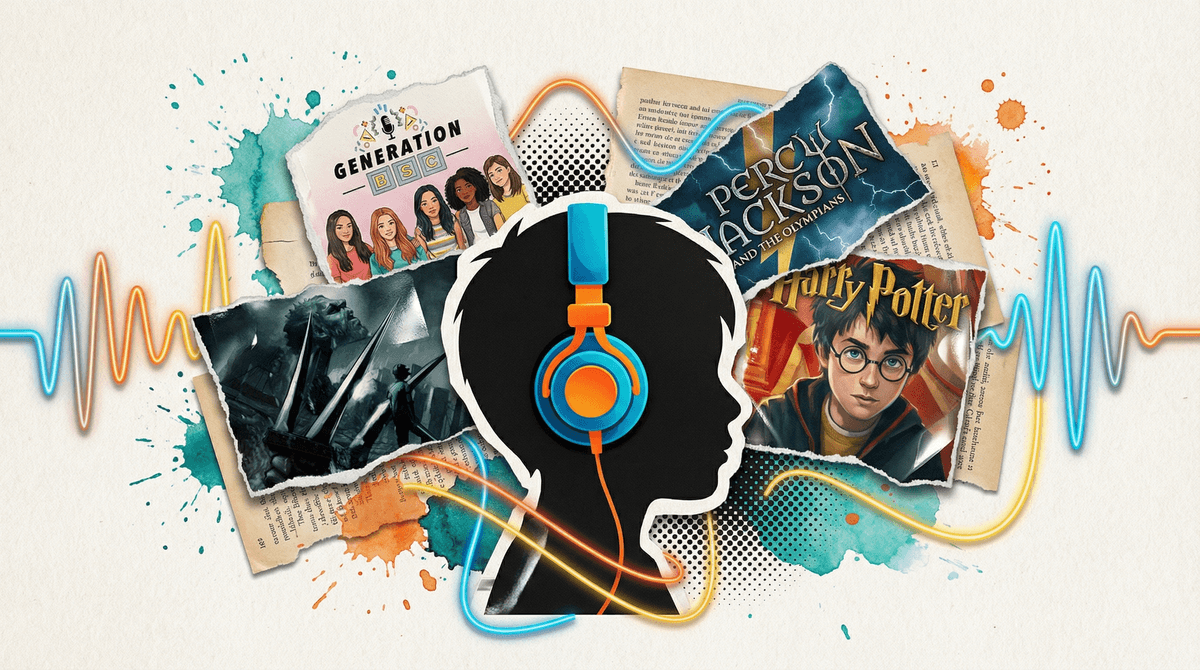
Remember when your kid begged you to buy the next book in a series, and now they're asking if they can listen to it instead? Welcome to the world of book-to-podcast adaptations—and it's not just audiobooks with a fancy name.
We're talking full-cast audio dramas with sound effects, music, and production values that rival Netflix shows. Think Percy Jackson but as an immersive audio experience, or Harry Potter reimagined with a cast of voice actors bringing Hogwarts to life in your kid's earbuds.
These aren't your childhood "Books on Tape." Productions like Pinna's adaptation of The Baby-Sitters Club or Audible's Sandman feature Hollywood-level talent, original scores, and production quality that makes traditional audiobooks feel like someone reading their grocery list.
It feels like watching TV—but you can do other stuff. Your kid can build in Minecraft, draw, or stare at the ceiling while experiencing a story. For a generation raised on multitasking, this is peak content consumption.
The imagination factor is real. Unlike screen adaptations where Harry Potter looks like Daniel Radcliffe forever, podcast adaptations let kids visualize characters their own way. The audio fills in just enough to guide the story, but leaves room for their brain to do the heavy lifting.
It's social currency. When a popular book series drops a podcast adaptation, it becomes playground conversation. Kids who struggled with reading the physical book can now participate in discussions about plot twists and favorite characters. The playing field levels out.
Accessibility matters. For kids with dyslexia, ADHD, vision challenges, or just slower reading speeds, these adaptations offer access to stories that might otherwise feel out of reach. And honestly? Even neurotypical kids who just prefer listening aren't missing out on literature—they're experiencing it differently.
This isn't "cheating" at reading. Let's address the elephant in the room: some parents worry that podcast adaptations are the easy way out, that kids should be reading the "real" book. But here's the thing—comprehension and engagement with story matter more than the delivery method. A kid who listens to and loves Wings of Fire is still developing vocabulary, following complex plots, and building literary knowledge. They're just doing it with their ears instead of their eyes.
Quality varies wildly. Not all adaptations are created equal. Some are gorgeously produced passion projects with A-list voice actors. Others sound like someone's cousin recorded it in their basement with a $20 microphone. Check out parent reviews before committing to a 12-episode series.
The subscription trap is real. Many of the best book-to-podcast adaptations live behind paywalls—Audible, Pinna, Spotify Premium. Before your kid gets three episodes into something, make sure you know what you're signing up for. Some platforms offer free trials, but they're banking on you forgetting to cancel.
Screen time... or not? Here's where it gets philosophically interesting. Most families don't count audiobooks or podcasts as "screen time," even when kids listen on tablets or phones. The device is just the delivery mechanism—the content is audio. But if your kid is also scrolling through episode lists, looking at cover art, or watching the screen while listening, that's a different story. Figure out what your family's boundary is here.
Ages 5-7: Look for adaptations of picture books and early readers. Tumble Leaf and Bluey both have podcast extensions that work well for this age. Keep episodes under 15 minutes—attention spans are still developing.
Ages 8-10: This is the sweet spot for chapter book adaptations. Series like The Wild Robot, Diary of a Wimpy Kid, and Dog Man have audio versions that capture the humor and heart of the originals. Kids this age can handle 20-30 minute episodes.
Ages 11-13: Middle schoolers are ready for more complex adaptations—think The Hunger Games, Percy Jackson, or A Series of Unfortunate Events. They can handle darker themes, longer story arcs, and more sophisticated production. Just preview content first—some adaptations lean harder into scary or intense moments than the books did.
Ages 14+: Teens can access the full range of young adult and even adult adaptations. The Sandman on Audible is genuinely stunning, and adaptations of books like Six of Crows offer the same content as the novels with added dramatic flair.
Let's get real: some educators and parents worry that podcast adaptations replace "real reading." And yes, if your kid exclusively consumes stories through audio and never picks up a physical book, that's worth examining. Reading text develops different cognitive skills than listening does—decoding, visual processing, self-pacing.
But here's the counterpoint: a kid who listens to stories is still building literary knowledge. They're learning vocabulary, following narrative structure, understanding character development, and engaging with complex themes. They're also more likely to seek out the physical book after loving the audio version, or vice versa.
Think of it like this—would you rather have a kid who listens to 50 books a year via podcast, or a kid who reads 5 books because that's all they can manage with their particular brain wiring? There's no wrong answer, but the goal is engagement with story, not rigid adherence to format.
Make it a gateway, not a replacement. Use podcast adaptations to hook reluctant readers, then offer the physical book as a "see what they left out" experience. Or reverse it—read the book together, then listen to the adaptation and compare notes.
Listen together sometimes. Long car rides, family cooking time, or pre-bed wind-down are perfect for shared listening. You'll know what your kid is consuming, and you'll have built-in conversation starters about plot, characters, and themes.
Check the content. Just because something is based on a kids' book doesn't mean the adaptation is automatically age-appropriate. Some podcast versions amp up scary moments with sound effects that might be too intense for younger listeners. Preview first episodes before handing over the earbuds.
Set boundaries around passive listening. If your kid is listening to podcasts while doing homework, playing video games, or scrolling social media, they're not actually engaging with the story—they're just adding noise. Encourage active listening during activities that don't require much cognitive load: drawing, building, walking, resting.
Book-to-podcast adaptations are here to stay, and that's actually pretty great. They make literature more accessible, offer new ways to experience beloved stories, and give kids another tool for engaging with narrative.
Are they a replacement for reading physical books? No. Should they be? Also no. But as one option in a varied media diet, they're a solid addition—especially for kids who struggle with traditional reading or just prefer audio learning.
The key is intentionality. Know what your kid is listening to, make sure it's age-appropriate, and use these adaptations as conversation starters rather than just background noise. Explore kid-friendly podcasts that align with your family's values, and don't be afraid to hit pause and discuss what you're hearing together.
Your kid's favorite book becoming a podcast isn't the death of reading—it's just another chapter in how we tell stories.