

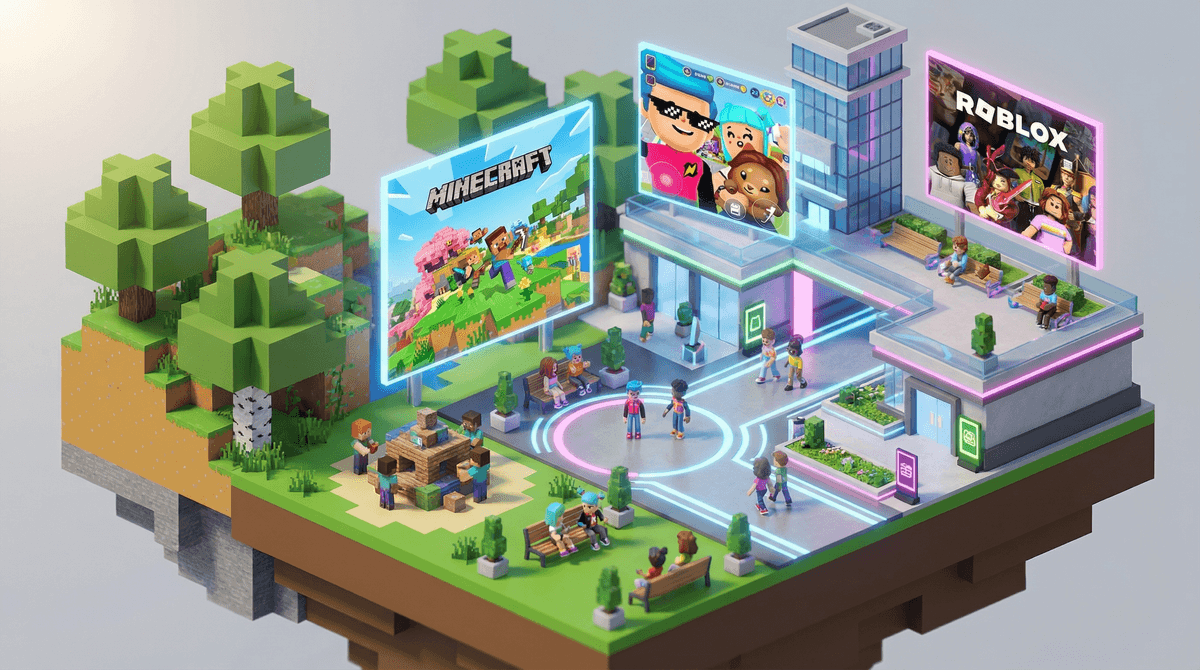
Here's the thing that catches most parents off guard: when your kid says they're "playing Minecraft" or "Roblox," they're not really gaming in the way we think about it. They're hanging out.
Think about it this way—when we were kids and said we were "going to the mall," were we really shopping? Sometimes, sure. But mostly we were socializing in a space that happened to have stores. Minecraft and Roblox are the digital mall, the playground, the basement hangout spot. The games are just the setting.
Minecraft is essentially a massive creative sandbox where kids build worlds together, chat in real-time, and collaborate on projects. Roblox is even more explicitly a social platform—it's actually a collection of millions of user-created games where the social interaction is often the main point. Your kid might spend an hour in Adopt Me on Roblox, and when you ask what they did, they'll say "hung out with Emma." They weren't really playing—they were being together.
Most of us parents grew up with Super Mario Bros or The Sims—single-player experiences or maybe couch co-op with a sibling. We think "video game" and picture our kid zoned out, staring at a screen, disconnected from the world.
But here's what's actually happening: Your 10-year-old is in a voice chat building a castle with their friend from camp who lives three states away. Your 13-year-old is teaching a younger kid how to code a game in Roblox Studio. Your 8-year-old is negotiating who gets to be the architect versus the interior designer in their Minecraft build.
The data backs this up—studies show that over 70% of kids ages 9-12 use these platforms primarily for social connection, not just gameplay. During the pandemic, mental health researchers actually found that kids who maintained social connections through platforms like these had better emotional outcomes than those who didn't.
This reframe matters because it changes how we parent around these platforms. If it's social media (which it is), then all our concerns about social media apply: Who are they talking to? What are they saying? How much time are they spending there? Are they experiencing social pressure or FOMO ?
?
Friend Groups and Social Pressure
Just like kids feel left out when everyone's talking about what happened at recess, they feel left out when their friends are all playing together in a Minecraft realm or Roblox server. "Can I get Roblox?" isn't always about the game—it's "Can I hang out with my friends?"
Around 4th-5th grade, you'll see this intensify. Kids start having "standing playdates" in these virtual spaces. They'll hop on after homework and just... exist together. Sometimes they're actively collaborating, sometimes they're just chatting while doing their own thing.
The Chat Function (This Is the Big One)
Both platforms have robust chat features—text and voice. In Minecraft, kids can type messages or use voice chat on servers. In Roblox, there's text chat and spatial voice chat (where you can hear people near your avatar).
This is where it gets real: Your kid is having unsupervised conversations with people you may not know. Some might be their IRL friends. Some might be "friends" they met online. The chat can be disabled or restricted, but many kids find workarounds or simply don't tell you it's happening.
The Economic Layer
Both platforms have virtual economies. Minecraft Realms require subscriptions. Roblox has Robux, its virtual currency, and kids experience real social pressure to buy skins, game passes, and accessories. There's actual social hierarchy based on what your avatar looks like.
If you want to learn more about how Robux is in fact real money, that's worth exploring—kids are spending and sometimes even earning real money through these platforms.
Ages 6-8: These platforms can work with heavy parental involvement. Play together, keep voice chat off, use the most restrictive privacy settings. Think of it as a digital playdate where you're in the room.
Ages 9-11: This is peak social platform age. They want independence but still need guardrails. Consider: approved friends lists only, periodic check-ins on chat history, conversations about online strangers, and clear time limits. Many families in this age range use these platforms as a "privilege" that requires maintaining other responsibilities.
Ages 12+: They're going to push for more freedom, and honestly, they need some. But this is when you shift to teaching digital citizenship. Talk about digital footprints, online reputation, and what information should never be shared.
Set up parental controls from day one. Both platforms have them—use them. In Roblox, you can restrict who can message your child, who can chat with them in-game, and what games they can access. In Minecraft, you control who can join their world.
Have the stranger danger conversation, but make it nuanced. Not everyone online is dangerous, but not everyone is who they say they are. Teach your kids: never share real names, location, school name, or personal info. If someone asks to move the conversation off-platform, that's a red flag.
Understand that "friends" might not be friends. Your kid might have 50 Roblox friends. Ask them: How many do you know IRL? How did you meet the others? This isn't about forbidding online friendships—it's about awareness.
Check in regularly, but not invasively. "Who'd you play with today?" should be as normal as "How was school?" You're not interrogating—you're staying connected to their social world.
Look, I get it. It would be easier if Minecraft and Roblox were just games. We could set a timer, limit screen time, and call it done. But treating them like simple games misses the entire point of why our kids are drawn to them.
These platforms are where modern childhood socializing happens. That's not inherently good or bad—it just is. Our job isn't to prevent it; it's to help our kids navigate it safely and healthily.
Think of it this way: We didn't stop our kids from going to the playground because they might fall off the monkey bars. We taught them how to be safe, checked that the equipment was secure, and stayed nearby when they were little. Same principle, different playground.
-
Ask your kid to show you what they actually do in these platforms. Not in a "I'm checking up on you" way, but genuine curiosity. You'll learn a lot.
-
Set up or review privacy settings together. Make it a conversation, not a lecture.
-
Establish clear expectations about time limits, who they can interact with, and what information is off-limits to share.
-
Check out alternatives if these platforms don't feel right for your family—there are other options like Animal Crossing, Stardew Valley, or Splatoon that have social elements with more structure.
-
Join the Screenwise community to see what other parents in your area are doing and get personalized guidance based on your kid's age and your family values.
The goal isn't perfect control—it's informed guidance. You've got this.